ad-hoc-semantic-reconciliation
1/4 · Reconciling two standard models of one network: cognition across the spectrum, and what a thin reference adds
Programme status: a complete analytical arc through the first of the programme’s four operational scenarios (transport-network service provisioning). It establishes the concept, characterizes how the cognition spectrum governs it, and validates one thin-reference variant (the lexical). Across the components of reconciliation it works the lexical, ontological/structural, and instance-level, together with verification; only the pragmatic component is held fixed: deferred, with the remaining three scenarios, to the work that follows.
Summary
This is the first of the programme’s four scenarios, and the one that establishes the concept; it is also the scenario written most as a foundation, opening with background and hypotheses (§1) before it turns, like the other three, to a concrete case and its results. The case is concrete. Two independently authored standard models of one optical transport network (ONF TAPI on one side, IETF TEAS/ACTN on the other) describe the same nodes, links, and services, each in its own vocabulary. A TAPI connectivity-service is a TEAS tunnel; a TAPI link-termination-point looks like a TEAS tunnel-termination-point but is a different thing: a link end, not a trail head. Two language-model agents must reconcile these two models, ad hoc, with no third model agreed in advance, getting the real correspondences right while refusing the look-alikes. What that takes, and what a thin shared reference adds to it, is what this scenario measures, and what the other three scenarios build on.
When two software systems must exchange information but hold different models, of the same domain, or of different domains that must connect, someone has to reconcile those models. This study asks whether the systems can do it themselves (reasoning, ad hoc, with no model agreed in advance) and puts the whole idea to an empirical test. We build a harness in which two language-model agents reconcile two independently authored semantic models of one network; it scores the result against a validated gold standard and measures both the quality of the outcome and the cognitive effort the agents spend. The governing variable is where cognition sits: a cognition spectrum running from both systems live and interrogable, through one inert, to both inert. A thin, published shared reference is switched on and off at each point (as much a probe of what cognition was doing as an object of study in its own right) and the whole is run across a ladder of model strengths and a growing number of systems.
Two things fall out that, as far as we know, have not been set out this way before. First, the concept holds: cognitive agents do reconcile divergent models correctly and for the occasion, not in a single hand-worked demonstration but measured across conditions. Second, the placement of cognition governs what a reconciliation can achieve, what it costs, and what can be verified. Between two fully-cognitive agents resolution is complete in principle: they can interrogate each other without bound and run decisive experiments in virtual space, so any question is confirmed, refuted, or authoritatively decided, and nothing need be left unresolved. As cognition recedes that resolving power falls away, and a growing residual must be referred onward: the residual is precisely the shortfall from full cognition’s reach. Everything else, the reference included, sits inside this frame.
The consequence is the study’s central point, and it is easily missed inside the machinery: it is cognition that completes a reconciliation. Lexical and descriptor methods carry it most of the way - matching on names, then on names plus a short gloss, reaches roughly ninety percent - and there such methods have historically stopped, the remainder left to an agreed standard or to human judgement. What the spectrum shows is that the remainder need not wait for either. Where both systems can reason - the fully-cognitive end - the reconciliation completes autonomously, with no model agreed in advance and no person in the loop; as cognition recedes, and only then, does closing the gap fall back to human effort or external verification. Full, ad hoc, machine-to-machine semantic reconciliation is therefore possible where the cognition is present to complete it, and the cognition spectrum is the measure of how far that automation reaches before it must hand off to a person. That the residual past the lexical ceiling can be closed by machine cognition, rather than only by a human or a prior agreement, is the shift this work rests on.
Within that frame, four findings concern the reference. First, for a capable agent a thin reference substitutes for cognition: it yields a perfect reconciliation across the whole spectrum, and where a single agent must reconstruct an inert side it collapses that agent’s hidden deliberation by one to two orders of magnitude. Second, the effect is capability-dependent: a weak agent cannot always exploit the reference, and when one or both sides are inert it can become a cognitive burden rather than an aid: its cheaper effort buys error, not savings. Third, on a hard case seeded with false cognates and opaque items, the reference prevents errors, raising precision and pre-empting traps, and it helps the weaker agents most. Fourth, reconciliation work grows linearly in the number of systems given a shared reference, against quadratically without one. The naive hypothesis that the reference’s benefit grows monotonically as cognition recedes is not supported; the more careful, capability-dependent claim is.
A fifth result runs the framework’s verification step and separates two claims the first four leave joined. Verification catches the false cognates that slip through the proposal, driving precision to near one across the whole spectrum. But without the reference this catching lowers the resolved fraction (correct correspondences the verifier can no longer confirm are referred onward to the residual rather than asserted) and that cost grows as cognition recedes, because the confirming mechanisms (interrogation, joint experiment) recede with it. The reference restores the confirmation the inert sides cannot give, holding the resolved fraction at one. So the reference’s value in effort peaks with live cognition, while its value in correctness concentrates where cognition, and therefore verification, is weakest: the two halves of a single substitution.
A further block of experiments (§5) bites into the harder half the primary experiments assume away: not reconciling inputs already lifted and bound, but producing and aligning them. Independent-lexicon alignment, two separately authored vocabularies with no shared ids, is tractable but capability-gated: the strong agent holds precision 1.00 and takes no false cognate, while the weaker agents commit a cross-lexicon cognate confidently in about two trials of three even with a reference present. Stripping the reference back to an opaque id, or removing it altogether, leaves the strong agent’s precision untouched, so its descriptive fields buy resolved fraction rather than the false-cognate guard; the thin-reference threshold is not reached by thinning them, and the real axis is lexicon divergence. Real vendor structural messiness collapses surface matching to 0.33 resolved fraction but is absorbed by cognition, which recovers to 0.89–1.00 resolved fraction at precision 1.00; the dependency map correlation needs is derivable from raw inventory rather than hand-fed, and correlation on the self-derived map matches the given-map baseline; the correlation operation itself generalises out of the observability scenario into this one, partition-exact 1.00 for the capable models; and onboarding a genuinely new system by reference-mediated reuse is linear where pairwise alignment is quadratic, 2.0–2.7× cheaper in real tokens and more accurate, because reuse preserves the resolved fraction pairwise scatters.
1. Background and hypotheses
Network and service management increasingly places software agents that reason on the management plane. Two such systems rarely share a data model: the scope a model must cover is not fixed, the useful level of abstraction depends on the task, and capable engineers produce different but defensible models. Rather than agree a universal model in advance, two systems that reason can reconcile their models for the occasion.
We treat the meaning a system must consume as a semantic model: an ontology, including its lexicon, together with pragmatics, over a base of provenance. A system usually holds its content as a data model: a schema and its data as they stand, meaningful to whoever wrote the schema but carrying no explicit meaning of their own; the move from that to a semantic model, attaching the ontology, lexicon, and grounding that make the content mean something a reasoner can use, is the lift. Who performs the lift is itself a variable of this study (§2.2): a live system lifts and explains itself, whereas an inert one is lifted by the agent that reads it. Reconciliation aligns two lifted semantic models to yield one reconciled model, and it is interesting only because models diverge. Divergence (and so the disambiguation a reconciliation must perform) falls into distinct components, each a different thing to resolve:
- Lexical: the terms concepts go by. Two models may name the same thing differently (synonyms: owned-node-edge-point and termination-point) or give one label to different things (a false cognate: a link termination versus a trail termination). This is the surface a name-matcher keys on, and where this study’s planted traps live.
- Ontological and structural: which concepts (types) exist and how they decompose the domain: granularity (one multi-layer topology versus per-layer networks), scope (what each model chooses to cover), abstraction, and the structural relations among concepts (a link terminates at a node; a service rides a tunnel). Reconciling here aligns the types and reconciles their structure, for instance by an explode-then-collapse transform between a single topology and stacked per-layer ones.
- Instance-level: co-reference of individuals across two populated graphs: is this ROADM the same device as that te-node, this ODU2 service the same as that te-tunnel? This is a separate exercise that follows schema-term reconciliation (once the types are aligned, one can compare like with like) and it runs on a different path: entity resolution over the data (the A-box) rather than meaning-comprehension over the vocabulary. The evidence differs accordingly (a shared key, then matching attributes, then relational/topological position), weighed and held with a confidence rather than assumed, and, where a reference helps, anchored by shared instance identifiers rather than concept definitions.
- Pragmatic. How content is used: whether it describes what was asked or what is operationally the case, the context that changes a signal’s meaning (a rising bit-error-rate is a page, a benign maintenance-window event, or a low-confidence matter to watch), and which side is the authority for a value.
Underlying all four is provenance, the base the semantic model sits over. This report’s primary experiments (§3.1–3.5) work the first two components: the schema-term level; two companion studies carry the same framework to the instance-level component and to verification taken as its own object, summarized in §3.6. The pragmatic component is held fixed; §6 makes the scope precise.
Against that divergence we study a thin shared reference: an identity-only anchor per concept: a stable id, a preferred label and synonyms, a shallow class, a disambiguating definition, and one canonical example. Each side binds its terms to the reference. It is deliberately small and is not a model of the domain. This is the lexical reference, one of a possible family (instance, unit, value-set, structural, pragmatic, and other variants); it is the variant we exercise here (see scope, §6).
The placement of cognition relative to the systems being reconciled is a variable we call the cognition spectrum: both systems live and interrogable (both-cognitive), one live and one inert (present and running, with all its data, but unable to explain itself), or both inert, reconciled by a third party that can only propose candidates. An inert system is not absent; it still exposes its structure and its instances, so its meaning must be reconstructed rather than volunteered, which is work.
The study has two aims. The first is to establish the method itself (that two cognitive agents can reconcile divergent models ad hoc, correctly and for the occasion) and to characterize how the placement of cognition along the spectrum governs what reconciliation can achieve, what it costs, and what can be verified: in the fully-cognitive case resolution is complete in principle, and the residual a reconciliation must refer onward grows as cognition recedes, as the shortfall from its reach (developed in §2.2). The second aim is to measure what the thin shared reference contributes within that frame. The reference, switched on and off at each placement, is the instrument that makes cognition’s own contribution legible, so the four hypotheses below, though stated about the reference, double as the probe by which the first aim is met.
We test four hypotheses.
- H1 (substitution). A thin shared reference substitutes for cognition: it reduces the reasoning a reconciliation requires and improves its reliability.
- H2 (spectrum). The reference’s benefit grows as cognition recedes, as one and then both systems go inert.
- H3 (capability). The reference’s benefit depends on the reconciling agent’s own capability.
- H4 (scaling). With a shared reference, reconciliation work grows with the number of systems N; without one, it grows with the number of pairs, N(N−1)/2.
2. Method
2.1 The task and the harness
A case is two lifted semantic models of one network plus a gold-standard reconciliation. Each concept carries a label and synonyms, a shallow kind, a disambiguating gloss and canonical example, its binding to the shared reference, and (so that an inert side has something to be reconstructed from) its structural relations to other concepts and a few concrete instances. The gloss and example are the self-lift a cognitive side would volunteer, provided here as a materialised artefact so the reconciliation runs over a fixed substrate; §3.7 lifts that assumption and has an agent produce them from the schema surface. The gold standard gives the correct cross-model correspondences, the planted false cognates that must not be proposed, the native gaps and proprietary items that have no counterpart and are expected to be correctly returned as unmatched (not counted as residual), the invariants a correct translation preserves, and the verification method each placement admits. Gold is derived from the models’ bindings by a script and validated, so it cannot drift from the models it scores.
The reconciling cognition is run directly. In the fully-cognitive case it is an exchange between two live agents: each agent holds only its own lifted model and a surface catalogue of the other’s, and they alternate turns: advertising, asking and answering, proposing correspondences, and ratifying the other’s proposals about their own concepts (a correspondence is confirmed only when one side proposes it and the owner accepts it, or both propose it independently), with the option to run a joint decisive experiment in virtual space. Each agent is the authority on its own model. With one side inert the live agent reconstructs the mute side from what it can read off it; with both inert a third party reconstructs both. The harness scores the outcome of that exchange against the gold. How many sides are live is the placement (§2.2). Two deterministic controls share the same interface: a reference-blind classical matcher and a reference-aware reconciler. The evaluation harness scores a stack’s output against the gold standard and records the metric families below.
2.2 The cognition spectrum, concretely
The agent is run at each placement. Under both-cognitive, each concept is presented in full and, with the reference, carries its binding. Under one-inert, the inert side is presented as label, kind, relations, and instances only (no gloss, synonyms, example, or binding) and the live agent must reconstruct its meaning; with the reference, it does so by matching each inert concept to the reference entry whose definition and example fit. Under both-inert, neither side can explain itself; the agent is a third party that reconstructs both sides from structure and data and can only propose candidates for external adjudication.
To be precise about what inert means: an inert side is passive: it cannot reason, answer a question, or run anything. The reconciling cognition works only with what can be read off it (its schema and structure, its identifiers and labels, its instance data) together with whatever the agent independently knows when that schema is a recognised public standard. The semantic model, the lift, is then built by the cognition above: a live side lifts and explains itself, whereas an inert side is lifted by the agent that reads it. (In this harness an inert side is supplied already organised into concepts with their relations and instances, with only the self-explanation withheld; extracting concepts from wholly raw data would be a further step, not exercised here.)
What the agent reconciles, at every placement, is two lifted semantic models, not two lexica. Per concept it is given the label, a shallow class, structural relations, and concrete instances (and, on a live side, a gloss and worked example), and it decides correspondence by meaning over all of this, not by lexical similarity over labels alone. This is worth stressing because the both-inert case is easily misread as string-matching two static term lists. It is not: inert means a side cannot explain itself (no gloss, synonyms, example, or volunteered binding), but it still exposes its structure and its instances, from which a cognitive third party reconstructs meaning. The planted false cognates are defeated on exactly this non-lexical evidence: a signal-grade and a service-grade share the token “grade” but differ in class (a quality versus a class), in what they attach to (an optical channel versus a tunnel), and in their instances (an OSNR grade versus a gold/silver service tier), which a purely lexical aligner, keying on the shared label, could not do. The reference, when present, is a further anchor layered on top of this; it is not the only, nor the primary, source of meaning.
That the lift, not the lexicon, is what reconciliation runs on is measured directly, not merely asserted. Stripping every concept back to its lexical surface (label and synonyms, the terms as a classical matcher would see them) and then restoring the lifted layers one at a time (the concept’s own explanation, its class, its relations, its instances) shows the lever directly: a matcher on the bare lexical surface, as a classical matcher would see it, resolves only about two-thirds of the correspondences, and it is the restored lift that lets cognition close the rest; the single largest step is the first, giving a concept its own explanation. This is the axis the ontology-matching literature’s label-only-versus-label-plus-gloss comparisons do not vary, and it is where the reasoning happens: pure lexical matching, however much gloss is bolted onto the labels, is not enough. It is also capability-gated in a way worth flagging early: the same restored content that lets a weak agent find more correspondences also hands it more surface to misfire on (its instances, in particular, turn toxic, over-read as evidence of identity), so the lift is unambiguously the lever, unambiguously safe for a strong agent, and a double-edged one for a weak agent. That pattern (the richer content that raises reach also raises exposure for the weakest cognition) recurs throughout the study. (Reported in full in the pre-lift baseline note; see §7.)
A structural fact about the spectrum organises the results that follow. In the fully-cognitive case, resolution of any reconciliation question is total in principle, for two reasons that are themselves functions of live cognition on each side. First, the agents can exchange unbounded further information: each is the live authority on its own model, so whatever is ambiguous about one side’s concept the other can ask about and get an authoritative answer. Second, because reconciliation operates on the knowledge graph rather than the live network, the agents can design and run decisive experiments in virtual space: provision a candidate service through a proposed correspondence, operate it, read it back, and check the invariants, resolving any specific doubt against a determinate outcome. Any issue is therefore confirmed, refuted, or, in the one case of a source model its own designers left underspecified, decided by the authoritative agent. This is a claim about what is possible within this scenario (operational semantics a virtual provisioning-and-readback can adjudicate), not about cost or step count. Both resolving mechanisms are functions of live cognition, so as cognition recedes they become unavailable: with one side inert the live agent can probe but not interrogate or co-design an experiment, and with both inert there is no one to ask and no joint experiment to run. The residual a reconciliation must leave unresolved and refer onward is, in this sense, the shortfall from full cognition’s resolving power, and it grows as that power recedes. It is not a fixed floor the fully-cognitive case merely reaches; between two fully-cognitive agents there is, in principle, none.
2.3 Metrics
Quality is scored against the gold standard. Precision is, of the correspondences a stack proposes, the fraction that are correct; the resolved fraction is the share of the true correspondences (those in the gold) that the stack actually resolves (finds and commits to), with the rest referred to the residual. Surviving false cognates counts the planted traps that slip through as false positives, and the residual is the true correspondences the stack does not commit: the ones it declines to assert and refers onward rather than guessing. (Genuine native gaps and proprietary items have no counterpart at all; the stack correctly returns them as unmatched, a resolved outcome, and they are not part of the residual.) Resolved fraction below one is therefore not, by itself, an error: an unresolved correspondence is one the stack referred onward rather than asserted, and (the point that governs §3.5) the honest response to evidence that cannot confirm a pairing is to leave it in the residual, not to guess. So precision and surviving false cognates measure committed error, while resolved fraction measures reach, and the two must be read together. Cognitive effort is measured, for a language-model stack, as the reasoning tokens it spends (its hidden deliberation), the total tokens, and latency: the effort signals the model exposes. Reasoning tokens are the cleanest single measure of how hard the agent worked.
The scores in §3.1–3.4 are of the reconciliation the agents propose, before any correction. A surviving false cognate there is one the proposal stage let through: an error the framework’s verification step would then have to catch. §3.5 runs that step (reconcile, verify, repair) and scores its effect separately, which is where the placement-dependent strength of verification, complete in the fully-cognitive case, weaker as cognition recedes (§2.2), becomes visible in the numbers.
2.4 Experimental design
The primary case is a transport-network reconciliation between an ONF TAPI model
and an IETF TEAS model: the same network decomposed differently, from the deeply
structural (one multi-layer topology versus per-layer networks) down to the lexical.
It is seeded with three false cognates (a link versus a trail termination, an optical
signal-grade versus a commercial service-grade, a protection group versus a
protection role) and two opaque, vendor-coded items with no public meaning. Each
model has fifteen or sixteen concepts. The agent is run over a ladder of three
models spanning a capability range: gpt-5.6-sol (strong), gpt-5-mini (mid),
and gpt-5-nano (weak), referred to throughout as sol, mini, and nano.
It is run at all three placements, with and without the reference, four trials each: 72 agent
runs. The three are one provider’s capability tiers, chosen so the ladder isolates
model strength rather than provider or architecture.
Scaling (H4) is studied separately with four independently authored models of one
network in different dialects (TAPI, TEAS, a TM Forum/MEF service model, and a
legacy SNMP model), differing in vocabulary and decomposition, extended by
construction to N = 12.
2.5 Controls
Two deterministic, model-free stacks bracket the space and do not vary by model. A reference-blind label matcher reaches precision 0.50 and resolved fraction 0.67 on the primary case and lets a false cognate through. A reference-aware reconciler, binding each side once and corresponding by shared entry, reaches precision 1.00 and resolved fraction 1.00 with every trap pre-empted and the seven no-counterpart items (native gaps and proprietary fields) correctly returned as unmatched.
3. Results
3.1 The reference substitutes for cognition (H1)
For the capable agent, the reference speeds the close and, where a single agent must reconstruct an inert side, collapses its deliberation. At the inert placements the strong model’s reasoning tokens fall from 1559 and 844 without the reference to 261 and 354 with it: a one- to two-order-of-magnitude reduction. At both-cognitive the two agents negotiate: without the reference they spend more (about 3,100 reasoning tokens across the exchange) and reach a resolved fraction of 0.63 at perfect precision — the two agents deferring the pairs they cannot ground without the reference, not mis-committing them; with the reference they reach a full close for about 1,140. With the reference the strong agent reaches precision 1.00 and resolved fraction 1.00 at every placement (Fig. 1, Table 1). Given the anchor the capable agent barely has to deliberate, and it does not err.
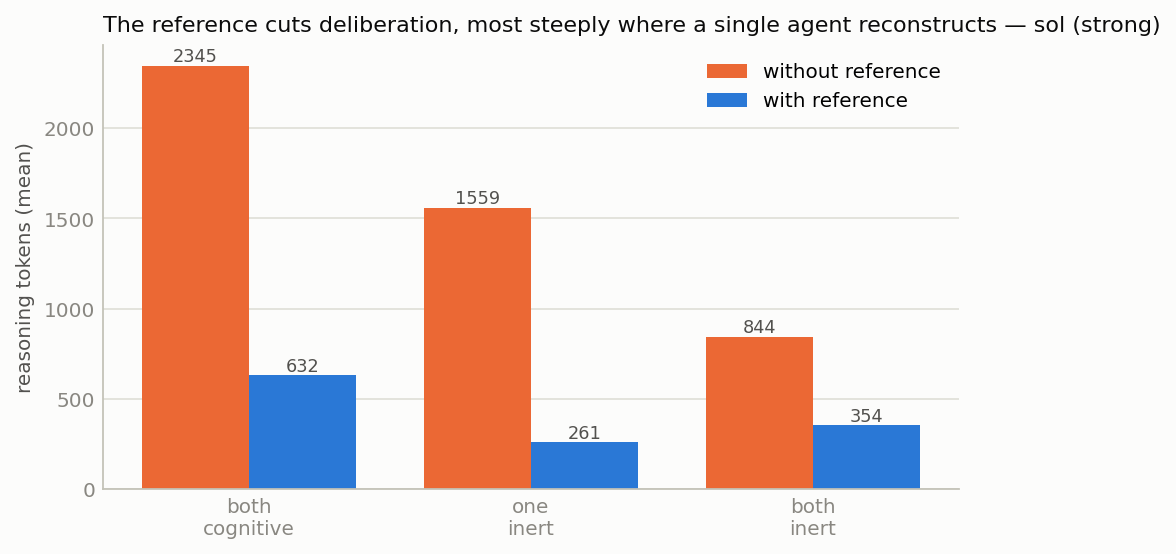
Figure 1. Reasoning tokens the strong agent spends with and without the reference, at each placement. At the inert placements, where a single agent reconstructs the mute side, the reference collapses its deliberation by one to two orders of magnitude; at both-cognitive it roughly halves the two agents’ negotiation cost and carries them to a full close.
| placement | reference | precision | resolved fraction | reasoning tokens | latency |
|---|---|---|---|---|---|
| both cognitive | without | 1.00 | 0.63 | ~3100 | ~116 s |
| both cognitive | with | 1.00 | 1.00 | ~1140 | ~75 s |
| one inert | without | 0.96 | 0.98 | 1559 | 36.1 s |
| one inert | with | 1.00 | 1.00 | 261 | 12.0 s |
| both inert | without | 0.92 | 1.00 | 844 | 23.3 s |
| both inert | with | 1.00 | 1.00 | 354 | 13.6 s |
Table 1. The strong agent (gpt-5.6-sol) on the primary case. The both-cognitive rows are the two-agent negotiation, with reasoning summed across the exchange (2 trials); the inert rows are a single agent reconstructing the mute side (n = 4). Resolved fractions below one at both-cognitive are correspondences the negotiation deferred at full precision, not errors.
3.2 The benefit is capability-dependent, and not monotonic in placement (H2, H3)
H2 predicted the reference’s benefit would grow as cognition recedes. It does not, and the reason is instructive (Fig. 2). For the capable agent the reference saves effort at every placement (the benefit is always positive) but it peaks at one-inert rather than climbing monotonically to both-inert. For the weaker models the benefit inverts once a side goes inert: the reference becomes extra material they cannot exploit while straining to reconstruct meaning, so it adds effort. At one-inert the weak model spends 5,520 more reasoning tokens with the reference than without.
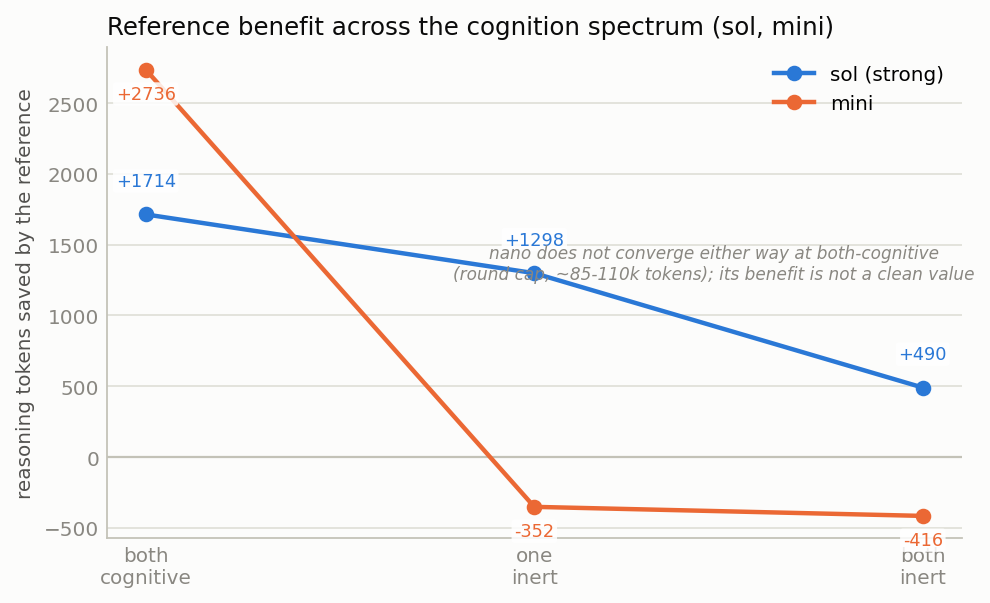
Figure 2. Reasoning tokens saved by the reference (positive = the reference helps) at each placement, per model. The capable agent (blue) stays above zero throughout; the weaker models fall below zero under inert load, where the reference becomes a burden.
So H2 in its simple form is refuted for effort, and H3 is supported: whether a reference helps, and by how much, depends on the reconciling agent’s own capability. A reference is a shortcut a capable agent exploits; it is not a free substitute for cognition that a weak agent can cash in under load. H2 for correctness is a separate question, which the placement-dependent verification structure treats differently; §4 takes it up.
3.3 On a hard case, the reference prevents errors (H1, quality)
Seeding the case with three false cognates and opaque items makes quality separate, and it separates in precision: a trap that is accepted is a false positive (Fig. 3, Table 2). Where a single agent must reconstruct an inert side, the weaker models take the traps: precision falling to 0.86 and 0.90 for the mid and weak models, the weak model accepting a false cognate on every trial at one-inert. With the reference, precision rises (0.94, 0.95) and the traps are pre-empted, because two labels that look alike bind to different reference entries. At both-cognitive the negotiation itself holds precision at one for every model (bilateral ratification refuses the traps), so the reference’s error-prevention value concentrates at the inert placements. The vendor-coded items, which have no counterpart in the other model and which the reference deliberately does not cover, are correctly returned as unmatched rather than forced into a correspondence.
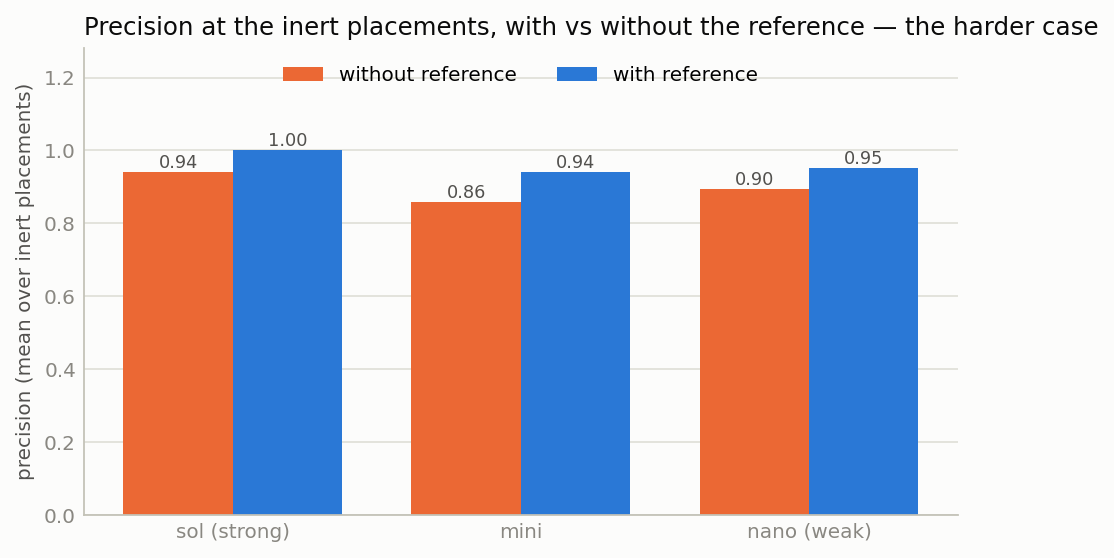
Figure 3. Precision at the inert placements with and without the reference. The reference lifts the weaker models’ precision by pre-empting the planted false cognates; at both-cognitive bilateral ratification already holds precision at one.
| model | precision (no ref, inert) | precision (ref, inert) | surviving false cognates (no ref) |
|---|---|---|---|
| strong (sol) | ~1.00 (never takes a trap) | 1.00 | 0 |
| mid (mini) | 0.86 | 0.94 | occasional |
| weak (nano) | 0.90 | 0.95 | up to 1 per trial (one-inert) |
Table 2. Quality separation on the hard case, averaged over placements.
3.4 Reconciliation scales with N given a reference, with N² without (H4)
If N systems each bind once to the shared reference, any pair’s correspondences compose from those N bindings; authoring an alignment for every pair instead grows with the number of pairs. We verify this on four independent models of one network (TAPI, TEAS, a TM Forum/MEF service model, and a legacy SNMP model) and extend it by construction to N = 12, checking at every N that composing the bindings reproduces the correct pairwise correspondences (Fig. 4). Binding grows as N; pairwise alignment grows as N(N−1)/2. The two break even at N = 3 and diverge after: at N = 12 the reference does 12 units of work against 66, and the ratio, (N−1)/2, keeps widening.
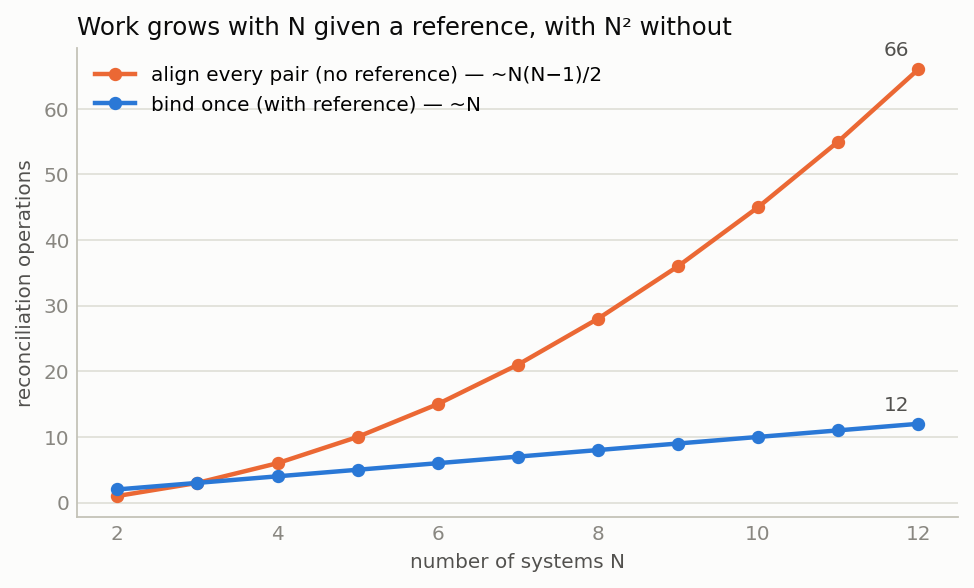
Figure 4. With a shared reference, work grows linearly in the number of systems; without one, quadratically. Composition was verified correct at every N.
3.5 Verification, run: what survives, and what gets referred onward (H2, correctness)
The quality results so far are of the reconciliation the agents propose, before the framework’s verification step. That leaves the correctness form of H2 argued rather than measured. Here we run the step: reconcile, then verify-and-repair, a second agent pass that judges each proposed correspondence against the semantic invariants (endpoint identity, connectivity, capacity, layer relationships, switching constraints, multiplexing), using only the placement-appropriate evidence and never the gold. A correspondence it refutes is removed from the asserted set; its endpoints revert to the residual, the channel the framework refers onward for external resolution. We score the proposal (pre) and the repaired result (post) at each placement, with and without the reference.
Two things happen, and they pull in opposite directions.
Verification removes false positives across the whole spectrum. The planted false cognates that slip through the proposal are caught by the invariant round-trip, and precision is driven to ~1.00 everywhere (Table 3). The effect is starkest for the weak agent, which is the one that bites: without the reference the weak model’s surviving false cognates fall from about one per trial to near zero once verification runs. This is the framework behaving as designed. At both-cognitive the verification is not a separate pass: the two agents’ bilateral ratification already refuses the traps as they are proposed, and a decisive virtual experiment settles any remaining doubt: the six-model ladder drives surviving false cognates to zero across almost the whole capability range by ratification alone (master §13.2). The verify-and-repair pass measured here is the check for the inert placements, where a single agent reconstructs the mute side and there is no partner to ratify.
| placement | surviving false cognates, no ref (pre → post) | with ref (pre → post) |
|---|---|---|
| both cognitive (ratified) | 0.00 → 0.00 | 0.00 → 0.00 |
| one inert | 1.00 → 0.33 | 0.33 → 0.00 |
| both inert | 1.00 → 0.00 | 0.00 → 0.00 |
Table 3. Surviving false cognates for the weak agent (gpt-5-nano). At both-cognitive bilateral ratification refuses the trap before any repair pass runs; at the inert placements the verify-and-repair pass clears the traps a single reconstructing agent takes, and the reference pre-empts them (n = 3 per inert cell). The strong agent never accepts a trap.
Without the reference, that cleaning lowers the resolved fraction, and the cost grows as cognition recedes (Fig. 5). This is the shortfall of §2.2 made empirical, and it is worth saying precisely what it is and is not. As a side goes inert, the verifier (reasoning from structure and instances alone, with no self-explanation to lean on and no reference to anchor to) can no longer confirm some correct correspondences. It does not silently discard them: it refuses them, and they fall from the asserted set into the residual, referred onward for whatever resolving power remains. Resolved fraction counts them as no longer asserted, so it drops; but the correspondences are not thrown away and not declared false, they are handed off.
Read the numbers as a count of what was confirmed and asserted versus referred onward, not as reconciliation quality lost: the correspondences are all present, on one side of that line or the other. Two cautions follow, and both matter for reading Fig. 5 correctly. The signal is the decline across the inert placements: as the side goes from one-inert to both-inert, the single reconstructing verifier (reasoning from structure and instances alone, with no self-explanation to lean on and no reference to anchor to) can confirm fewer of the correct correspondences, so the resolved fraction falls, and it is that fall that tracks the shortfall. At both-cognitive the story is different in kind: there the two agents confirm through mutual interrogation, ratification, and the decisive experiment, so the confirmation the inert verifier lacks is present. The without-reference resolved fraction is highest where cognition is fullest and falls as it recedes; the reference supplies, at the inert placements, the confirmation the lone verifier cannot.
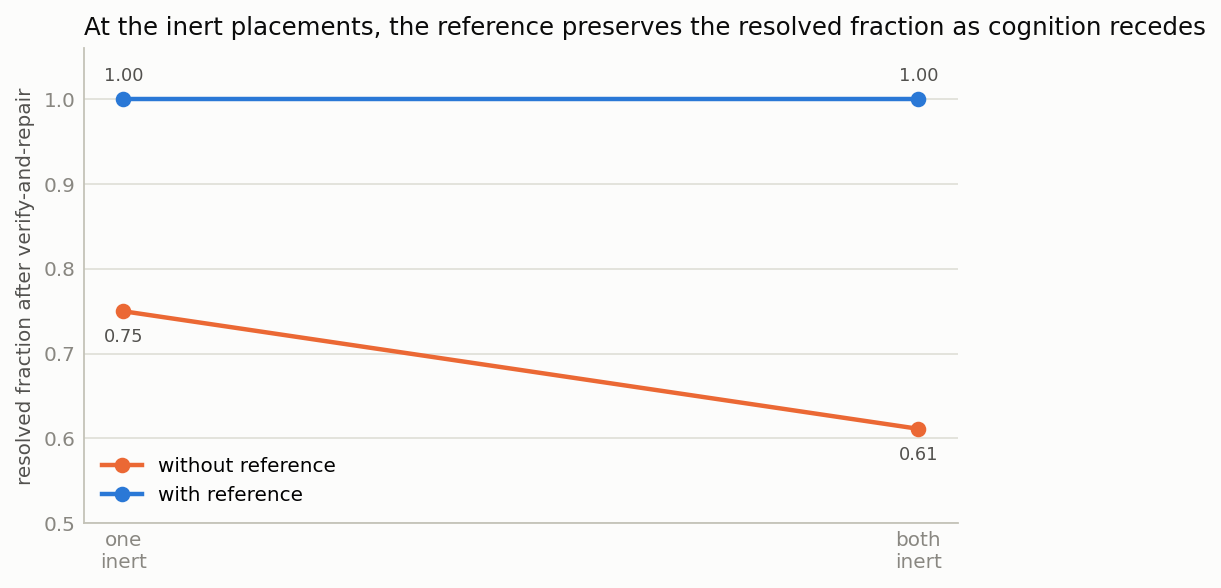
Figure 5. Resolved fraction after verify-and-repair for the strong agent, with and without the reference. Without it, the resolved fraction falls as cognition recedes: the correspondences the verifier cannot confirm are referred to the residual rather than asserted. With it, resolved fraction holds at 1.00: the reference supplies the confirmation the inert sides cannot.
The reference supplies the confirmation that inert sides cannot. With it, resolved fraction holds at 1.00 at every placement (Fig. 5): the anchor lets the verifier confirm a correspondence rather than only fail to refute it, so almost nothing is referred onward, and the traps are pre-empted before verification even runs. The reference’s value therefore concentrates where verification is weakest: it does its most distinctive work in the inert cases, exactly where cognition can no longer resolve on its own. This is the correctness form of H2, now measured rather than argued: not that the reference saves more effort as cognition recedes (it does not, §3.2), but that it prevents more irrecoverable error, because the safety net it substitutes for is by construction weakest there.
Two honesty notes on the mechanism. The inert-placement verify-and-repair pass drops on an active refutation and keeps an unjudged pair, so the resolved fraction it loses without the reference is the verifier wrongly refusing correct pairs under thinning evidence (a false negative), not a graceful abstention; either way the destination is the residual, not an assertion of falsehood. And two conceptually different outcomes must be kept apart here. A correspondence left unconfirmed and referred onward is a residual: a deferral a stronger or better-placed cognition could close. A concept with genuinely no counterpart is not a residual at all: “no match” is the correct, resolved answer, one any cognition returns identically. The resolved fraction we report tracks the first (the deferral, the shortfall the spectrum is about) while no-counterpart items are correct non-correspondences that persist at every placement, cognition or none.
3.6 Beyond the schema terms: instance co-reference and verification
The experiments above are the core of this report, and they work the schema-term level. Two companion studies carry the same framework past it (one to the instance level, one to verification as its own object) and their results belong here because they extend the report’s central point to the other levels at which reconciliation must be shown to hold. Each is reported in full separately; the essentials follow.
Instance co-reference (method note, notes/studies/instance-disambiguation.md). Once the
types are aligned the individuals must be too: is this ROADM the same device as that
te-node. This runs on a different path (entity resolution over keys, attributes, and
topology) and, decisively, the cognition spectrum bites harder: some individuals are
separable only by acting on the live system (an authoritative interrogation, or a
provision-and-read-back), so that class of evidence is gated by live cognition. On a
populated case seeded with structurally-identical devices and same-named-but-distinct
services, an agent running a tool-use loop over a live-cognition oracle resolves the
individuals in full at both-cognitive, at perfect precision, and the resolvability shortfall
becomes structural as a side goes inert. The sharpest result is a measured curve. The probe
budget is how many live-system interrogations the agent is allowed: its allowance of
authoritative experiments against ground truth. At both-cognitive, spending more of that budget
drives the hardest (“experiment-only”) residual monotonically to zero (experiment-only resolved
fraction 0.00 → 0.38 → 1.00); with one side inert the same unbounded budget barely moves it
(→ 0.08), because the inert side cannot be interrogated at any budget (Fig. 6). Capability governs how the shortfall is paid, exactly as at the
schema level: the strong agent resolves and defers cleanly at perfect precision, the weaker
agents trade precision for reach, take the traps as the oracle is lost, and are no less
confident on a wrong merge than on a right one. This is the instance-level proof of the
report’s central point: where the cognition is present to complete it, the machine resolves
the individuals itself, and the shortfall is a limit not of effort but of cognition’s
placement.
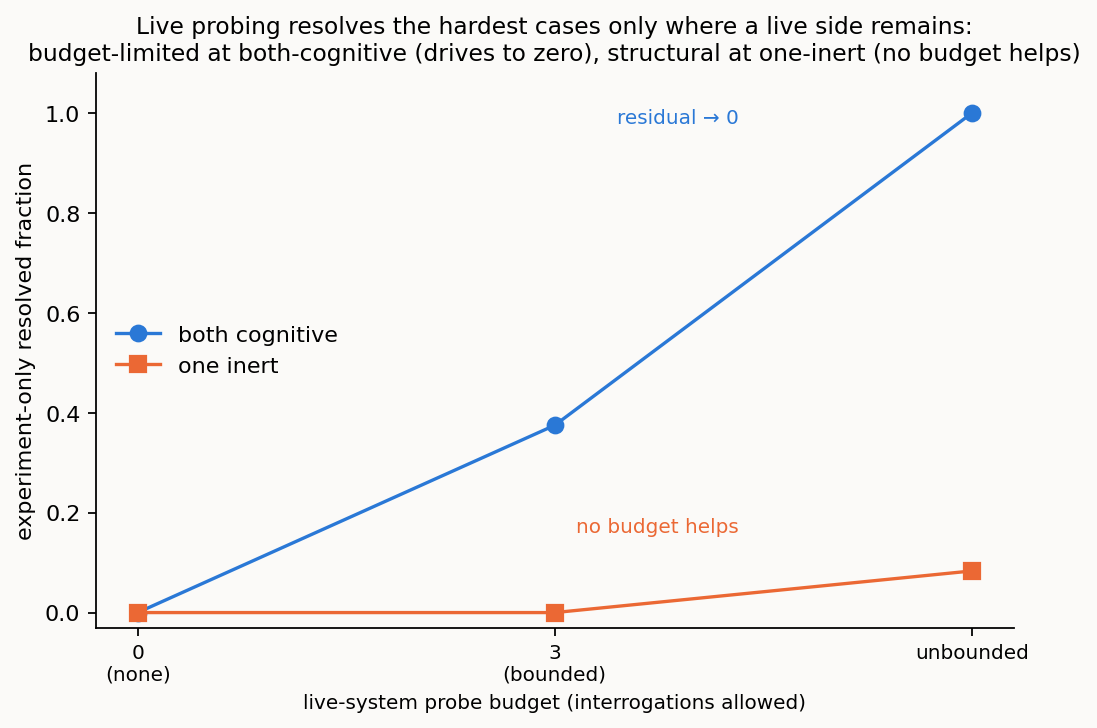
Figure 6. The hardest look-alike individuals, for the strong agent: what fraction gets resolved as the live-system probe budget is swept from none through bounded to unbounded, at two spectrum placements. Budget (the x-axis) and placement (the two lines) are crossed, so the curves isolate their interaction. At both-cognitive a live side can be interrogated and the residual is budget-limited: it drives to zero as probes are spent. At one-inert there is nothing live to probe and it is structural: no budget helps. Same sweep, opposite outcomes, decided by placement, not by effort.
Verification as its own object (method note, notes/studies/verification-modes.md). §3.5 ran
verification as a step in the pipeline; the companion study makes the verifier itself the
object and asks which checking method catches which error, across three modes: a byte
round-trip (translate and compare surface form), an invariant round-trip (a model
judging, from the static records, whether a correspondence preserves the semantic
invariants), and the virtual operation (provision-and-read-back on the knowledge graph).
The methods are not of equal weight, and the ordering is instructive even though it is partly
a property of the seeded error mix. The byte round-trip is dominated: it catches nothing on
its own, passing every wrong correspondence, including ones that round-trip perfectly: it is
the check to beat, not to use. The invariant round-trip and the virtual operation are
complementary but not co-equal. The invariant round-trip catches errors whose invariant break
is visible in the records and is available at every placement, but it is blind to a
“byte-clean” error whose two records are identical: a crossed identity between two look-alike
devices. The virtual operation is strictly more powerful where it can run: it alone catches
those byte-clean errors, by acting on the graph rather than reading it, but its reach is gated
by live cognition and falls away as sides go inert. So the practical ranking is: never rely on
a byte round-trip alone; use the invariant round-trip as the portable static check; and reserve
the virtual operation (the most powerful mode) for the hard identity cases and the
fully-cognitive end where it can be run. That the virtual operation is indispensable rather
than merely strongest is a consequence of the case containing byte-clean errors at all; a case
without them would be fully served by the invariant check, and the relative importance of the
modes is in that sense a function of the error mix a deployment expects. The assurance is the
same one the instance study proves for reconciliation: at the fully-cognitive end the modes
together catch every seeded wrong correspondence, so the machine both settles the
correspondences and confirms them.
3.7 The lift, performed by an agent
The results so far reconcile over lifted models whose explanation layer (each concept’s gloss and example) is a materialised fixture standing for what a cognitive side volunteers. To test whether that authored substrate matters, an agent is given one side’s schema surface alone (labels, synonyms, kinds, relations, and instances, with the gloss, example, reference binding, the other model, and the gold all withheld) and asked to produce each concept’s gloss and example; the reconciliation is then re-run over the agent-lifted models and compared to the fixture, at both-cognitive with and without the reference. On the two configuration cases the agent lifted every concept (coverage 1.00), and the reconciliation landed in the same regime as the fixture: the strong agent matched it exactly with a reference (1.00 on both cases) and tracked it without one (flagship 0.56 either way; hard 0.75 against the fixture’s 0.83, precision 1.00 throughout). Given its own generated glosses the mid agent became slightly more conservative: on the flagship no-reference cell it resolved 0.78 at precision 1.00, where the fixture resolved 1.00 but took one wrong pair (precision 0.90), deferring a little more and keeping precision clean. The lift is cheap for the strong agent (a few hundred reasoning tokens a side) and dearer for the mid one (several thousand), and its wording overlaps the fixture only weakly (lexical fidelity about 0.2), yet the reconciliation is unchanged: meaning survives the rephrasing. The full four-scenario picture, including standard-free and observability, is in the master report (§13.8); the finding there is the same, with the familiar weak-end capability-gating showing up as a single cross-domain false-cognate slip at mid capability.
4. Discussion
The first thing the study establishes is the concept itself. Two cognitive agents reconcile independently-authored, divergent models correctly and ad hoc, with no standard agreed in advance, measured against a validated gold across the whole cognition spectrum, not shown once by hand. And the placement of cognition is the variable that governs the scenario: between two fully-cognitive agents resolution is complete in principle (unbounded interrogation and decisive virtual experiment) so nothing need be left unresolved; as cognition recedes that power falls away and a residual must be referred onward, the shortfall from full cognition’s reach (§2.2, §3.5). That is the frame, and to our knowledge it has not been laid out this way before. The reference’s role, to which the rest of this section turns, sits inside it.
A thin shared reference substitutes for cognition, for a capable agent. Given the anchor, the strong model’s reconciliation is perfect and verified: precision and resolved fraction of one, every planted false cognate pre-empted, at every point on the spectrum (§3.1), and where a single agent must reconstruct an inert side its hidden deliberation collapses by one to two orders of magnitude. The reference does the reasoning’s work, and it does so robustly. That is the headline.
It is a substitute a capable agent exploits, though, not a free one a weak agent can cash in. The benefit is capability-dependent (§3.2), and the dependence is easy to misread. For the weaker models the reference can add effort once a side goes inert (extra material to process while straining to reconstruct an inert side’s meaning), so on raw effort a weak model can look like the economical choice. That reading mistakes what the effort buys. The comparison is only meaningful at equal quality, and the weak models do not hold quality once a side goes inert: there they accept the planted false cognates (precision 0.86 and 0.90 against the strong model’s 1.00), and even after verification, without the reference, a trap can still survive. A weak model’s lower effort is not a saving but a purchase of error; what the strong model restores is reliability: a trap-free reconciliation that needs no human to catch its mistakes. So the naive spectrum hypothesis (H2) is refuted for effort: the reference’s effort benefit peaks with live cognition and is gated by the agent’s own capability (H3).
In its correctness role (as opposed to the effort role just discussed, which is where the extra material can burden a weak agent), the reference is most valuable exactly where cognition is weakest. The two roles must be kept apart precisely because they run in opposite directions along the spectrum: the effort benefit peaks with strong, live cognition and can invert to a burden for a weak or inert agent (above), whereas the error-prevention benefit, the subject of this paragraph, grows as cognition recedes. The spectrum carries a structural fact (§2.2): in the fully-cognitive case verification (and hence error correction) is complete in principle, because two live agents can interrogate each other without bound and run decisive virtual experiments, so any issue is confirmed, refuted, or authoritatively decided. There the reference is least necessary; cognition can resolve everything itself. As a side goes inert that resolving power recedes (the verifier can still refute a bad correspondence but can no longer confirm every good one) and the correspondences it cannot confirm are referred onward to the residual, unasserted (§3.5). This is where the reference earns its keep: it supplies the confirmation the inert sides cannot, holding the resolved fraction at one where cognition alone would leave correct correspondences unconfirmed. So for correctness the same spectrum hypothesis holds: the reference’s correctness value concentrates where verification is weakest: the mirror image of its effort value, which peaks where cognition is strongest. One anchor, two roles, distributed oppositely along the spectrum.
Seen this way, the reference is not what supplants prior agreement; cognition is. Two reasoning systems can reconcile divergent models with no standard settled in advance; the thin reference is a cheap, published aid to that reconciliation, not a precondition for it. It is least needed under full cognition and most useful as cognition thins, which is precisely the regime, inert or weaker systems, that a real deployment will often be in.
There is a subtlety worth stating, because it explains why the reference can be so thin.
The meaning that reconciliation runs on lives in each side’s own ontology and instances: that is what defeats a false cognate such as signal-grade versus service-grade, which
differ in class, in what they attach to, and in their data despite the shared label. The
reference carries none of that structure itself; it is a common-ground anchor the two systems
point at, so that binding to the same entry means denoting the same thing. Its power is coordination,
and it can be thin precisely because it carries no meaning of its own — it works only by tying into
the two grounded ontologies it connects — while giving it an ontology of its own
would turn it back into the universal standard the approach exists to avoid. Its descriptive
fields are best read as compressed proxies for the grounding a full ontology supplies (a
canonical example is a single instance, a definition a compressed gloss, a shallow class one
type), cues a weaker agent leans on to make the binding when it cannot extract the distinction
from its own structure and data, and which a capable agent, already grounded, does without.
This is why the descriptive fields matter only as cognition thins, and a factorial ablation
of the fields themselves shows there is no capability-free answer to which field carries the
weight. For the strong agent the descriptive fields are moot: it lets no planted cognate
through with the full reference, a bare opaque anchor, or none at all. For the mid agent any
single field (class, definition, or example) is a clean fix, the three near-perfect
substitutes for one another. For the weak agent the lexical field (label and synonyms) helps
most, a definition or example helps partially, and a shallow class tag does not help but
actively hurts: the single worst condition in the study, because a class surface like
quality versus class reads to a weak agent as evidence for the very cognate it was meant
to block. The publishing lesson: a reference is a safety rail for weaker cognition, not a
semantic payload; author the lexical field and a definition or example first, and be wary of
shallow class tags, which can mislead exactly the consumers who most need help. A companion ablation
run on the independent-lexicon case (§5.2) sharpens the anatomy further: there the strong agent’s
precision is flat across every field subset, from the full reference down to an opaque id and even to
no reference at all, so on that case the descriptive fields carry resolved fraction rather than the false-cognate
guard, and the guard, once the lexicons are independent, is a cognitive act the strong agent performs
without them. (The ablation
also carries a methodological caution: the anchor must be an opaque identifier, because a
human-readable id already names the concept and silently defeats the test. Reported in full in
the reference-anatomy note; see §7.)
Two practical implications. First, the reference is most valuable exactly where the motivating problem is sharpest: pre-empting the silent, precision-eroding errors (false cognates, mismatched opaque items) that a matcher accepts and a human would otherwise have to catch, largest on hard, realistic cases and for the smaller models most likely to be deployed at scale for cost reasons. Second, because binding scales linearly while pairwise alignment scales quadratically (§3.4), the reference’s advantage compounds with the number of systems, independent of any per-reconciliation effect.
5. Further experiments
The experiments of §3 reconcile inputs that are already lifted and, where a reference is present, already bound to it; they measure what cognition does given those inputs. The harder half of the problem lies on the other side of that line: the study convincingly shows reconciliation once a shared reference and the authored inputs are in place, and the harder half is producing and aligning those inputs in the first place. The experiments below bite into that harder half within this scenario, rather than only reframing the scope. Each is written up in full separately; the essentials, with exact numbers, follow. This report’s resolved fraction (§2.3) is the share of the true correspondences the stack finds and commits to, with the rest referred onward — the same quantity other write-ups may report under a different name.
5.1 Independent-lexicon alignment is tractable, but capability-gated
This is the hardest version of the problem: the primary experiments have both sides bind to
one shared reference, whereas the harder task is aligning two independently developed lexicons.
We built config_evpn_indeplex, the carrier-Ethernet-VPN case re-represented with two independently
authored vocabularies (a MEF vocabulary and an IETF/EVPN vocabulary, with no shared ids), the gold
carried over unchanged from the shared-reference config_evpn, and ran it against that
shared-reference original as a direct contrast, over three checkpoints, three placements, with and
without the reference, three trials each.
The mechanical controls fix the floor. The reference-blind label matcher reaches precision 0.667 and resolved fraction 0.5 on both cases. The reference-aware reconciler resolves the shared case perfectly (1.00 / 1.00) but the independent case not at all (0.00 / 0.00): with no shared ids there is nothing for it to match, so independent-lexicon alignment is invisible to the mechanical shortcut and only cognition can perform it.
The agents split by capability. On the shared reference every model reaches precision 1.00, the reference pre-empting the planted false cognates (a segment/Ethernet-Segment and a MAC-learning/MAC-mobility trap) and lifting the weaker models from 0.889 without it to 1.00. On the independent lexicons that protection holds only for the capable agent: the strong model aligns the two vocabularies by their meaning and keeps precision 1.00 with zero confident errors, while the mid and weak models fall to 0.89 and 0.88 precision with the reference present, taking a cross-lexicon false cognate and asserting it confidently in about two trials of three (the weak model’s calibration gap near zero, almost as sure when wrong as when right). The resolved fraction stays near 1.0 for the weaker models throughout.
What this changes: the report no longer only reframes the harder half, it tests it. A shared reference was doing two jobs at once, supplying meaning and pre-empting false cognates by shared identity; when the lexicons are independent the second job becomes a cognitive act rather than a mechanical one, and it is capability-gated exactly where confident false-cognate errors are most dangerous.
5.2 The reference’s descriptive fields buy resolved fraction, not the false-cognate guard
A natural question is where a thin or degraded reference stops helping, and whether “definition helps most” is the right anatomy. We ran the full 2⁴ factorial field ablation (lexical, class, definition, example) on the independent-lexicon case of §5.1, at the two inert placements, for the strong and weak checkpoints, expecting to trace where stripping the descriptive fields breaks the strong model’s cross-lexicon alignment.
| reference content | strong (sol) precision / resolved fraction | weak (nano) precision / resolved fraction |
|---|---|---|
| full (lexical + class + definition + example) | 1.00 / 1.00 | 0.88 / 0.92 |
| definition + example only | 1.00 / 1.00 | 0.91 / 0.98 |
| id-only (all descriptive fields stripped) | 1.00 / 0.94 | 0.89 / 0.98 |
| no reference at all | 1.00 / 0.90 | 0.89 / 1.00 |
Table 4. Field ablation on the independent-lexicon case (§5.1) at the inert placements: precision and resolved fraction for the strong (sol) and weak (nano) agents as the reference’s descriptive fields are stripped.
The expected break did not occur. The strong model holds precision at 1.00 across everything, from the full reference down to an id-only anchor and even to no reference at all; what the descriptive fields buy it is a little resolved fraction (1.00 with the fields present, easing to 0.94 at id-only and 0.90 with no reference), not the discrimination. The weak model sits at ~0.88–0.91 precision regardless of which fields are present, and the planted false cognates survive 0 times in every cell for both models, so the weak model’s residual precision gap is spurious over-proposals, not the traps, and is insensitive to reference detail.
What this changes: the thin-reference threshold is not reached by thinning the descriptive fields. The reference can be stripped almost to nothing without the strong model losing precision, which sharpens the anatomy story of §4: on independent lexicons the descriptive fields drive resolved fraction, not the false-cognate guard. The axis that would locate a real break is lexicon divergence, not reference thinness.
5.3 Cognition absorbs real vendor structural messiness
The tidy cases give both sides clean labels and usable glosses; a further question is whether a
structurally messy real vendor model defeats the approach. We built config_vendor_messy, pairing a
clean IETF-style L3VPN service model with a deliberately messy vendor device model carrying every real
difficulty: deep nested path labels, sparse or empty glosses, a config/state split (the
route-distinguisher appears as both a config leaf and an operational-state leaf, two vendor concepts
for one standard concept), cross-module augments, a leafref-indirection false cognate, and native gaps
both ways (9 standard and 11 vendor concepts, 9 correspondences including one config/state 2:1).
| stack | precision | resolved fraction |
|---|---|---|
| label-matcher (surface) | 1.00 | 0.33 |
| reference-reconciler (shared binding) | 1.00 | 1.00 |
| agent — strong, both-cognitive, with reference | 1.00 | 1.00 |
| agent — strong, no reference | 1.00 | 0.89 |
| agent — mid, both-cognitive, with reference | 1.00 | 1.00 |
| agent — weak, all conditions | 1.00 | 0.89 |
Table 5. Precision and resolved fraction by reconciliation stack on the harder standards case — deep nested paths, sparse glosses, a config/state split, cross-module augments, and native gaps both ways.
Surface matching collapses to 0.33 resolved fraction (against 0.5 on the tidy config cases): the deep paths and sparse glosses give almost nothing to key on. Cognition recovers almost all of it and never at the cost of precision, lifting the resolved fraction to 0.89–1.00 while holding precision at 1.00 for every model at every placement, with and without the reference (surviving false cognates 0 throughout). The agents resolve the config/state 2:1, mapping both vendor route-distinguisher leaves to the one standard concept, and not one model of any tier takes the leafref false cognate. The reference’s value concentrates on the single hardest correspondence: without it the strong and mid models plateau at 8/9 (0.889), and with it they reach 9/9; even the weak model recovers 8/9 at precision 1.00.
What this changes: the messiness costs cognition resolved fraction, not precision, and the last correspondence it hides is exactly where the shared reference earns its place. The one thing a practitioner would most fear about real deployments, that vendor models are too messy to align, does not hold; the mess is largely absorbed.
5.4 The dependency map is derivable, and correlation survives the derived map
One open question is whether the correlation results depend on a hand-fed resource-dependency map. We
built derive_deps_config and asked the agent to derive that map from raw inventory (optical lines
lighting router ports, IP links on ports or LAG bundles, services running over IP links), a multi-hop
join with a LAG-bundle indirection and a name lure (otu5b resembles otu5 but lights an unused
port), then tested whether correlation still works on the agent’s own map.
Every checkpoint derived the entire map correctly on every trial (precision 1.00, resolved fraction 1.00, exact 3/3), resolving the LAG-bundle indirection and rejecting the name lure. Correlating on that self-derived map then matched the given-map baseline: for the strong and mid models both arms are identical at a perfect 1.00, and for the weak model the two arms differ (0.78 given, 0.89 derived) only because of the weak model’s own correlation variance, not any map error, since its derived map was itself flawless.
What this changes: the clean correlation finding does not depend on a curated input. The agent builds the map from inventory, indirection and lure included, and correlation on the derived map is indistinguishable from correlation on the hand-fed one.
5.5 The correlation operation generalises into this scenario
Three operations, composition & correlation among them, are not yet in the drafts;
correlation was shown unconditionally needed within the observability scenario; the open question was
whether it is a real operation or an artefact of that one case. We ported the same correlation agent
and oracle into this configuration/transport domain, over the entities this scenario already models but
never correlates (an OTN line underlies an IP link underlies an L3VPN/EVPN service), as
correlation_config (three cases), with the pragmatics on (semantics plus the dependency map)
against off (the legacy page-everything pipeline).
| model | ON — partition-exact / cause-accuracy | OFF |
|---|---|---|
| strong (sol) | 1.00 / 1.00 | 0.00 / 0.00 |
| mid (mini) | 1.00 / 1.00 | 0.00 / 0.00 |
| weak (nano) | 0.78 / 0.78 | 0.00 / 0.00 |
Table 6. Cross-layer correlation carried into the configuration/transport domain, per model: partition-exactness and cause-accuracy with the dependency map on, against the page-everything pipeline with it off.
The operation transfers cleanly. The strong and mid checkpoints partition the configuration-domain incidents perfectly, identical to their observability performance, and name the right root cause every time; the off baseline scores zero exact partitions by construction, because these cases all contain genuine multi-symptom incidents a page-everything policy can never group. The weak model drops to 0.78 (7 of 9 case-trials exactly right) on the more demanding cases, but still beats the off baseline’s 0.00 by a wide margin: a capability effect on top of a clean generalisation, not a failure of it.
What this changes: correlation is a real, portable operation, unconditionally needed in this scenario too, not an observability artefact, and the finding rests on cross-scenario evidence rather than a single case.
5.6 Reuse onboarding is linear, cheaper, and more accurate (H4/T6, made empirical)
The scaling result of §3.4 is a construction count: it verifies that binding N systems once composes the right pairwise correspondences and grows as N against N(N−1)/2. The missing half is the real cost of onboarding a genuinely new system. We ran it: four systems over one domain, each bound to a shared nine-entry reference, onboarded one at a time two ways, across three models and three trials. Reuse onboards each new system with one referenced agent pass and derives its correspondences to every earlier system through the shared binding (N−1 passes, linear); pairwise reconciles each new system directly against every earlier one with no reference (N(N−1)/2 passes, quadratic). At N = 4 that is 3 passes against 6.
| model | reuse tokens (mean) | pairwise tokens (mean) | ratio |
|---|---|---|---|
| strong (sol) | 6,505 | 13,576 | 2.1× |
| mid (mini) | 8,572 | 17,157 | 2.0× |
| weak (nano) | 11,045 | 30,225 | 2.7× |
Table 7. Onboarding cost, per model: mean tokens for reuse (linear — one referenced pass per new system) versus pairwise (quadratic — every earlier pair), and their ratio, at N = 4.
Real effort tracks the linear/quadratic gap and widens at the weak end: the strong and mid models pay almost exactly the pass ratio (2×), while the weak model pays 2.7×, because each unreferenced pairwise reconciliation costs it extra deliberation. Reuse is also the more accurate arm. It holds precision and resolved fraction at 1.00 on 8 of 9 trials (strong 1.00 / 1.00, mid 1.00 / 1.00, weak 1.00 / 0.94); pairwise keeps precision at 1.00 but its resolved fraction sags and scatters (strong 0.91, mid 0.99, weak 0.88), because it reconciles each pair from scratch with nothing to catch a miss, whereas reuse derives every pair through one correct onboarding binding and preserves the resolved fraction by construction. The single failure mode is that reuse concentrates the risk in that one binding (one weak-model trial faltered at 0.833 and propagated), but that worst trial still beat pairwise’s worst (0.685).
What this changes: T6 is now empirical and stronger than the structural claim. A shared reference does not merely change the count of passes from quadratic to linear; on a real onboarding it cuts token effort by 2.0–2.7× and raises correctness at the same time.
5.7 The lexicon-divergence sweep: no break for a capable agent
§5.2 ruled out reference-thinness as the axis that would make a reference “too thin to trust” and
redirected to lexicon divergence — how far the two sides’ vocabularies have diverged — as the axis
that would, if anything, defeat the alignment. This experiment sweeps exactly that axis. Holding the two
models, the gold, and the placement fixed, it varies only how many of the eight correspondence pairs are
lexicalised independently rather than through a shared reference entry, from a fully shared reference
(divergence 0, equivalent to config_evpn) through to two fully independent lexicons (divergence 1,
equivalent to config_evpn_indeplex) in five steps, with the two planted cross-lexicon false cognates
crossing into the independent regime at known points. Each level is run across the ladder at
both_inert, four trials, with a no-reference floor at the endpoints.
The result, for a capable agent, is a robustness one. The strong model holds precision at 1.00 at every divergence level, with the reference and without it, and takes no planted false cognate anywhere on the sweep — its alignment does not degrade as the lexicons diverge. Nor does any model take a planted cross-lexicon cognate at any level: surviving false cognates are zero throughout, for all three rungs, so the guard itself never fails. The mid model’s precision holds in a narrow band (0.92–0.97 across the sweep) and the weak model’s declines only gently (0.94 at divergence 0 to 0.89 at divergence 1), and — as §5.2 already found on the endpoint case — that residual gap is spurious over-proposal, not the planted traps.
| divergence (independent pairs) | 0.00 | 0.25 | 0.50 | 0.75 | 1.00 |
|---|---|---|---|---|---|
| strong — precision | 1.00 | 1.00 | 1.00 | 1.00 | 1.00 |
| mid — precision | 0.97 | 0.97 | 0.94 | 0.92 | 0.97 |
| weak — precision | 0.94 | 0.89 | 0.92 | 0.92 | 0.89 |
| any model — surviving false cognates | 0 | 0 | 0 | 0 | 0 |
| weak — confident errors (mean per run) | 0.25 | 0.50 | 0.50 | 0.50 | 0.75 |
Table 8. The lexicon-divergence sweep: precision per model, surviving false cognates, and the weak agent’s confident-error count across independent-pair divergence from 0.00 to 1.00 (the data behind Figure 7).
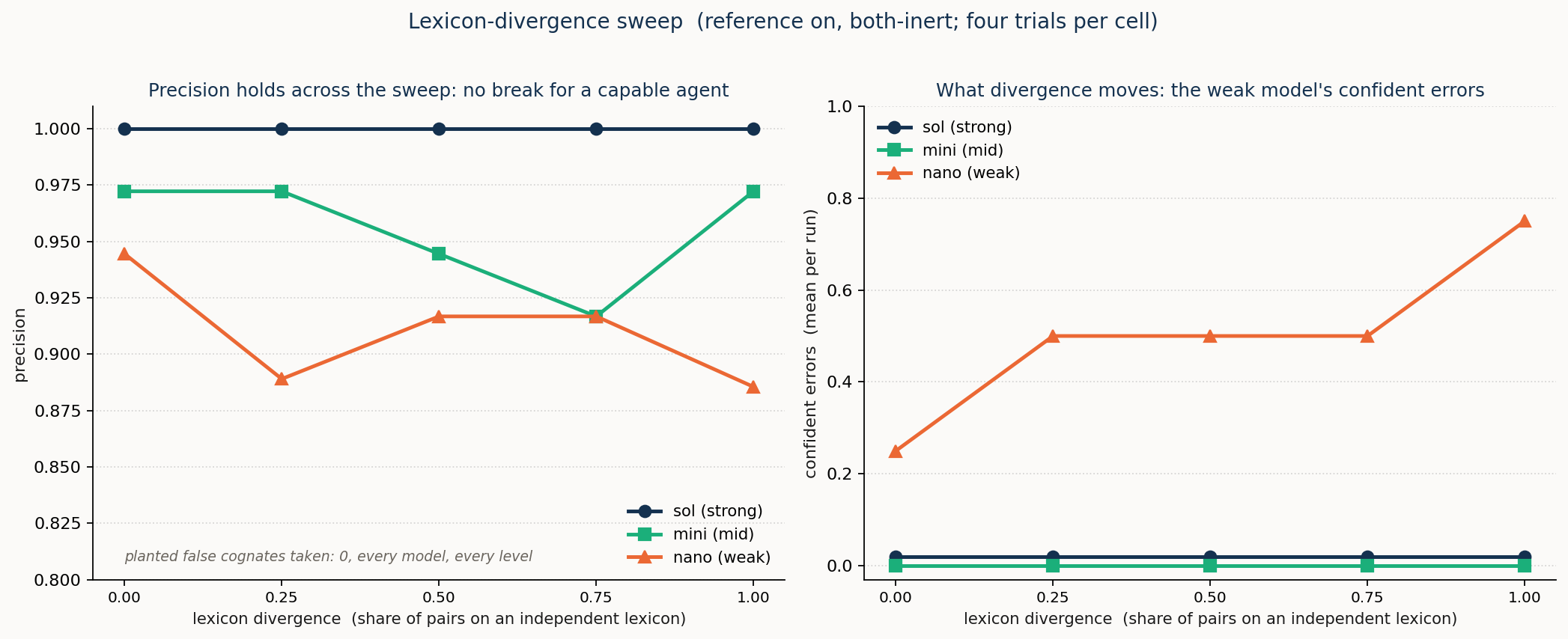
Figure 7. Left: precision across the divergence axis, per model. The strong agent is flat at 1.00, and no model takes a planted cross-lexicon false cognate at any level, so the guard itself never fails; the mid and weak agents vary in a narrow high band, spurious over-proposal rather than trap-taking. Right: the one quantity divergence moves is the weak model’s confident-error count, which roughly triples across the sweep, while the stronger two stay at zero. Reference on, both-inert, four trials per cell.
The one thing divergence does move is confined to the weak end and shows up in the confidence signature rather than in the guard: the weak model’s confident-error count roughly triples across the sweep, from 0.25 to 0.75 per run, even as its trap-taking stays at zero. So the cost of lexicon divergence, on this case, is not a broken false-cognate guard but a graded rise in the weak model’s confident, spurious assertion — the same pathology the confidence metrics record elsewhere, now shown to grow with divergence.
What this changes: the reference-quality threshold §5.2 sent us to look for on the divergence axis is, within a full sweep on this case, not reached for a capable agent — its alignment is robust from a shared reference all the way to two independent lexicons. The residual risk is the weak model’s confident over-proposal, which divergence amplifies. Locating a hard break, if one exists, is now a question for more divergent domains (different granularity, coverage gaps, denser cross-lexicon cognates) rather than for this pair; that, and a second domain, are the honest next steps.
6. Threats to validity
The primary case, though seeded to be hard, is a single pair of models of one network; the effect sizes are specific to it, and the sample is four trials per condition, so the numbers are indicative rather than tight. Language-model behaviour varies run to run and is model-dependent; results are reported per model and compared under fixed conditions, so effort is read as a relative signal across treatments rather than an absolute cost. Public standards may have been seen by a model in training, which could flatter the no-reference conditions; the effect we rely on is the difference the reference makes under identical inputs. The scaling result is exact by construction and verified by composition, but it counts binding-versus-alignment operations, not wall-clock effort; combined with the per-reconciliation effort measured here, the two advantages compound. The gold standards are derived from the models and validated, which removes drift but does not make the modelling choices themselves beyond dispute. A few golds in the hard case encode a modelling decision rather than an uncontestable fact: where one model carries a single multi-layer concept and the other carries per-layer ones (a service paired with the tunnel that realises it; a node, a topology, and a link paired with their per-layer counterparts), the 1:1 gold asserts an adjacent-abstraction, aggregation-style mapping. These are defensible but debatable, and, tellingly, they are exactly the correspondences the two-agent negotiation defers without a shared reference and the relabelled-identity control leaves unresolved: the machinery rediscovers the very pairs a careful reader would flag, and a shared reference is what settles them.
The single-case worry, tested in-house. The most natural objection is that the
one pair of models above was, without anyone meaning it to be, chosen to make the
point work. To probe that, two further cases were built for this scenario from
scratch: an IP/MPLS layer-3 VPN described once as a network model and once as
device configuration (config_l3vpn), and a carrier-Ethernet VPN described in two
different service vocabularies (config_evpn), different domains, different words,
different traps, and the same agents were run on them against the same kind of
validated answer key. The finding of this scenario reappears on both: the strong
agent reconciles each new case correctly on its own (of the matches it commits, all
are right, and it finds all the true matches), and the weaker agents commit a wrong
match here and there until the small shared glossary (the reference) pulls them
back to a clean, correct close. In other words, the pattern that cognition does the
matching while the reference mainly prevents the weaker agents’ mistakes is not a
property of the one case; it shows up again on cases built to be different. This
does not remove the deeper limitation (the same author built all three, so they
test robustness to variation, not to real network data) but it closes the
“you only showed it once” gap as far as in-house work can. The two new cases, their
answer keys, and the recorded runs are in the repository alongside the original, and the
further experiments of §5 add four more cases in this scenario
(config_evpn_indeplex, correlation_config, derive_deps_config, and config_vendor_messy),
widening the case base further.
A note on scope, in terms of the components of §1. This study reconciles at the schema-term level: it exercises the lexical and ontological/structural components, and its scored output is concept correspondences (which type in one model denotes the same type as which in the other), with the planted false cognates riding on the lexical surface. Instance-level co-reference, a separate exercise that follows schema alignment and runs on a different path (entity resolution over the data, from keys, attributes, and topology), deciding that this individual ROADM is that te-node, is taken up in the companion study summarized in §3.6, where individuals are scored against a validated instance gold; within the schema-term experiments of §3.1–3.5 themselves, instances enter only as evidence (the concrete data that grounds what a concept means, and against which a verification round-trip provisions and reads back), not as alignment targets. The pragmatic component is not varied: the two models differ in vocabulary and structure, not in use or context. And the reference varied in the primary experiments is the lexical one of the possible family; the companion studies add the instance and invariant variants.
All of this is deliberate, on grounds of necessity and focus: reconciliation had to be pinned to its clearest, most separable mechanism first (lexical and structural identity, and the false cognates that ride on it) before the harder components are brought in. Each such component is a natural axis for the work, and each pairs with machinery beyond the schema-term core: instance co-reference with the instance and invariant reference variants and evidence-weighted individual matching (now taken up in the companion study of §3.6) and pragmatic reconciliation with the pragmatic reference variant and scenarios where meaning turns on context (observability, where the same measurement is a page, a benign event, or a matter to watch), which remains for the scenarios to follow.
7. Reproducibility
The harness is standard-library Python for everything except the language-model stack, which uses the OpenAI API. The controls and the whole pipeline run with no model access.
python pipeline/run.py --case config_big_hard \
  --agent --trials 4 \
  --placement both_cognitive,one_inert,both_inert \
  --model gpt-5.6-sol,gpt-5-mini,gpt-5-nano
python pipeline/verify_experiment.py --case config_big_hard --trials 3 \
  --placement both_cognitive,one_inert,both_inert \
  --model gpt-5.6-sol,gpt-5-nano                # reconcile -> verify -> repair (§3.5)
python pipeline/summarize.py --case config_big_hard    # per-condition means and the benefit matrix
python pipeline/figures.py  --case config_big_hard     # regenerate the figures
python pipeline/scaling.py  --max-n 12 --write          # the scaling result

# the companion studies of §3.6:
python pipeline/instance_reconcile.py --stage 1lite \
  --model gpt-5.6-sol,gpt-5-mini,gpt-5-nano --trials 3 --budget 12   # instance co-reference
python pipeline/verify_study.py --model gpt-5.6-sol,gpt-5-mini,gpt-5-nano --trials 6   # verification modes
Cases live under benchmark/cases/<case>/ as plain JSON (two models, the
reference, the traps, and the derived gold); benchmark/schema.md documents the
format and benchmark/derive_gold.py derives and validates the gold. The exact
per-run data behind the reported figures and tables are in results/, one CSV per
experiment (config_big_hard.csv, verify_config_big_hard.csv,
scaling_scaling_otn.csv).
The four sub-studies whose essentials are folded into this report above, the pre-lift
lexical baseline (§2.2), the reference-field anatomy (§4), and the instance-co-reference and
verification studies (§3.6), are written up in full, with their per-condition tables, seeds,
and exact commands, as repo-only method notes under notes/studies/:
notes/studies/lift-baseline.md, notes/studies/reference-anatomy.md,
notes/studies/instance-disambiguation.md, and notes/studies/verification-modes.md. They are method
detail behind this scenario’s report, not separate reports in the four-scenario set.
Appendix: the metric families
- Reliability. Precision and resolved fraction against the gold standard; surviving false cognates; and the residual: the true correspondences the reconciliation defers and refers onward rather than guessing (the complement of the resolved fraction). Concepts with no counterpart are counted separately, as correct non-correspondences, not as residual.
- Cognitive effort. Reasoning tokens (hidden deliberation), total tokens, and latency, recorded only for a language-model stack.
- Scaling. Reconciliation operations as a function of the number of systems: bindings (with a reference) against pairwise alignments (without).