ad-hoc-semantic-reconciliation
2/4 · Reconciling intent with realisation: refinement, negotiation, and a service that renegotiates itself
Programme status: the second of the programme’s four operational scenarios (intent-based service management). The first scenario reconciled two structural models of one network by an equivalence; this one reconciles a declarative intent against a concrete realisation by refinement, and so exercises the parts the first scenario could not: verification by satisfaction, a two-sided negotiation when nothing fits exactly, the pragmatics of whose authority decides, and a service reconciled repeatedly across its whole life. Consistent with the programme’s aim at this stage, the report is written to explain and illustrate the concept in action and to make plain what is new against the first scenario, with the measured results as confirmation rather than as the whole point.
Summary
Two software agents face each other across the boundary between a customer and a network operator. The customer’s agent, O, knows only what the customer wants: a connection from one site to another, at least so much bandwidth, no more than so much delay, available to so many nines, protected or not. The operator’s agent, N, knows only what it has: a catalogue of concrete optical services, each a discrete client signal carried over a particular route, with a measured latency, an availability, a protection scheme, and a cost. Neither speaks the other’s language, and neither will adopt the other’s model. They must work out, between themselves, which of N’s concrete services satisfies O’s declared wish.
That last word is the whole difference from the first scenario. There, reconciliation was an equivalence: this TAPI term is that TEAS term. Here it is a refinement: “latency below 5 ms” is not equal to any service N offers; it is a bound that a service either clears or does not, and many different services may clear it. Once the relation is refinement rather than equivalence, four things follow that the first scenario never had to confront, and each is a deliberate object of this study: verification must be by satisfaction (you check the chosen service against every bound, because you cannot check a lossy refinement by handing the wish back); when no service meets every bound the agents must negotiate a best-achievable offer and someone must decide whether to accept it; that decision turns on pragmatics: the customer’s priorities, budget, and authority, which this study carries in a small, portable policy the customer’s agent holds; and because a live service’s circumstances change, the whole exchange recurs across the service’s life, a loop rather than a single hand-off.
We built a harness in which a live reasoning agent performs this reconciliation against the provider’s capabilities and the customer’s policy, given as deterministic oracles, over a seeded case grounded in the first scenario’s OTN/optical network, and scored every step against a validated gold standard. The headline is a single, sharp result. When both agents can reason, the reconciliation completes autonomously, including the negotiation, with no human in the loop. As cognition recedes, the negotiated decisions collapse to a residual that must be referred to a person, and a small pre-placed policy the customer carries recovers the part of that residual it was authorised to decide, closing autonomously what a mute customer would have to hand off. That is the programme’s central insight (cognition is what completes a reconciliation), now measured on this scenario’s negotiation (a two-sided framing that, as §5 records, is earned where the provider must weigh its own deliverability and unearned where its side is a fixed catalogue), and sharpened by a second finding: a thin published reference can supply an inert agent the facts it needs to check satisfaction, but it cannot supply the authority to decide; where the missing ingredient is judgement rather than information, no reference substitutes, and only cognition closes the gap. Around these, the study shows a clean capability gradient (a strong agent negotiates, verifies, and defers cleanly on a fraction of the effort; a weak one burns an order of magnitude more reasoning to do less) and it follows one service through a four-hop lifecycle, bought and degraded and rerouted and stretched past what the network can give and finally restored, as a worked illustration of the concept in motion.
Two further experiments (§5) then test the scenario’s own framing. Putting an actual second reasoning agent where the study had used a deterministic provider oracle changes the negotiation almost nothing: it reproduces the oracle’s best-achievable offers (0.89–1.00 across the model ladder) and its accept/reject outcomes (0.96–1.00). That is an honest null, and it qualifies this report’s central word: the “two-sided negotiation” language is not earned here, because the provider behaves as a solved optimisation rather than a party whose reasoning shifts the result, and the exchange is better read as one-sided refinement against a checkable oracle. A second experiment sharpens the capability gradient on the act of asking: recognising that more information is needed is easy for every model (ask rate ≈ 0.89–1.00), but issuing a targeted request for exactly the disambiguating attribute is capability-gated — the strong model asks for the right attribute and resolves every case (1.00) while the weak model cannot target it and lands at the guessing floor (0.50), so the weak model’s apparent caution is inability rather than judgement.
The scenario is grounded in the IRTF NMRG Internet-Draft Dynamic Network-as-a-Service Life-Cycle Automation Using End-to-End Agent Negotiation (draft-janz-nmrg-naas-agentic-negotiation; Janz, Rahimi, and Yu), whose consumer policy-and-wallet agent, agent-to-agent negotiation, and closed-loop lifecycle renegotiation this study operationalizes and puts to an empirical test.
1. The scenario: two agents, and what passes between them
Picture the two agents and the one thing they are trying to do.
Agent O sits on the customer’s side. It holds an intent: a statement of what the customer’s workload needs, in the customer’s own terms. A concrete example, the one we will follow: a connection from the New York floor to Frankfurt, at least 8 Gbit/s, latency at most 5 ms, availability at least four-nines (0.9999), protection not required. Every clause is a bound: a predicate over a delivered service, not a service itself.
Agent N sits on the operator’s side. It holds a catalogue of concrete realisations: real Layer-1 services it could provision over the OTN/optical core. Each realisation is a specific thing: a discrete ODU client signal (ODU0 ≈ 1.25 Gbit/s, ODU2 ≈ 10 Gbit/s, ODU3 ≈ 40 Gbit/s, and so on) carried on a particular route (a short direct path, or a diverse protected one), and it comes with the properties that matter to O’s bounds: a bandwidth, a latency, an availability, a protection scheme, and a cost. For the New York–Frankfurt endpoints, say, N can offer a direct ODU2 (10 Gbit/s, 3 ms, 0.99995, unprotected, cost 40) or a diverse protected ODU2 (10 Gbit/s, but 6 ms, five-nines, 1+1 protected, cost 70).
What passes between them is a refinement. O does not tell N how to build anything, and N does not adopt O’s vocabulary of bounds. N proposes a realisation; the question is whether that realisation satisfies every one of O’s bounds. Take O’s intent above against N’s direct ODU2: 10 ≥ 8 ✓, 3 ms ≤ 5 ms ✓, 0.99995 ≥ 0.9999 ✓, protection not required ✓: the direct service satisfies the intent, and the reconciliation is complete: O’s wish is refined down to that concrete service. The diverse service would also have served on bandwidth and availability but fails the latency bound (6 ms > 5 ms); it is not a valid refinement of this intent, though it might be of another.
Three consequences of “satisfied by” rather than “equal to” run through everything that follows.
Verification is by satisfaction, not round-trip. In the first scenario you could check a proposed equivalence by mapping a term across and back and seeing that you returned to where you began. A refinement is lossy and one-to-many (“≥ 8 Gbit/s” does not remember that it was met by exactly an ODU2), so there is nothing to round-trip. You verify by taking the chosen realisation and testing it, bound by bound, against the intent. Verification is the satisfaction check.
When nothing fits, the agents must negotiate. Some intents cannot be met by any single realisation: the bounds pull against each other, or the catalogue simply lacks a service that clears them all. Then N computes the best-achievable offer (the realisation that gives up only the least-important bounds) and O must decide whether to accept the degraded offer or reject it. This is a genuine two-sided negotiation, and (the point the scenario is built to test) in the fully-cognitive case it closes with no human in the loop. (One qualification, reported in §5: whether the negotiation is genuinely two-sided depends on what the provider has to reason about. Where the provider only selects from a fixed catalogue of concrete offers, a control that puts an actual second reasoning agent in its place changes the outcome almost nothing — the provider behaves as a solved optimisation; give it its own deliverability to judge and the second agent diverges substantially, and the exchange is genuinely two-sided. The framing is thus scoped to where the provider has something of its own to weigh, not softened away.)
The decision turns on pragmatics, which a portable policy carries. Whether a degraded offer is acceptable is not a property of the network; it is a property of the customer: which bounds are sacred, what the customer can afford, how this particular flow should behave when the network tightens. This study makes that concrete as a small, portable movable policy the customer’s agent holds: a priority ordering over the bounds, a set of hard (must-hold) bounds, an affordability floor, and a flow-class rule. The same infeasible intent, decided under two different policies, comes out differently, and correctly so. That portable policy turns out to be the pivot of the whole scenario, for a reason developed in §3.3.
One concrete illustration of the negotiation, before the method. Consider an intent for a 40-Gbit/s market-data feed that wants latency ≤ 10 ms, four-nines availability, and protection. N has two realisations for those endpoints: a direct ODU3 (40 Gbit/s, 8 ms, but only three-nines and unprotected) and a diverse ODU3 (40 Gbit/s, protected, five-nines, but 12 ms). Neither satisfies the intent: the direct one misses availability and protection, the diverse one misses latency. There is no equivalence to find; there is only a choice to negotiate. Under a latency-first policy the correct answer is to reject: the direct offer’s best-achievable degrades availability, which this policy holds sacred. Under a resilience-first policy the correct answer is to accept the diverse offer: it holds availability and protection, giving up only latency, which this policy is willing to trade. Same intent, same catalogue, opposite decisions, each right for its policy. That is the scenario in miniature: reconciliation here is not a lookup but a judgement, and the judgement is the customer’s.
2. Method
2.1 The agents, the oracle, and the phases
Here the reconciling cognition is one live reasoning agent, the consumer’s agent O, working against the provider’s live capabilities and the customer’s policy, each supplied as a deterministic tool that returns a hidden ground truth: the negotiation is between a reasoning agent and those authoritative oracles, not between two language models. (This differs from the schema scenarios, where both sides are live reasoning agents; here the provider’s feasibility and best-achievable offer are determinate facts, so modelling them as an oracle is exact rather than a simplification.) The agent runs a bounded tool-use loop: the model is given the intents, the catalogue, and the policy in force, and a small set of tools that stand for the live capabilities of each side. The provider side, when live, can be asked to check the feasibility of a realisation (does it actually satisfy the bounds, using the true operational figures rather than the advertised catalogue) and to compute the best-achievable offer. The consumer side, when its judgement is present, can be asked to consult the policy: accept or reject an offer against the hard bounds and affordability floor. In the assurance phase a read-operational tool returns live telemetry. Every tool call is counted; the whole exchange is captured as a transcript, so a run can be shown, not only scored. The tools are deterministic and read a hidden ground truth the model never sees; their availability follows the cognition placement (§2.2), which is how the spectrum is imposed.
The reconciliation is exercised in four phases, run by a single command as a launch-and-leave sequence:
- Refine-down + satisfaction: for each intent, choose the realisation to provision and say whether it satisfies every bound.
- Feasibility and the judge (negotiation): for each infeasible intent, obtain the best-achievable offer and decide accept or reject against the policy in force.
- Endpoint co-reference, a supporting step: decide which of O’s delivery points and N’s access points are the same physical entity. This is instance-level co-reference and reuses the machinery (and the finding) of the first scenario’s instance study.
- Assure-up (the lifecycle): walk a service through a multi-hop life, classifying fulfilment and renegotiating at each turn.
2.2 The cognition spectrum, for intent
The spectrum is the same instrument as in the first scenario (both agents live, one inert, both inert), but the negotiation gives it a new place to bite, and the movable policy gives it a genuinely new rung. The consumer’s judgement can be present in two different ways: as a live reasoner in the moment, or pre-placed in the portable policy that decides on the customer’s behalf without a live customer present. That distinction splits the middle of the spectrum and is, as it turns out, exactly where the scenario’s sharpest result lives. The placements we run are:
- both-cognitive: provider live, consumer judgement present; the reconciliation, negotiation included, completes autonomously.
- provider-inert, N is a static catalogue: no live feasibility, no fresh best-achievable offer. O must reason from the advertised catalogue alone.
- consumer-policy: the consumer is not a live reasoner, but carries a pre-placed movable policy that closes the decisions it was authorised for.
- consumer-mute, the consumer is a static description with no policy: decisions it cannot settle must be referred onward to a person.
- both-inert: neither side is live; a third party proposes from static evidence and refers every acceptance decision.
The residual (the reconciliation that cannot be closed and must be handed to a person) is the measure of what cognition, at each placement, leaves undone.
2.3 The case, the policies, and the reference
The case is small and seeded so that every mechanism is exercised and every trap is provable: seven intents over five endpoint pairs, a catalogue of nine realisations, three movable policies (latency-first, resilience-first, cost-sensitive), and three lifecycle trajectories (eight hops in all, one of them the worked set-piece of §3.5). A deterministic satisfaction–feasibility–policy–fulfilment oracle derives the gold (the satisfying realisations, the best-achievable offer and correct decision under each policy, the co-reference truth, and the per-hop lifecycle verdicts) and validates it before any run, refusing to proceed unless the seeded case is internally consistent: that every “experiment-only” intent genuinely needs a live probe (its advertised and actual figures disagree), that every infeasible intent truly has no satisfier, and (the check that keeps the pragmatics honest) that the accept/reject decision really does vary with the policy.
Two of the seven intents are experiment-only: their advertised catalogue figures and their true operational figures disagree, so a purely static agent gets satisfaction wrong and only a live feasibility probe resolves them. They are the intent-scenario analog of the first study’s static-twins-need-a-probe, and they are where the spectrum bites in the refine-down phase.
The reference is run as two arms plus a no-reference control, exactly as the design proposed. A unit/value-set arm pins what the units mean, the discrete value hierarchies (ODU rates, protection classes, availability nines), and (guarding the “nature” trap) the separation of an expectation-kind bound (“latency ≤ 5 ms”) from a realisation-kind metric (a measured latency). An invariant arm publishes the committed guarantee floor per realisation, an anchor a satisfaction check can evaluate against when a side cannot be probed. What the reference contributes, and where it stops, is one of the study’s findings (§3.3).
2.4 Metrics
Correctness is the currency throughout. Refine-down is scored by satisfaction accuracy (did the
agent’s satisfy/refer verdict match the truth, and did a claimed satisfier really satisfy) and by
experiment-only correctness. Negotiation is scored by decision accuracy (accept/reject
matching the policy-correct verdict) and by whether the best-achievable offer was the right one,
with the refer rate tracked alongside as the honest measure of what a placement cannot close.
Endpoint co-reference reuses the first study’s two core measures: precision (of the correspondences
the agent commits to, the share that are correct) and resolved fraction (of the true
correspondences that exist, the share the agent finds and commits, the rest deferred to the residual
rather than guessed). The lifecycle is scored by hop
accuracy (fulfilment status, decision, and migration all correct) across the trajectory. Effort
is reported as reasoning tokens and negotiation turns. The models are the same ladder as the
first scenario: a strong model (sol, gpt-5.6-sol), a mid model (mini, gpt-5-mini), and a weak one (nano, gpt-5-nano).
3. Results
3.1 Refine-down: satisfaction is easy where it can be checked, and the probe is what checks it
With both agents live, refinement is reliable: sol and mini satisfy every intent correctly (accuracy 1.0) and catch both experiment-only intents, using the live feasibility probe to see past the misleading advertised figures. The spectrum then bites exactly where it should. Once the provider goes inert (no probe) the experiment-only intents can no longer be caught by any model (they fall to zero), and accuracy settles at the 0.71 that corresponds to getting the five honest intents right and the two probe-only ones wrong. The weak model is weak even when the probe is available: nano at both-cognitive reaches only 0.71 and catches just one of the two experiment-only intents: handed the mechanism that would resolve them, it does not reliably use it. This is the first face of the capability gradient: the live probe is necessary, but not sufficient; a model must be strong enough to reach for it.
One nuance worth stating plainly, because it looks like a defect and is not. Under full inertness, the strong model scores lower than the mid model on raw satisfaction accuracy (sol 0.29 vs mini 0.71). That is not sol failing; it is sol refusing to assert what it cannot verify. Blind, with no probe, sol declines to affirm satisfaction and refers the intents onward, where mini trusts the advertised catalogue and affirms. On the honest intents mini’s trust happens to pay; but the behaviour that scores lower is the more trustworthy one, and §3.3 shows it is exactly the behaviour a published reference can rescue.
3.2 The negotiation, and the policy-recovery: the central insight, measured
The negotiation is where the scenario earns its place, and the result is clean enough to read off a single figure (Figure 1). When both agents can reason, both the strong and mid models decide every infeasible case correctly (accuracy 1.0): they obtain the right best-achievable offer and accept or reject it exactly as the policy dictates, with no human in the loop. Hold the provider live and the result holds. Then remove the consumer’s live judgement, and everything turns on how the customer’s authority is present:
- with a pre-placed movable policy, the decision still closes: sol and mini stay at 1.0;
- with a mute customer and no policy, the decision cannot close: accuracy falls to 0.0, and the models correctly refer all three decisions onward rather than guess.
That contrast is the programme’s central insight made visible on a two-sided negotiation. A reconciliation that needs the customer’s judgement completes autonomously exactly to the extent that the judgement is present (live, or pre-placed in a portable policy) and where it is absent the work is not done wrongly, it is handed to a person. The pre-placed policy is a concrete mechanism for pushing the hand-off boundary: it lets the customer’s cognition be present in the reconciliation without the customer being live in the moment, closing autonomously what a mute description must refer.
The weak model traces the same shape, more roughly: nano decides correctly with both sides live (1.0), largely recovers under a pre-placed policy (0.83), and correctly collapses to referral when the customer is mute (0.06): the mechanism is robust enough to survive a weak reasoner, even as its precision frays.
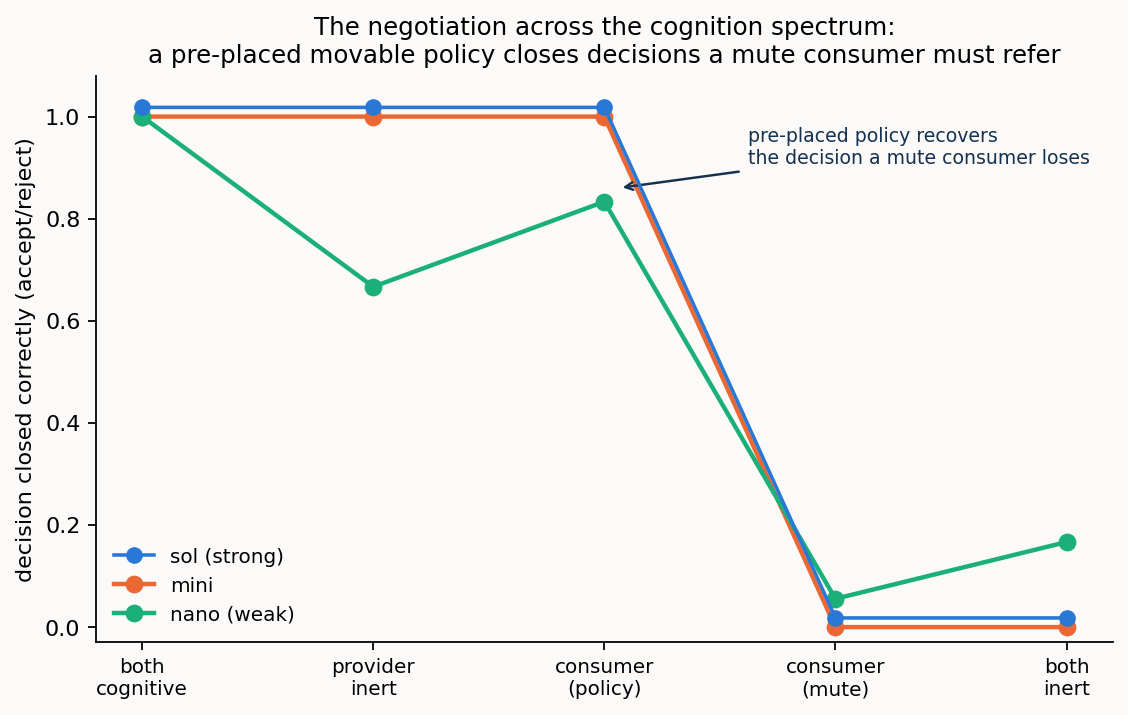
Figure 1. Decision accuracy across the cognition spectrum. The line holds high while the customer’s judgement is present (live, or pre-placed in a movable policy) and falls to the floor at consumer-mute and both-inert, where the correct behaviour is to refer the decision to a person. The pre-placed policy is what holds the line where a mute customer cannot.
On pragmatic sensitivity, the check the whole scenario rests on: every model, with both sides live, applied each policy’s accept/reject correctly (accuracy 1.0 under all three policies). The decisions genuinely track the policy: the 40-Gbit/s intent of §1 that a latency-first policy rejects and a resilience-first policy accepts is decided each way, correctly, by the same model. The reconciliation is not reading a fixed answer; it is exercising the customer’s judgement as the customer’s policy defines it.
3.3 The reference reaches the information gap, and stops at the authority gap
The reference arms give the scenario its second, sharper finding, and it took a targeted look at the inert placements to see it, since with both agents live everything is already at ceiling and the reference has no room to show.
Where a side is inert, the reference can supply missing information. The clearest case is the strong model’s caution from §3.1: blind at both-inert, sol refuses to affirm satisfaction and scores 0.29, but publish the invariant reference (the committed guarantee floor), and sol has an anchor to check satisfaction against without a probe, and rises to 0.71. The reference saves the verification the missing probe would otherwise have done. In the negotiation, similarly, the unit reference gives the weak model a modest lift when the provider is inert (nano’s decision accuracy 0.67 → 0.83), steadying an agent that would otherwise mishandle the offer.
But the reference cannot supply missing authority. At both-inert, no reference (unit or invariant) moves the negotiation decision: every model refers all three cases, with or without a published anchor. The reason is exact and worth stating carefully. What is missing at both-inert is not a fact about the network that a reference could publish; it is the customer’s judgement itself: the authority to accept a degraded offer. A reference can tell you what a service guarantees; it cannot tell you whether this customer is willing to live with it. Where the gap is information, a thin reference closes it; where the gap is authority, only cognition (live, or pre-placed as a policy) closes it, and the reference stops at the boundary.
This is the programme’s central insight seen from a new angle. The first scenario showed a thin reference substituting for cognition on a lexical task; this scenario shows the limit of that substitution. The reference reaches as far as the information a reconciliation needs and no further; the completion of a reconciliation that requires judgement is cognition’s alone.
3.4 Endpoint co-reference: a supporting step, and the same probing gradient
Deciding which of O’s endpoints and N’s access points are the same physical entity is instance-level co-reference, and it reproduces the first study’s texture on new data. With both sides live, the same-site endpoint twins (indistinguishable on their static records) are resolvable only by interrogating an authoritative fibre-id, and the capability gradient shows in how each model gets there: the strong and mid agents resolve the twins fully (resolved fraction 1.0), while the weak agent only partially resolves even with the live side present (0.67), leaving the ambiguous pairs in the residual. Once a side goes inert and the probe is gone, all three collapse to the same 0.6, the twins unresolvable from static records alone — deferred to a live probe at unchanged precision, not mis-merged. The step is supporting, not the headline, but it confirms that the live-probe mechanism and its capability-dependence carry over intact from the first scenario.
3.5 The lifecycle, watched: a service that reconciles itself across its life
The scenario’s most complete illustration is a single service followed through a four-hop life: the worked set-piece, run and scored like everything else, and reproduced here from the strong model’s actual transcript, which walked all four hops correctly (Figure 2).
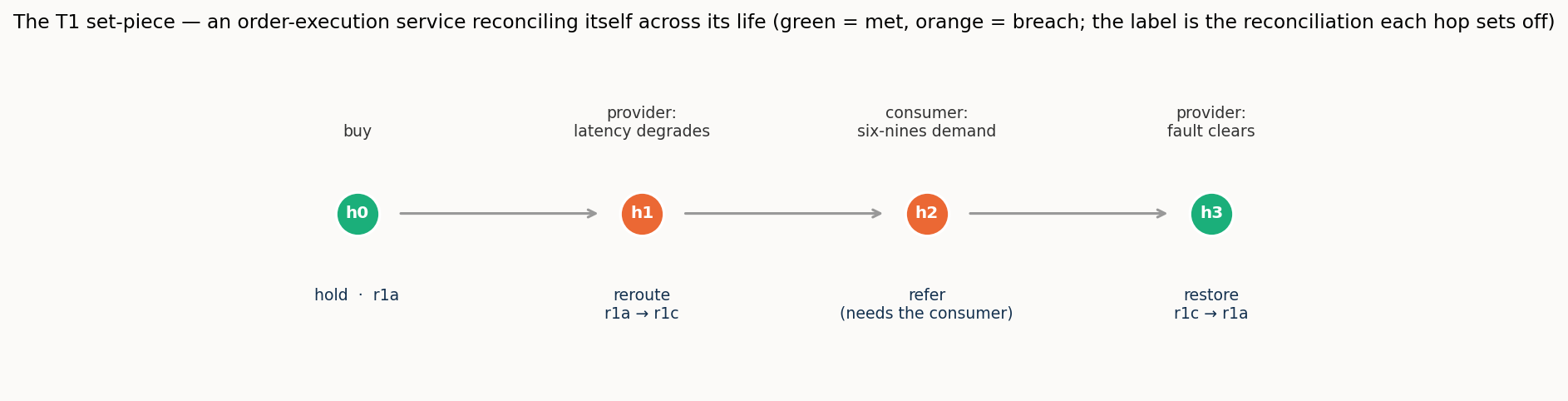
Figure 2. One order-execution service across its life. Each hop is a fresh reconciliation of the same intent against the network’s current reality; the service is migrated, held, or referred as the policy and the live state dictate.
The intent is the New York–Frankfurt order-execution service of §1 (≥ 8 Gbit/s, ≤ 5 ms, four-nines), under a latency-first policy, provisioned initially on the direct ODU2, r1a.
Hop 0: bought and running. The agent reads the operational state (latency 3 ms, availability 0.99995), finds every bound met, and holds. Nothing to reconcile; the refinement stands.
Hop 1: a degradation, self-remediated. The direct path’s latency has drifted to 6 ms; the agent reads it, sees the latency bound breached, and must re-reconcile. Here the transcript shows real judgement, not a lookup: the provider’s best-achievable tool points back at r1a (whose catalogue spec is still a healthy 3 ms), but the agent (seeing that r1a is precisely the path that has just degraded) does not take it. It checks the feasibility of the alternative diverse path r1c (4 ms, five-nines, protected), confirms it satisfies every bound, consults the policy (accept: within the affordability floor), and migrates the service to r1c. A breach the network could remedy on its own, remedied autonomously.
Hop 2: a demand the network cannot meet, referred. The consumer now needs six-nines availability for a critical window. The agent reads the in-service r1c (five-nines) against the tightened intent, sees the availability bound breached, and looks for a remedy, but no realisation on these endpoints reaches six-nines. The best-achievable offer still violates a hard bound, the policy will not accept it, and the agent does the right thing: it refers the decision to the consumer. This is the hand-off boundary in the lifecycle: the point where automation has reached as far as it can and the customer’s own judgement is required.
Hop 3: the fault clears, and a restore. The direct-path degradation lifts. The provider offers to move the service back to the cheaper r1a; the agent checks that r1a again satisfies the (restored) intent, consults the policy (accept: cheaper and compliant), and restores the service. The life comes full circle.
Four hops, four reconciliations of the same intent against a changing reality (bought, self-healed, handed off, and restored) and the strong model gets all four right. The capability gradient shows here too: hop accuracy on the multi-hop trajectories runs sol 1.0, mini 0.88, and nano 0.62 on this set-piece, the weak model fraying as the life grows longer and the state it must track accumulates.
3.6 Effort: the strong agent does more with far less
The capability gradient is nowhere clearer than in the cost of the negotiation. To reach its decisions, the strong model spent on average about 150 reasoning tokens over fewer than three turns; the mid model about 860; the weak model about 5,400 (roughly thirty-five times the strong model’s effort) over more turns, to reach lower accuracy. The pattern is the one the first scenario found and this one confirms on a harder task: capability buys not just correctness but economy; a weak agent does not merely make more mistakes, it spends far more cognition making them.
4. Discussion
What is new against the first scenario. The first scenario established that cognitive agents can reconcile two structural models ad hoc, and that a thin lexical reference can substitute for cognition on that task. This scenario moves from equivalence to refinement, and in doing so exercises everything the first could not. Verification became satisfaction: checking a chosen realisation against every bound, the mode the first study named and deferred. A genuine two-sided negotiation appeared (best-achievable offers, accept/reject decisions) and the study showed it completing autonomously under full cognition and collapsing to referral as cognition recedes. Pragmatics moved from a fixed backdrop to a measured axis, carried by a portable movable policy, and the decisions were shown to track it. And the reconciliation became a loop across a service’s life, not a single hand-off. The one component the first scenario held fixed and this one puts to work is exactly the pragmatic one; only the schema-structural machinery is now shared ground.
The central insight, sharpened twice. The programme’s claim is that cognition is what completes a reconciliation, and that the fully-cognitive end completes autonomously, with no standard and no human. This scenario sharpens it in two ways that the first could not reach. First, it shows the claim holding on a negotiation (the hardest thing to automate, because it needs both sides’ live participation) and it identifies the pre-placed policy as the mechanism that pushes the hand-off boundary outward: the customer’s cognition, placed in a portable artefact ahead of time, closes autonomously what a mute customer would refer. Second, it draws the limit of the thin reference that was the first scenario’s protagonist. A reference reaches the information a reconciliation needs (it can hand an inert agent the facts to check satisfaction) but it stops at the authority to decide. Where the missing ingredient is judgement, no reference substitutes; cognition, live or pre-placed, is the only thing that closes the gap. Information has a published stand-in; authority does not.
The honest limits of what was measured. Two results are worth stating plainly rather than smoothing over. The hardest lifecycle move for every model was the voluntary one: the cost-sensitive service stepping aside to a cheaper path when nothing was broken (hop accuracy 0.5 across all three models on that trajectory). A breach compels a reconciliation; a mere opportunity to save money does not, and the models default to holding a service that is meeting its bounds. This is arguably defensible behaviour, but it marks a real edge: proactive, unforced optimisation is harder for these agents than reactive remediation. And the study is, by design, illustration-first: one seeded case, a modest measured cross-product, a few worked cases rather than a large factorial. It is built to show the concept in action and to establish the mechanisms cleanly, not to characterise their statistics; the numbers here are consistent and repeatable across trials, but the claim they support is existential and mechanistic: this is how it works, and here it is working, not a population estimate.
Where this leaves the programme. Two of four scenarios are now complete. Between them they have exercised the lexical, ontological/structural, and instance-level components of reconciliation, the verification of a reconciliation, and (new here) its pragmatic component and its extension across a service’s life. The through-line holds and has sharpened: it is cognition that completes a reconciliation; a thin reference reaches the information gap and no further; and the fully-cognitive end completes autonomously, the pre-placed policy carrying the customer’s authority to exactly where a person would otherwise have to stand.
5. Further experiments
Three further experiments test the scenario’s own framing. The first goes at the load-bearing word in this report’s own title and framing, negotiation: it puts an actual second reasoning agent where the study had used a deterministic provider oracle, and asks whether that changes anything. The second addresses the “conservatism, not competence” reading of the weak model’s apparent safety, by isolating a skill the study had not separated out: not recognising that more information is needed, but requesting exactly the right information. The third returns to the negotiation with the provider given something real to reason about — whether it can actually deliver an offer against its own network state — to locate where the two-sided framing is earned. All are small, single-case studies in the same illustration-first spirit as the rest of the report, and all are reported here with the same exact numbers as the underlying runs.
5.1 A real second agent in the negotiation: an honest null
The sharpest question about this scenario concerns its language: the report describes the
exchange as a two-sided negotiation, yet the provider side is a deterministic oracle, not a second
reasoning agent. To test whether the framing is earned, the best-achievable oracle was replaced with
an actual reasoning provider agent — given an intent’s bounds, its candidate realisations with
their true delivered attributes, and the policy’s priority order, it chooses which realisation to
offer — while the consumer’s accept/reject decision was held deterministic, so that any change in
outcome is attributable solely to making the provider a second agent. This was run over three
negotiation intents, three policies, and the three-model ladder, three trials each, alongside a
deterministic oracle control.
The second agent changes almost nothing. The reasoning provider reproduces the oracle’s best-achievable offers closely (offer-match 0.89 for sol, 1.00 for mini, 0.96 for nano) and reproduces the negotiation outcomes more closely still (decision-match 1.00 for sol, 1.00 for mini, 0.96 for nano); the oracle control sits at 1.00 / 1.00, confirming the harness. The one divergence is instructive rather than troubling: where the strong model matched the oracle’s offer only 0.89 of the time, its accept/reject decision still matched the gold every time (1.00), because the realisation it named instead was decision-equivalent — a tie the oracle happened to break by cost, broken differently but to the same end. The second agent introduces variation in which realisation is offered but not in what is ultimately accepted.
What this changes is the claim, not the mechanism. The provider’s role here is a well-posed optimisation — offer the best-achievable realisation under the priority order — that even the weak agent computes reliably, and the deterministic oracle is therefore a faithful stand-in for a provider agent rather than a simplification that hides a live party’s reasoning. On this evidence the “two-sided negotiation” language is not earned in this scenario: the provider behaves as a solved optimisation, not as a second party whose reasoning shifts the result. As noted in the summary and in §1, the exchange is here better read as one-sided refinement against a checkable oracle, with the customer’s judgement the only cognition the outcome turns on. But the null is specific to this well-posed framing: a negotiation in which the provider must weigh its own deliverability, holds hidden incentives, or could propose outside its advertised catalogue could well make a second agent matter. §5.3 takes the first of these — a provider that must judge what it can deliver — and finds that it does, so the two-sided language is not retired but scoped to where the provider has something of its own to reason about.
5.2 Targeted requests: recognising a shortfall is easy, targeting it is capability-gated
The “conservatism, not competence” reading of the weak model’s apparent safety invites a direct test. This experiment isolates the skill at issue. A candidate correspondence is left under-determined: a matching label appears on both sides, and only one further attribute, available on request, settles whether the pair is a true correspondence or a false cognate. The question is whether the agent both recognises the shortfall and issues a targeted request for exactly the disambiguating attribute, as distinct from guessing and from the ask-for-everything reflex. The case is six under-specified pairs — each false pair resolvable only by its disambiguating attribute, each true pair carrying an incidental difference that could mislead an over-rejecter — run over the three-model ladder, three trials, against a surface-only control that fixes the guessing ceiling at 0.50.
Recognition is not the hard part. Every model asks rather than guesses (ask rate roughly 0.89–1.00 across the ladder). Knowing what to ask for is where capability bites. The strong model asks for the disambiguating attribute every time (hit 1.00) and resolves every item (request accuracy 1.00), though it is not perfectly minimal (it asks for only the disambiguating attribute on 0.61 of items, averaging 1.39 attributes). The mid model usually asks for the right attribute (hit 0.89) and mostly resolves (0.94), less economically (targeted 0.22, 1.67 attributes). The weak model hits the disambiguating attribute only 0.56 of the time, never asks for it alone, asks for the most (1.94 attributes on average), and ends at request accuracy 0.50 — no better than guessing.
This makes the point measurable in this scenario. The affordance to ask is worth only as much as the judgement to target it: for the weak model the request buys nothing over surface guessing, because it asks for the wrong things or indiscriminately. The weak model’s apparent safety is inability, not judgement — it acts, but without the discrimination to act correctly — which is the same boundary the negotiation and lifecycle results trace, now shown on the specific act of asking for the one attribute that would resolve an ambiguity.
5.3 A provider with its own deliverability to weigh: where the negotiation is two-sided
§5.1 found the second agent changed nothing, and pinned the reason: the provider’s task was a solved
optimisation over a fixed catalogue, with nothing to reason about. This experiment gives the provider
something of its own to reason about — whether it can actually deliver an offer — and finds the
second agent then matters. Each realisation is placed on a bearer path, and a live capacity state
can mark a path saturated, so an attractive realisation may be undeliverable now. The provider must
offer the best-achievable realisation on an available path, or decline when nothing is
deliverable. Three capacity regimes per intent: clear (no path saturated, so the
deliverable-best equals the catalogue-best — the §5.1 regime), constrained (the attractive
realisation’s path is saturated, forcing a counter-proposal or a changed outcome), and outage (every
path saturated, forcing a decline). A reasoning provider across the ladder is compared against two
deterministic controls: a catalogue oracle that picks the best-achievable ignoring capacity (the
§5.1 provider), and a deliverability oracle that picks the best deliverable option or declines (the
gold). Three intents × three regimes × three policies × three trials.
The result reverses §5.1’s null exactly where deliverability starts to bind. In the clear regime the
reasoning provider tracks the catalogue oracle (divergence from it ~0.00 for the capable models) — the
§5.1 result reproduced, because with everything deliverable there is again nothing to reason about. Once
a path saturates, the provider diverges: its divergence from the catalogue oracle rises to 0.56
in constrained and 1.00 in outage, because it must counter-propose a deliverable alternative or
decline rather than name a realisation it cannot deliver. The cost of not reasoning is large and
concrete: the catalogue oracle offers a service it cannot deliver in 0.52 of cells, while every
reasoning provider, across the whole ladder, offers none (deliverable 1.00, sol / mini / nano). And
this particular reasoning is, unlike the pragmatic verdict of §3, largely robust to capability: the
strong and mid providers match the deliverability gold exactly (offer 1.00, decision 1.00), and even the
weak provider never offers an undeliverable service, its only slippage a little optimisation error
(offer-match 0.91, and some spurious divergence, 0.22, in the clear regime).
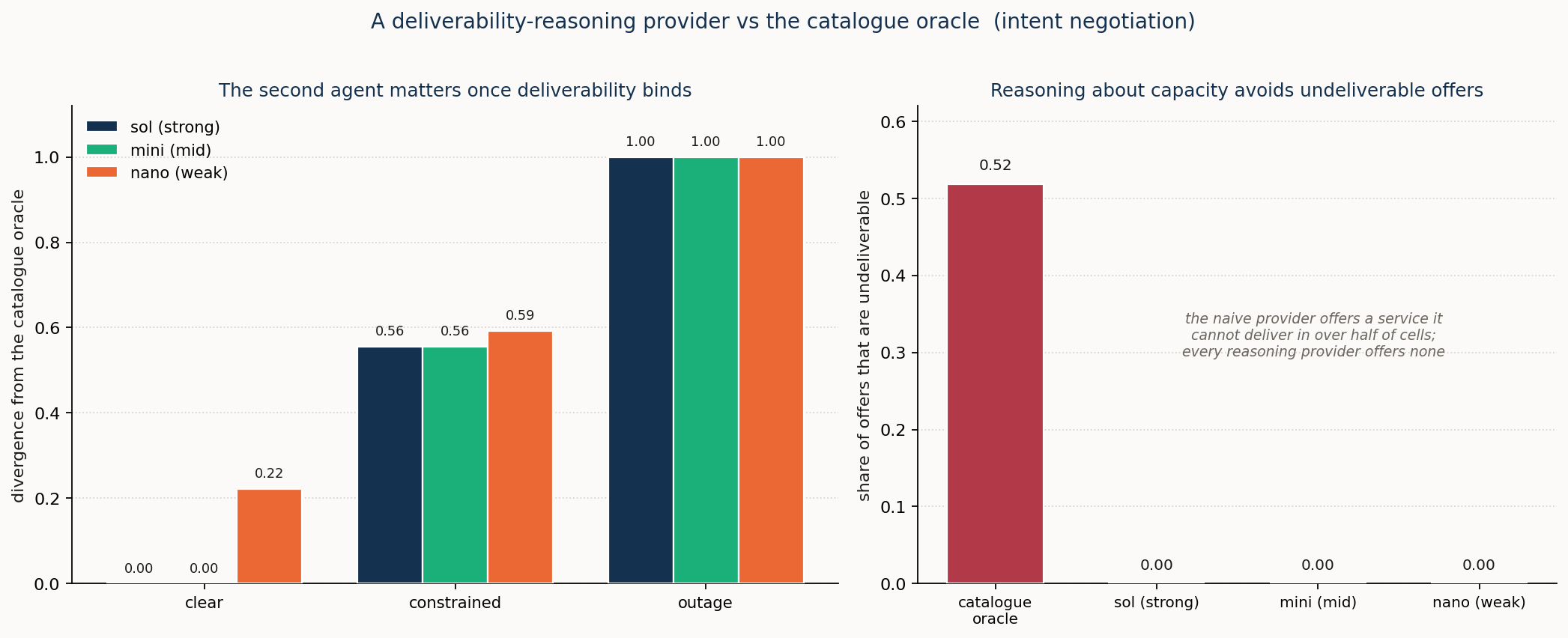
Figure 5.3. Left: the reasoning provider’s divergence from the catalogue oracle by regime, per model — near zero while paths are clear (the §5.1 fixed-catalogue regime) and rising as paths saturate and the provider must counter-propose or decline. Right: the catalogue oracle offers an undeliverable service in 0.52 of cells; every reasoning provider, across the ladder, offers none.
So the two-sided-negotiation language is scoped, not retired. Where the provider’s side is a fixed menu it is unearned, and §5.1’s null stands; where the provider must judge its own deliverability the second agent diverges substantially from a capacity-blind oracle, and the negotiation is genuinely two-sided. The honest next steps for widening it further are the other cases §5.1 named — a provider with hidden incentives or one that may propose outside its advertised catalogue.
6. Threats to validity
The case is seeded rather than sampled (constructed to exercise each mechanism and prove each trap, not drawn from a population) so the results establish that the mechanisms work and how, not how often they would work in the wild.
To guard against the worry that the one case above happened to be built in a way that flatters the
finding, two further intent cases were constructed for this scenario from scratch: an enterprise
metro-Ethernet case (intent_metro) and a data-centre-interconnect case (intent_dci), each with its
own sites, rates, policies, and traps. As a reminder, in plain terms:
refinement is working out which of the operator’s concrete catalogue entries actually satisfy the
customer’s stated wish; negotiation is deciding, when nothing fully fits, whether to accept a
near-miss or refer it upward under a stated policy; and the lifecycle is running the chosen service
across its life, hop by hop, and reading whether it is still meeting its target. On the two new cases
the scenario’s findings reappear. Refinement completes for the capable agents (the strong and mid
agents get every case right, including all four of the deliberately hard “only a live check settles it”
cases, where the advertised catalogue entry and the live truth disagree) while the weakest agent lags,
because it does not reliably perform that live check, which ties back to the reach study’s separate
finding that asking the live system is a capability-gated act. Negotiation (applying a fixed policy to
a fixed set of offers) is done correctly by all three agents including the weakest, on both new cases,
exactly as in the original. And the multi-hop lifecycle remains the demanding operation that grades
with capability, strongest to weakest. So the shape of the result is a property of the mechanism, not
of the one case. (The same author built all three, so this tests robustness to variation, not to
real network data; the latter needs carrier collaboration.)
The oracle is deterministic and the gold is derived and validated from a hidden truth, which removes drift but also means the “difficulty” of the case is authored rather than found. The intent scenario is run on the three-point core ladder; the six-model sweep that fills in the shape of the gradient covers the schema scenarios, so within intent the gradient is clear but its shape between the points is not resolved. The measured cross-product is deliberately modest, and the lifecycle in particular rests on a small number of worked trajectories; the accuracies reported are stable across the trials run but are illustrations of behaviour, not tight estimates. Finally, the negotiation and policy are a faithful but simplified rendering of the NMRG draft’s richer model: scarcity-driven pricing, wallets, and multi-party settlement are represented only as far as the reconciliation question requires, and their fuller dynamics are out of this study’s scope.
7. Reproducibility
The case builder, the validating gold deriver, the agent stack, the four-phase runner, and the figure scripts are in the repository, alongside the seeded case and the recorded per-model results and transcripts. The build, the gold derivation, and the offline tests run with no API and no network; the staged runs are a single launch-and-leave command, resumable and segmented by phase and model. The worked set-piece of §3.5 is reproduced verbatim from the recorded transcript.