ad-hoc-semantic-reconciliation
3/4 · Reconciling across a domain boundary with no public standard: what a strong agent will not guess, and what a thin reference is worth
Programme status: the third of the programme’s four operational scenarios (standard-free reconciliation across adjacent domains). The first scenario reconciled two public standard models of one network; this one reconciles two home-grown, private models of adjacent domains that meet at a single seam, with no public standard beneath either side. It exercises the same schema-binding muscles as the first scenario, and is written to make plain what changes in execution when the standard is removed, with the measured results as confirmation of a mechanism, not as the whole point. Consistent with the programme’s stage, the report isolates and explains one stage of the reconciliation; the instance-level and the full conversational process are, by design, out of its frame (§2).
Summary
Two software agents face each other across the boundary between two networks that must interwork. Meridian is a home-grown transport OSS: it thinks in circuits, bearers, wavelengths, protection grades. Cascade is a home-grown IP/VPN controller: it thinks in services, attachments, VLANs, classes of service. Their models were written by different teams for different purposes; neither is a public standard, and neither will adopt the other. Their worlds touch at exactly one place: a Cascade service must ride a Meridian circuit as its underlay. Everything a customer’s order needs to survive that boundary (the committed rate, the latency bound, the protection, the identity of the hand-off) has to be reconciled there, with no shared vocabulary and no standard to appeal to.
This scenario is the deliberate complement to the first. There, two different models faced each other too, but both were public standards (TAPI and TEAS) the agents already knew, so cognition could lean on recognition to bridge them. Here that crutch is gone: both models are bespoke and recognisable to no one in advance. The first scenario’s muscles are the same (lift, bind, a thin reference, the cognition spectrum), but with the standard removed, the execution diverges, and that divergence is the report’s subject.
We measured one stage of the reconciliation (the schema-level binding, the step that decides which concept on one side corresponds to which on the other) as an exchange between two live agents, across the cognition spectrum, with and without the reference the two agents would construct. The central result concerns what happens without that shared ground. The strong agent defers, and where a single agent must reconstruct a side the weak agent over-commits. The strong model, facing two foreign vocabularies with no shared ground, will not guess: it binds only the names that already coincide and leaves the rest in the residual: a low resolved fraction, but perfect precision and no false cognates. The weak model’s error is the opposite (binding freely and taking the cross-domain “grade” trap at a precision of barely one-half), but it shows at the inert placements, where a lone agent reconstructs the mute side; at both-cognitive its partner’s ratification refuses the over-bindings, so it under-resolves rather than mis-commits. A single thin reference repays the deferral: constructed, it lifts the strong agent to a full close and disciplines the weak agent’s precision where it is a lone reconstructor. Ablating the reference field by field shows the ground it supplies is remarkably thin: any one descriptive field (a shared label, a class, a one-line definition, or a canonical example) is enough to unlock the strong agent’s commitment, while a bare shared identifier with no description is worthless, and even harmful. And a separate axis (whose realm owns each shared field) shows the reference reaching meaning but not authority: it settles what a field is, not who governs it. That authority is not, however, something the scenario must hand-author: a later experiment shows it is derivable from an external artefact (an interconnect agreement), and that when two sources contradict each other on ownership the agents surface the conflict rather than silently choose a side (§6).
Read carefully, none of this qualifies the programme’s thesis that fully-cognitive agents can close a reconciliation. What it measures is one early stage of that process, and the worth of the one step (constructing the shared ground) that the stage was not allowed to take. The through-line holds and gains a clause: with no public standard beneath two models, cognition still closes, but only once it has built the shared ground, and building that ground is the work. Run end to end (the two agents constructing the shared reference themselves from their models and then binding through it, with none pre-given), the protocol bears this out: the strong agent lifts from a no-reference resolved fraction of 0.20 to a constructed-reference 0.80, and to 0.90 when the agents also run a decisive virtual experiment on the candidates, approaching the reference-given 1.00, at perfect precision and with no false cognate. Constructing the ground is the work, and a capable agent does it. A separate cost study across the schema scenarios (master report §13.6) puts a price on that work and locates where it is worth paying: constructing the reference is load-bearing precisely here, where no standard exists and the agent is capable, and it is cheap for such an agent (a few hundred extra reasoning tokens over binding with no reference); where a standard already exists (the configuration and observability scenarios), binding through the given reference reaches the same close for a fraction of the cognition, so building one is redundant; and for a weak agent, construction is capability-gated and its cost explodes for a worse close. In short, build the reference where there is none to bind through and the agent can build a good one; otherwise use the one that exists.
Two further experiments (§6) test the standard-free scenario where it is thinnest: the authority axis. The first shows cross-domain authority need not be hand-authored at all. Structure-only attribution is steeply capability-gated (the strong agent 1.0, the mid and weak agents 0.47 and 0.40, the weak one taking the transport lure), but an external interconnect artefact rescues every model to 1.0, and the agent correctly defers on the one genuinely co-owned field. The second shows that when two sources contradict each other on who owns a field, every model, the weak one included, surfaces the conflict rather than silently picking a side: the failure one might fear does not occur when the disagreement is visible.
The scenario is grounded in the demonstration Non-standard cross-domain provisioning and in the programme’s wider account of ad-hoc, agent-constructed references.
1. The scenario: two home-grown models, and the one seam between them
Picture the two agents and the single place their worlds meet (Figure 1).
Agent X, Meridian provisions optical transport. Its concepts are a transport engineer’s: a circuit carried on a bearer (a wavelength), presenting at a hand-off to the customer, with a rate, a latency, a protection scheme, and a grade. Agent Y, Cascade provisions IP/VPN services. Its concepts are an IP engineer’s: a service with an attachment to the customer site, riding an underlay, carrying a VLAN, with a rate, a latency, a protection requirement, and a grade. The two were built independently; the labels line up where the domains happen to share a word and diverge everywhere else.
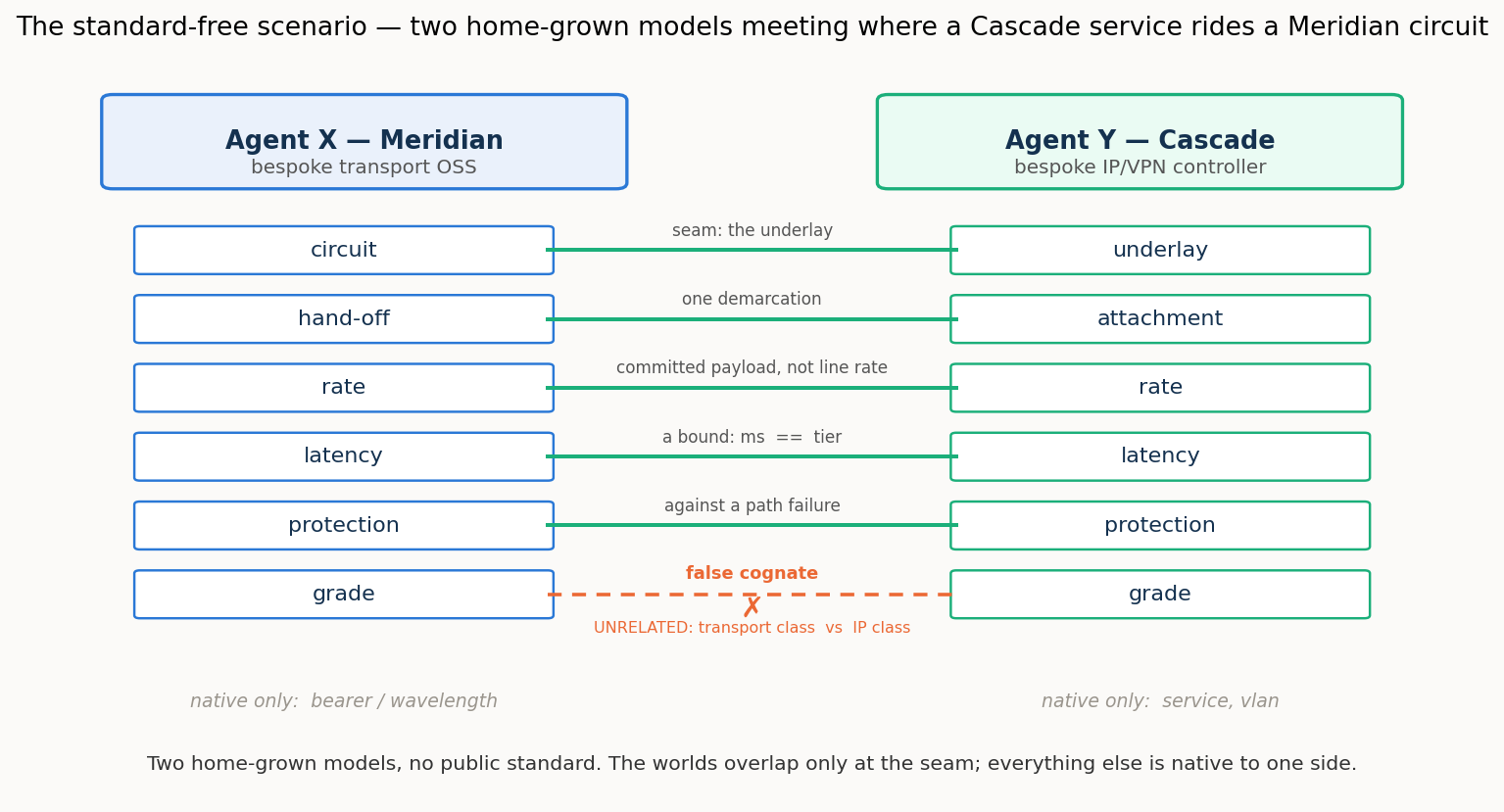
Figure 1. Two home-grown models, no public standard. Five things must be reconciled where a Cascade service rides a Meridian circuit; “grade” looks like a sixth but is a trap; and each side carries native concepts with no counterpart at all.
Follow one order across the boundary. A customer asks Cascade for a service from its New York site to its Frankfurt site (call it SVC-42), committed to 5 Gbit/s, latency no worse than tier T2 (≤ 8 ms), protected. Cascade cannot deliver that itself; the service must ride a transport circuit, so Cascade and Meridian must reconcile the order across the seam. Five bindings have to hold. Meridian’s circuit is Cascade’s underlay: the same object, named from two domains. Meridian’s hand-off at New York is Cascade’s attachment there: one demarcation, two names. And three requirements must be pinned so they cannot be misread across the boundary: the rate is a committed payload (5 Gbit/s), not the circuit’s 100-Gbit/s bearer line rate; the latency is a bound, whether written as a number of milliseconds or a named tier; the protection is against a transport path failure, a fibre cut, not against some IP event.
And one thing must not bind. Both models carry a concept called grade, but Meridian’s grade is a transport protection class (a platinum circuit is dual-path protected) and Cascade’s grade is an IP class of service (gold traffic gets a low-latency queue). Same word, unrelated meanings. Corresponding them would silently mis-provision the service. This is the scenario’s false cognate, and because there is no standard to consult and the two concepts share no structure either, it is nastier than any in-domain trap.
That is the whole reconciliation in one order: five bindings to make, three of them requiring a pin, one look-alike to reject, across two vocabularies with nothing public beneath them.
2. What is on the bench: the schema binding, and the residual it leaves
A full reconciliation between two agents is a staged process. Each side must first lift its implicit model into an explicit one; the two must find or construct a shared reference to talk through; they bind their concepts to it; they pin the ambiguous requirements; they co-refer the specific endpoints; and they verify by a worked provisioning. Cognition is spent across all of these stages. This study does not run that process end to end, and it makes no claim about whether the process closes; that two fully-cognitive agents can close a reconciliation is the programme’s thesis, established across the earlier scenarios and not re-litigated here. What this study isolates is a single, early stage: the schema-level binding, given two already-lifted models, deciding which concept on one side corresponds to which concept on the other.
We measure that binding as an exchange between two live agents: each holds only its own lifted model and a surface catalogue of the other’s, and they alternate turns: asking, answering, proposing correspondences, and ratifying the other’s proposals about their own concepts, so a correspondence is confirmed only when one side proposes it and the owner accepts it. We isolate the binding from the later stages: in this measurement the agents do not construct the shared reference or verify by a worked provisioning; those are held to one side so the worth of the reference-construction step can be read cleanly. The quantity of interest is therefore not only how much they close, but how much they leave in the residual: the correspondences they do not confirm, which pass downstream to the rest of the process, to further machine cognition where the agents are live to continue, or to a person where they are not.
Two variables shape the pass. The first is the cognition spectrum, exactly as in the first two scenarios. At both-cognitive, both sides disclose their lift in full: each concept’s gloss and canonical example are present. At one-inert, one side is a mute snapshot that exposes only its structure and instances, so its meaning must be reconstructed. At both-inert, neither side discloses, and the binding rests on structure alone. The second variable is the shared reference: present or absent. Because the reference in this scenario is not adopted from a standard but constructed by the two agents themselves (categories proposed, each fixed by a canonical example both can instantiate, and agreed), the reference-absent condition is best read not as “the reference was withheld” but as “the reference has not been constructed yet.” It brackets the construction step, so that the gap between reference-absent and reference-present measures precisely what that one step is worth.
One point deserves to be stated plainly, because it is easy to misread. A low result at both-cognitive with the reference absent is not the fully-cognitive process failing to close: it is two careful agents declining to guess across two foreign vocabularies without the shared ground they would themselves construct. They interrogate each other in full and then defer the pairs they cannot be sure of (honest deferral, not error), leaving the worth of that ground in the residual, precisely where the reference-construction step recovers it.
Scope, and a blurry line. The scenario’s reconciliation touches several components: lexical, schema, instance-level co-reference, and pragmatic. This study measures the schema binding, and the line to the others is genuinely blurry at the seam: co-referring the specific demarcation (which physical hand-off is which logical attachment) is instance-level work; pinning a requirement (a committed rate, not a line rate) shades into attribute semantics; the “grade” trap is as much lexical as schema. We measure the schema binding and say so. The instance-level co-reference we bracket: it is the entity-resolution-by-probing of the first scenario’s instance study, it behaves the same way here (the intent scenario’s endpoint phase, which reused that machinery, confirmed as much), and re-running it would largely replicate a known result. The pragmatic component (whose realm owns each shared field) we take up separately (§4).
Correctness is the currency: we report the resolved fraction (of the true correspondences that
exist, the share the pass finds and commits), precision (of the correspondences it commits to, the
share that are correct), surviving false cognates, the residual, and
reasoning effort. The model ladder is the programme’s: a strong model (sol, gpt-5.6-sol), a mid model
(mini, gpt-5-mini), and a weak one (nano, gpt-5-nano).
3. Results
3.1 Without the shared ground, the strong agent defers and the weak one errs
With the reference present, the binding closes cleanly; the strong agent reaches a resolved fraction of 1.0 at both-cognitive with perfect precision (the mid agent 0.70, committing only what it is sure of and deferring the rest at clean precision), and the deterministic reference reconciler confirms the case is fully resolvable in principle. The finding is what happens with the reference absent (the construction step bracketed out), and it is not the shape one might expect (Figure 2).
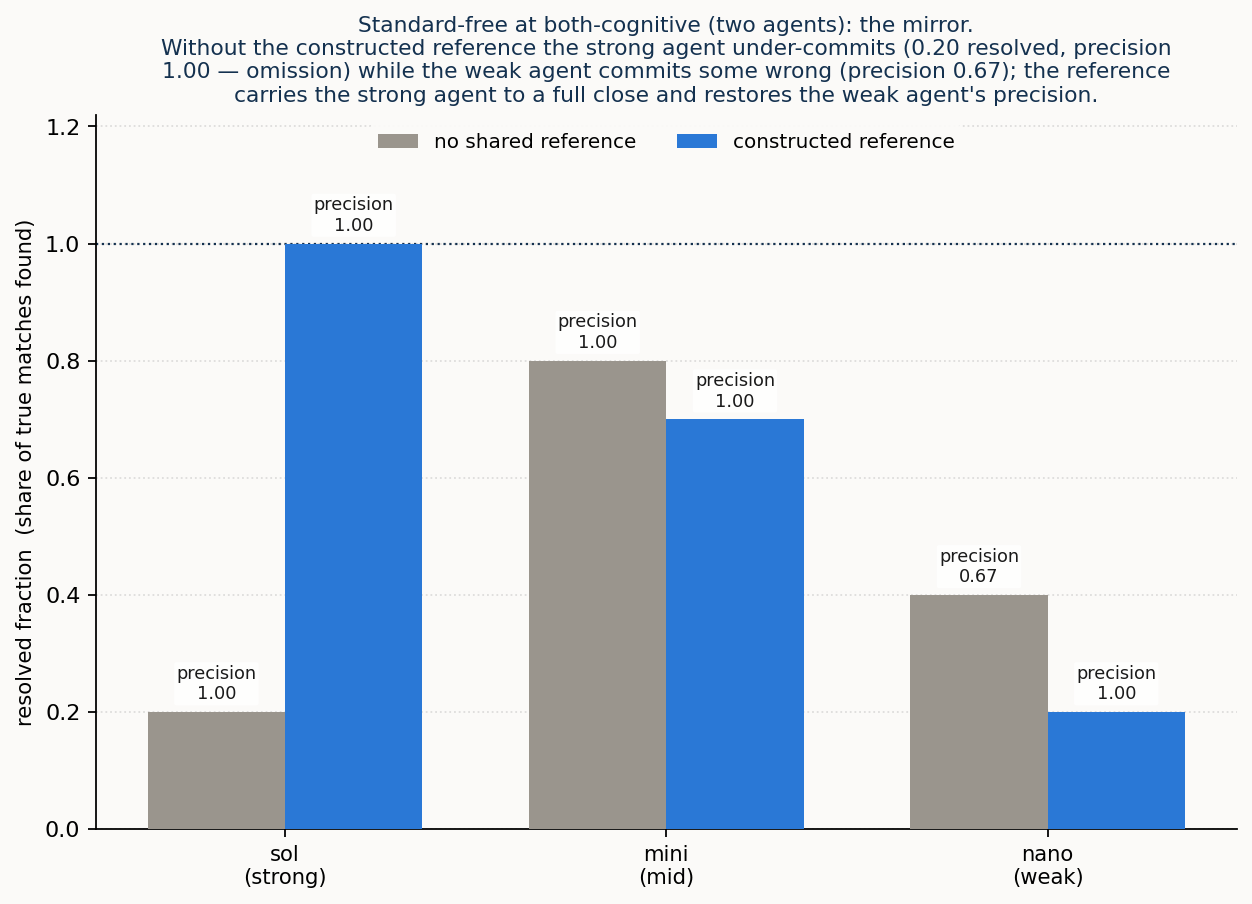
Figure 2. Resolved fraction against precision, averaged over the spectrum, reference off (hollow) to on (filled). Without the constructed reference the strong agent sits top-left: it commits little but everything it commits is right; the weak agent sits lower-right: it commits much of it wrongly. The reference pulls both toward the top-right corner.
The strong agent does not fail; it defers. Negotiating over the two bespoke models with no shared reference, sol interrogates the other side in full and then commits only the correspondences whose surface names already coincide, leaving the foreign-named seam pairs (circuit-to-underlay, hand-off-to-attachment) in the residual: a resolved fraction of 0.20 at both-cognitive, and around 0.4 once a side goes inert, but with precision at 1.0 and not a single false cognate taken. This is omission, not error. Faced with two genuinely foreign vocabularies and no shared ground to bind on, the strong agent declines to guess and hands the unresolved pairs downstream, the fully-cognitive process deferring honestly, not failing to close.
The weak agent’s failure is commission, but where it shows depends on the placement. Where a single agent must reconstruct a side, at the inert placements, nano binds freely and takes the cross-domain “grade” false cognate, its precision never clearing 0.83 and falling to 0.57. At both-cognitive, though, nano cannot bind without its partner’s ratification, so the negotiation refuses its over-commitments: it under-resolves (0.40) rather than mis-commits, and the trap does not survive. Commission is confident wrong binding where the strong agent left silence, but it is a property of a lone reconstructing agent, not of two agents negotiating; mini sits between, closing the seam on its own at both-cognitive and beginning to slip only as a side goes inert.
So the reference-construction step, when it is skipped, costs the two ends of the capability range in mirror-image ways: the strong agent’s cost is a larger residual (deferral) and the weak agent’s is lower precision (error). And a single thin reference repays both. Constructed, it lifts sol’s binding to a full close, and lifts nano’s precision toward 1.0 while pre-empting the trap; it does double duty, supplying the strong agent the ground it needs to commit and the weak agent the discipline it needs to be right.
This is the scenario’s central result, and it is where this case departs from the first scenario. There, the two sides spoke different models, but both were public standards the agents already knew: TAPI on one side, TEAS on the other, two distinct standards, each recognisable on sight. Strong cognition could lean on that public knowledge to bridge them, and bind without an explicit reference. Here, both models are home-grown and private, recognisable to no one in advance, so there is no public knowledge to lean on; the constructed reference is what gives cognition the ground to commit. The programme’s through-line holds and gains a clause: with no public standard beneath the two models, cognition still closes, but only once it has built, or been given, the shared ground, and building that ground is the work. What the reference-absent numbers measure is not a limit of cognition; it is the worth of the one step the binding pass was not allowed to take.
3.2 The mechanism: a thin descriptive toehold, not a shared pointer
If the constructed reference is what lets the strong agent commit, what part of it does the work? A factorial ablation, at the inert placements and with the reference’s identifiers made opaque (so a concept cannot cheat by reading an entry’s name), separates the reference into four descriptive factors (a lexical surface, a class, a definition, and a canonical example) and turns each on and off. The answer is sharper than “the definitions” or “the examples,” and it is the same for the strong agent whichever single factor is present.
| reference content (strong agent, inert) | resolved fraction | precision | surviving false cognate |
|---|---|---|---|
| none (no reference) | 0.50 | 0.93 | 0.17 |
| a bare shared identifier, no description | 0.40 | 0.50 | 0.00 |
| a shared label only | 0.97 | 1.00 | 0.00 |
| a shared class only | 1.00 | 1.00 | 0.00 |
| a shared definition only | 1.00 | 1.00 | 0.00 |
| a shared example only | 1.00 | 1.00 | 0.00 |
Table 1. Reference-content ablation for the strong agent at the inert placement: resolved fraction, precision, and surviving false cognates as each descriptive factor is provided alone.
Two things stand out. First, a bare shared identifier is worse than nothing: given opaque tokens to match on and no description to say what they mean, the strong agent binds by the token and binds wrongly; precision falls to 0.50, below the no-reference floor. The reference does not work through the shared pointer. Second, any single descriptive field is sufficient: a shared label, a class, a one-line definition, or a canonical example, each alone lifts the strong agent to a near-perfect close. They are substitutes, not a stack. The strong agent has the cognition to bind; what it lacks without the reference is any shared ground with meaning in it to bind on, and it converts even the thinnest such ground (a single descriptive category the two models can both point at) into a full commitment. The ad-hoc, by-example reference works because a canonical example is one sufficient form of that ground; but it is the shared description, not the example specifically, that does the unlocking.
The weak agent is a different story, and an honest one: for nano the fields are not interchangeable. A shared label or definition carries most of the precision gain; a shared class alone does nothing (it stays at the no-reference floor); and no single field fully pre-empts the cross-domain “grade” cognate: it keeps surviving a fifth to a half of the time whatever field is present. The reference helps the weak agent, but where the strong agent needs only a toehold, the weak agent cannot be fully rescued by one.
3.3 Effort: the standard-free bridge is dear for the weak agent
The now-familiar effort gradient is, if anything, steeper here than in the earlier scenarios. Reaching its bindings, the strong agent spent a few hundred reasoning tokens; the weak agent spent several thousand (roughly an order of magnitude more) and, without the reference, spent them to land at a precision of one-half. Capability buys economy as well as correctness: the standard-free bridge is cheap for the agent that can build a toehold and dear for the one that cannot.
4. The pragmatic axis: the reference reaches meaning, not authority
The binding settles what two concepts mean. It does not settle whose realm owns a shared field, and provisioning across a domain boundary is only correct if it does. When a Cascade service rides a Meridian circuit, the committed rate, the realised latency, the path protection, and the demarcation are each seen from both domains, and for each there is an authoritative source of truth: the realm that realises the value and whose reading must govern if the two sides disagree. We measured this directly, asking the agent to attribute each shared field to the transport realm, the IP realm, or a co-owned “shared,” and scoring against the realm that in fact owns it.
Three things come out, and they are more textured than the binding result. First, authority attribution is hard and steeply capability-dependent: the strong agent gets it about right, the weak-to-mid models markedly less so, and the characteristic error is a “transport owns everything it carries” bias, attributing to the transport realm fields the IP realm actually owns (its committed rate, its class of service), simply because transport carries the traffic. The mid model shows this strongly and also under-recognises “shared,” rarely naming the demarcation as co-owned.
Second, and echoing the intent scenario exactly, the reference reaches meaning but not authority. The same reference that unlocked the binding does not cleanly help the authority call; for the strong agent it slightly hurt, its service-oriented phrasing nudging attribution toward the IP realm. A reference can pin what a field is (that a rate is a committed payload, that protection is against a path failure), but not whose it is to govern. Where the missing thing is information, the thin reference supplies it; where the missing thing is authority, it does not, and only cognition settles it. That the same boundary appears in two different scenarios (intent and standard-free) is itself worth noting: it is a property of what a reference is, not of one case.
Third, an honest limit of the measurement: one field, the committed rate, is genuinely contested. The transport model says it “guarantees” the rate; the IP model says it “commits” it; both have a claim, and the models split near evenly. We report this as what it is (a field whose authority is legitimately shared or negotiated rather than cleanly owned), not as agent error. Some pragmatic questions do not have a single right answer, and saying so is part of measuring them honestly.
A note on provenance, since it bears on all three points. The realm ownership scored against here is hand-authored in the scenario’s gold, but that is a convenience of measurement, not a load-bearing assumption. A further experiment (§6) shows the same authority is derivable from an external interconnect artefact, lifting even the weaker agents to a correct attribution, and that when two sources disagree on an owner the agents surface the contradiction rather than silently choose one.
5. Discussion
What is new against the first scenario. The first scenario established that cognitive agents can reconcile two structural models ad hoc, and that a thin reference can substitute for cognition on that task, but there both models were public standards the agents recognised. Removing the standard changes the execution in the way this study set out to find. The reference-blind binding, which had a comfortable floor when a standard underwrote the vocabulary, loses that floor entirely: the strong agent will not guess across two private vocabularies and defers instead, and the weak agent guesses wrongly. The thin reference, which in the first scenario mostly improved an already workable binding, here becomes what makes the binding possible at all, and the ablation shows the ground it must supply is minimal but non-zero and must carry meaning: a bare shared pointer will not do. The pragmatic component, held fixed in the first two scenarios, we measured here and found to sit outside the reference’s reach.
The thesis, refined not weakened. It would be easy to read the strong agent’s low reference-absent numbers as “cognition cannot close without help,” and it would be wrong. What we put on the bench was one early stage of the reconciliation (the schema binding), run as a single pass, with the reference-construction step bracketed out. The strong agent’s shortfall in that condition is deferral: it leaves the unresolved bindings in the residual, precisely for the later stages (more agent cognition, or a person) to close. The reference-present condition (the ground already constructed) closes them. So the finding is not a limit of cognition; it is a measurement of how much the one bracketed step is worth, and to whom the unclosed remainder falls when it is skipped. The programme’s claim that fully-cognitive agents close a reconciliation is untouched; what this scenario adds is that, with no public standard, constructing the shared ground is the pivotal act of the close, and that even a very thin ground suffices for a capable agent.
Where this leaves the programme. Three of four scenarios are complete. Between them they have worked the lexical, schema, and instance components, verification, the pragmatic component (across two scenarios now), and the extension of reconciliation across a service’s life. The through-line holds and has sharpened at each turn: it is cognition that completes a reconciliation; a thin reference reaches the information a reconciliation needs and stops at the authority it does not supply; and the fully-cognitive close, standard or no standard, proceeds by building whatever shared ground the parties lack, a step that is itself an act of cognition, and, this scenario shows, a thin one for an agent strong enough to take it.
6. Further experiments
Two further experiments bear on a single question: the worry that cross-domain authority (whose realm governs each shared field, §4) is simply hand-authored into the scenario, an assumption doing quiet work beneath the pragmatic result. They test the two halves of that worry in turn: whether the authority can instead be derived from an artefact the two operators would already hold, and whether, when the sources that would derive it disagree, an agent quietly picks a side. Both run on the same standard-free case as the rest of the report, over the programme’s three-point ladder.
6.1 Authority is derivable from an external artefact, not hand-authored
The first experiment answers this directly. It withholds the authored ownership and gives the agent an external interconnect-agreement artefact instead (SLA clauses stating who owns, realises, and measures each seam field), asking it to derive the authority against a structure-only baseline. Two fields are diagnostic: the committed rate (owned by the IP realm, though transport carries it, so the lure is to hand it to transport) and the demarcation (genuinely co-owned, so the agent must defer rather than invent an owner).
Structure-only, the attribution is steeply capability-gated, exactly as §4 found. The strong agent infers every field correctly (1.00), keeping the committed rate with the IP realm and deferring on the demarcation; the mid and weak agents reach only 0.47 and 0.40, the weak agent taking the transport lure on the committed rate and neither weaker agent deferring on the co-owned field. The external artefact then closes the whole gap: with the interconnect agreement in hand, the mid and weak agents jump to 1.00, the transport lure falls to zero, and every model correctly returns “shared” for the demarcation.
This changes the report’s position on the pragmatic axis. The authored authority gold of §4 is a convenience of measurement, not a standing assumption of the scenario: cross-domain authority is derivable from the kind of artefact two interworking operators would already possess, and the artefact, as with the reference elsewhere in the programme, is worth most exactly where capability is weakest.
6.2 When two sources conflict, the agent surfaces it rather than choosing silently
The second experiment presses the honest-failure question the first one raises: if authority is read off an external source, what happens when two sources contradict each other on who owns a field? It supplies two documents (the interconnect agreement and a transport runbook) that disagree on the committed-rate owner, the runbook reinforcing the same transport lure a weak agent already tends to follow, so silently siding with transport is the natural failure. The correct behaviour is to report a conflict, not an owner.
Every model does. Across the whole ladder the committed-rate conflict is flagged in every trial (1.00), no model silently defaults to transport (0.00), none confuses the genuine source conflict with the co-owned demarcation (still correctly reported as “shared”), and none over-calls conflict on the four single-sourced fields (no false conflicts). The weak agent that did take the transport lure under a single implicit source in §6.1 surfaces the contradiction once a second source makes it explicit.
This is the reassuring counterpart to the first experiment: where the disagreement is visible in the evidence, the failure one might fear (an agent quietly inventing an owner when its inputs disagree) does not occur. The caveat is honest. The contradiction here is explicit, two clauses plainly asserting opposite owners, so the result says agents catch an obvious conflict; a latent conflict, where two sources disagree only by implication, is the sharper follow-on and is where a capability gradient, absent here, would be expected to appear.
7. Threats to validity
The case is seeded rather than sampled (built to exercise the mechanism and prove the trap, not drawn from a population), so it establishes how the standard-free binding behaves and why, not how often.
To check that the one case above was not, unintentionally, built in a way that makes the point come out
right, two further standard-free cases were constructed from scratch: a private radio-access management
system meeting a private mobile-core controller at the user-plane transport seam (config_xdom_ran),
and a private data-centre fabric meeting a private overlay controller at the VLAN-to-VNI seam
(config_xdom_dc). Each is a fresh pair of home-grown vocabularies with no shared standard between
them, the hardest of the four scenarios. The signature finding here is a mirror: given no shared
reference, a strong agent under-commits (it binds only what it is certain of and refuses to guess
the rest, so of the matches it commits every one is right but it finds only some of the true matches)
while a weaker agent over-commits, binding freely and taking a look-alike, so it finds more but
commits wrong ones; a small constructed reference then repairs both: lifting the strong agent’s close
and disciplining the weaker agent’s precision.
That mirror reappears on both new cases. Without a reference the strong agent holds perfect precision
but finds only 0.40 of the true matches on the RAN-to-core seam and 0.20 on the fabric-to-overlay seam
(correctly declining to guess a seam it cannot be sure of), while the mid agent commits more and gets
some of it wrong (about 0.80 precision and 0.80 resolved fraction on the RAN seam). Adding the
constructed reference takes the strong agent to a full close on the fabric seam and to 0.80 on the
harder RAN seam, and the given reference closes both fully. So “strong agents omit, weak
agents commit, and a thin shared reference fixes both” is a property of the mechanism, not of the one
original case. (All three cases are the same author’s hand-built constructions, so this shows
robustness to variation, not yet to real network data, which only carrier collaboration can supply.)
The central measurement is the single-pass schema binding, and the reference-absent condition brackets the construction step rather than running the full construct-then-bind protocol; the full protocol (the two agents constructing the reference themselves and then closing, with no reference pre-given) is also run, and it confirms the thesis in this hardest scenario: the strong agent lifts from 0.20 to 0.80, and to 0.90 when the agents also run a decisive virtual experiment. The core ladder is three points; the shape of the capability gradient between them is filled in by a six-model sweep at both-cognitive (master report §13.2, Figure 8), the standard-free mirror included. The pragmatic gold is largely clean but includes one field (committed rate) whose authority is genuinely contested, reported as such. And the instance-level co-reference is bracketed, not measured, on the argued grounds that it reproduces the first scenario’s result; that argument rests on the intent scenario’s endpoint phase and on the shared mechanism, not on a standard-free instance run.
One further check bears on who performs the lift here. These models, like the others, are reconciled over a materialised lift; re-running with the lift produced by an agent from each side’s schema surface alone leaves the reference-bound close unchanged: the strong agent reaches a full 1.00 through the constructed or given reference on the agent-produced lift, exactly as on the fixture. The construct gap is where the agent-lift is most exposed: with no reference at all the strong agent’s own glosses led it to commit one pair at the floor (where the fixture defers, resolving 0.20), and the mid agent took the grade look-alike its fixture avoided, the same weak-end over-commitment the mirror describes, now visible in the lift as well as in the bind. The full cross-scenario table is in the master report (§13.8).
8. Reproducibility
The bespoke standard-free case (two lifted models, the constructed reference, the derived gold), the single-pass binding harness and its reference-blind and reference controls, the factorial reference ablation, and the pragmatics stack and its gold are in the repository, with the recorded per-model results. The build and the offline checks run with no API and no network; the runs are launch-and- leave commands, segmented by wave and resumable. The figures are regenerated from the recorded CSVs.