ad-hoc-semantic-reconciliation
Portable semantic models and ad hoc reconciliation by cognitive agents
Programme abstract: Two software systems that must exchange information rarely fully share a model of the world, and the classical answer, to agree a common standard in advance, is expensive, slow, and permanently behind the systems it governs. This programme asks what changes once the systems can reason. Its central object is the portable semantic model: a model lifted from a system’s data so that any sufficiently-reasoning agent can pick it up and use it from the package alone, with no pre-agreed standard. Part 1 defines portability and shows how a lift produces it. How well that production succeeds depends on where the cognition sits: a live source that describes itself, an inert one reconstructed by an agent, or a human. Part 1 also treats the reference as a common-ground anchoring device on two independent axes: how critical it is, and where it comes from. It then measures portability directly. A solid lift is comprehensible to strong, middle, and even weak reasoners, across six cases and across model families, softening only for the weakest reasoner on the hardest material. A meaning-poor surface is the one thing that breaks it; a reference used in the lift is the repair. Part 2 takes up reconciliation: aligning two independently-built models of an overlapping domain so the systems can interoperate. It is a flagship use of portable models, and bridging the divergence between the two is the work. Its difficulty is set by two independent things: the divergence between the two models, which only cognition bridges; and any shortfall in either lift’s portability, which adds burden by leaving meaning for the other side to reconstruct. It maps the space of divergences, then measures reconciliation in four operational scenarios of network and service management (configuration, intent, standard-free provisioning, observability), scoring every outcome against a validated gold standard while varying the live cognition on the two sides from both, through one, to neither. The through-line the scenarios establish is one thesis: cognition is what closes a reconciliation. It bridges the divergence that matching on names and descriptions alone cannot. A thin reference can partly stand in for that cognition, and can supply the facts an inert side can no longer provide, but never the authority to decide whose value governs when two sides conflict — the one decision that stays with a human.
Part 1: The lift, and the portable model it produces
1. The burden, and a question worth asking
Two software systems that must exchange information rarely fully share a model of the world. The scope a model must cover is not fixed, the useful level of abstraction depends on the task, and capable engineers, working independently, produce different but defensible models of the same network. The classical remedy is a standard model agreed ahead of time: everyone adopts one vocabulary, and the reconciliation is done once, by committee, before the systems ever meet. That remedy is expensive, slow, and permanently behind the systems it tries to govern — a standards quest that never quite ends, because the world it models keeps moving.
So it is worth asking a question that, until recently, would have sounded absurd: do two sufficiently capable systems need a data model agreed in advance at all — or can they produce a suitable one themselves, for the occasion? The question is not whether models stop mattering. It is whether the pre-agreement — the part that is slow and expensive — is still required or useful once the systems on each side can reason.
This has to be asked with both feet on the floor. The installed base is enormous and mostly inert: decades of systems that cannot explain themselves, data of mixed and often poor quality, and high-reliability operations that must keep working in all circumstances. Nothing here proposes ignoring that. The claim this programme investigates is narrower and, we will argue, more useful: that production of a shared understanding, and agreement upon it, can increasingly be done ad hoc — between the systems, for the task at hand, machine-to-machine — lifting the pre-agreement burden while coexisting with the legacy it cannot replace. The answer we reach is yes, with real qualifications — and those qualifications are the substance of what follows, not a hedge on it.
Everything in Part 1 is about the object that makes an affirmative answer possible: a semantic model that can stand on its own. We first say precisely what “stand on its own” means, then how such a model is produced, then whether it actually holds up when handed to a cold reader. Part 2 takes up the hard case — two such models that must be made to work together — the flagship use of the object Part 1 produces.
2. What would it mean for a model to stand on its own? Portability
The concept at the centre of the programme is portability, and it is worth defining before anything else, because everything downstream is either its production, its measurement, or its use.
A lifted model is portable when any agent of sufficient reasoning power, but without prior knowledge of the particular system or schema, can make arbitrary use of it without seeking clarification that does not lie within the package. The package is what the model features directly, together with any reference it resolvably points to; live parts (current values, present state) may need refreshing.
Four things in that definition carry weight, and each draws a boundary that recurs throughout the programme.
Portability is monadic — a term we use in its strict sense, a property that belongs to one thing on its own (as opposed to a dyadic property, a relation between two things). Portability is a property of one lifted model, produced by one lift. Model A is portable if an arbitrary cognitive agent can comprehend and use it; that is true or false about A on its own, before any second system exists. Testing it needs a consumer, but the consumer is any separate agent brought in only to probe A — a planner, an auditor, a human — not a peer that also carries a model. This matters because it locates the primary object. The two-system dance of reconciliation is a downstream operation; portability is what each side brings to it.
No prior knowledge of this system is what keeps the definition from collapsing into circularity. A sufficiently-reasoning agent derives the model’s meaning from the package; it does not check the model against pre-held concepts of this system or schema, because it holds none. It still brings the general conceptual competence a capable reader has — the domain notions it already holds, and its ability to interpret the concepts the package supplies — but not prior familiarity with the particular system being lifted. The bar is a reasoning threshold, universal above it, not a store of insider familiarity. This is what ad hoc means — an understanding built to purpose, for the case at hand — restated as a property: no pre-shared standard is required, only a competent reader.
The bar on clarification from outside the package carves off what portability does not cover, and there are two such things — both matters of decision, not of meaning. Updating a value the package already declares — reading a live counter, refreshing present state — is not external clarification; a portable model can have live parts. But two kinds of question lie outside any package. One is an authority fact — whose right it is to set a contested value — a matter of governance, not of what the model means, which stays where the owning authority lives. The other is a genuine underdetermination — a question no fact anywhere settles, whose answer must be stipulated rather than recovered. Neither is a meaning a sufficient reasoner can derive. The frame has a clean edge: self-sufficient for what a model means and how to use it, and rightly not self-sufficient for what must be decided — who governs a value, or what no fact determines.
The payoff of defining portability this way is that it changes what capability means. Whether a reader can use a model stops being a fixed fact about the reader and becomes something the lift can move: a good lift makes each concept self-describing, which adds no knowledge to the reader but lowers the reasoning it must bring to use the model. A self-describing package is usable by a modest reasoner; a bare one demands a strong reasoner to reconstruct the meaning — and, as the measurements will show, a middling reasoner will confabulate it. The better the lift, the less reasoning the consumer must supply.
Much of that lowering is done by one mechanism, and because it recurs from here on it is worth naming now: a reference. A reference is a small, shared vocabulary of common ground — a flat set of entries a lift can tie its local terms to, anchoring each term to something a competent reader already holds. That anchoring is how a lift lowers the reasoning threshold without adding knowledge: the reader recognises the common ground rather than reconstructing the meaning. A reference is deliberately thin, and it anchors rather than standardises — it is not the universal model-agreed-in-advance the approach exists to avoid. §5 develops how critical it is and where it comes from; its role is already in play in the examples that follow.
3. How is a portable model produced? The lift
Portability is produced by the lift (Figure 1).
A system usually holds its content as a data model: a schema and its records as they sit in a
database or a controller. That content is already a partial semantic picture, but a fixed one, frozen
by the format it uses: a field named och_grade with values 1, 2, 3 is legible to the software
and engineers built around its schema, yet says nothing, on its own, to a consumer that was not told
what it means; the meaning lives in a specification and in shared convention, outside the data itself.
The lift is the move from that to a semantic model: the same content given grounded, explicit
meaning, structured as three parts. First, an ontology, which includes its lexicon: a
schematic layer (the concepts, their kinds and relations, and their preferred labels and any synonyms) and a concrete layer (the individual instances that populate those concepts). Second,
pragmatics: the contextual information a consumer needs (what a thing is for, whose authority
governs it, in what context it holds). Third, provenance: who asserted each part, by what method,
and how firmly. The lift itself is a cognitive act, helped along by a few supports that are
aids to that cognition rather than parts of the model: definitions, worked examples, a canonical
example, and an optional link to a shared reference. Who performs that cognitive act — and what
happens to the lift as the available cognition shifts — is a spectrum in its own right, the
lift-cognition spectrum, taken up in §4.
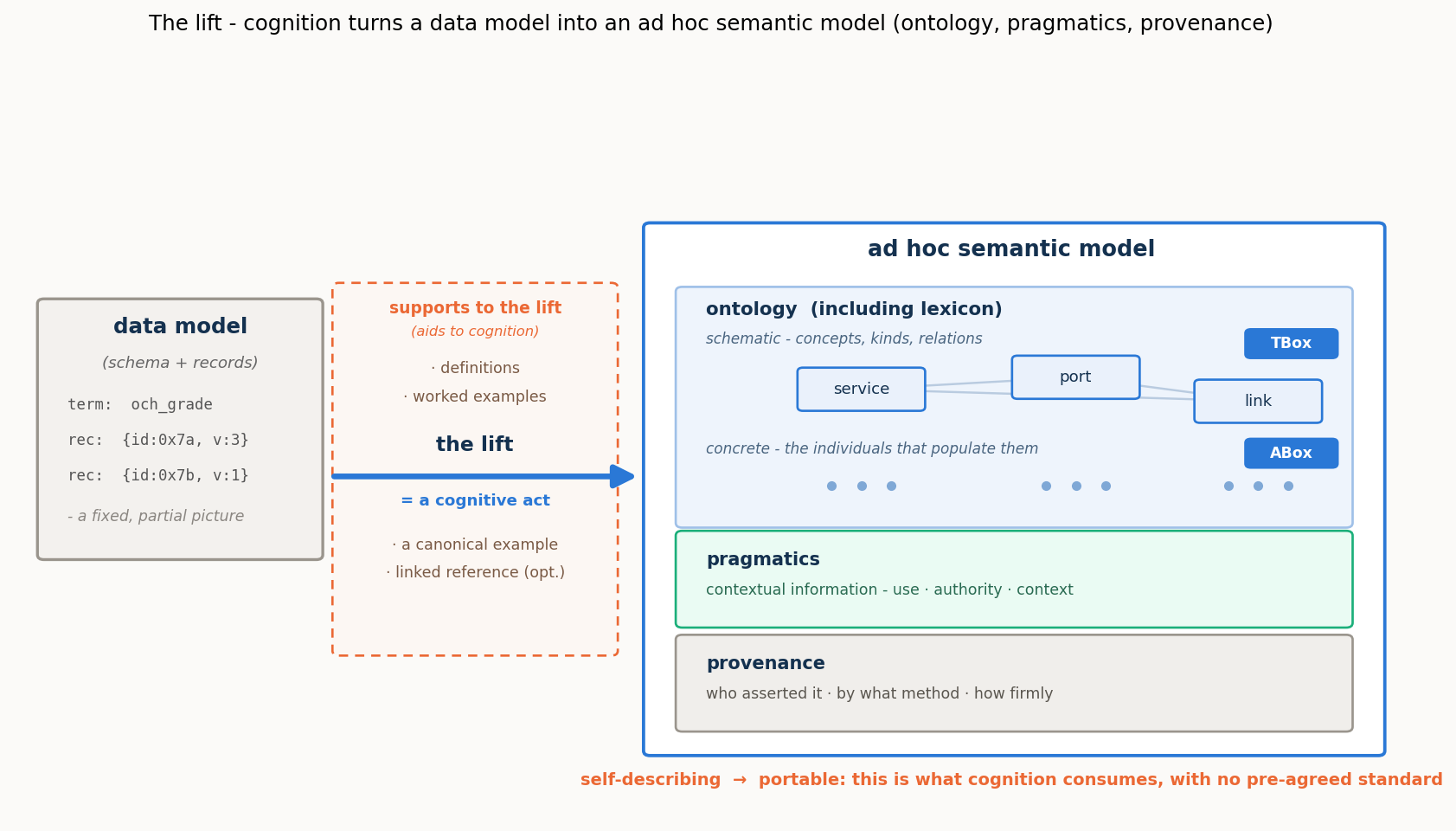
Figure 1. The lift. A data model (schema plus records) is a partial semantic picture, fixed by its format, with much of its meaning left implicit: in specifications, convention, and the engineers who built around it. The lift is a cognitive act, aided by a few supports (definitions, worked examples, a canonical example, an optional linked reference), that turns the data model into an ad hoc semantic model built from three parts: an ontology including its lexicon (a schematic layer of concepts, kinds and relations, the TBox, and the concrete instances that populate them, the ABox), pragmatics (use, authority, context), and provenance. Being self-describing, the result is portable: any cognitive consumer can pick it up and understand it, with no pre-agreed standard.
A lifted semantic model is self-describing, and being self-describing is exactly what makes it portable: it lets any cognitive consumer — this agent, another agent, a human — pick it up and understand it without a prior agreement. That is not a convenience; it is the precondition for the whole approach. Every cognitive use of a model — reasoning over it, planning with it, auditing it, reconciling it with another — requires meaning made explicit, and the lift is how meaning is made explicit on demand rather than by standardisation. Reconciliation, the subject of Part 2, is one such use; the scenarios that follow also refine an intent against a catalogue and read an anomaly for its significance, all over the same lifted substrate. Get the lift right, and the rest is operations over portable semantic models.
To make this concrete, here is one of a lifted model’s concepts, the TAPI connectivity-service from the flagship configuration case (a model is the list of such concepts under a short header). It is shown as a composite of the complete lifted semantic model — carrying, for illustration, the per-concept pragmatics and provenance that the running benchmark record holds more separately — not as a literal case-file entry:
{ "id": "t.cs", "label": "connectivity-service", "kind": "service",
  "synonyms": ["service"], "ref": "connection-service",
  "gloss": "an end-to-end connectivity service across the network",
  "example": "the A1-A3 ODU2 service",
  "relations": [ {"rel": "uses", "target": "t.sip"},
                 {"rel": "realized-by", "target": "t.cep"},
                 {"rel": "over", "target": "t.topo"} ],
  "instances": ["cs-a1a3-odu2 (ODU2, A1 to A3)"],
  "pragmatics": { "use": "the billable, SLA-bearing unit of connectivity",
                  "authority": "owned by the service layer; the transport side may not redefine its grade" },
  "provenance": { "asserted-by": "the ONF TAPI controller", "method": "context export", "firmness": "authoritative" } }
Figure 2. One lifted concept: the TAPI connectivity-service, shown as a composite of the complete lifted semantic model — lexicon and ontology, the concrete instances, the pragmatics and provenance, and the reader supports (gloss, example, reference).
The fields carry the lexicon (label, synonyms), the ontology (kind, relations), the concrete layer (instances), the pragmatics (use, authority), the provenance (who asserted it, by what method, how firmly), the explanation supports (gloss, example), and the binding to a shared reference (ref). A live side volunteers the meaning-bearing fields — gloss, example, and pragmatics; an inert side exposes only the structural ones, and its provenance and authority must be supplied from outside. The structural content is independent of its serialisation: the lexicon, ontology, and instances shown here as JSON map just as readily to OWL/RDF, provided an explicit schema or JSON-LD context supplies the distinctions — literal versus identifier, class, typed relation — that plain JSON does not carry by itself; that mapping is also how a deterministic pipeline that compiles a formal schema (such as YANG) to an ontology carries them. The meaning-bearing content our JSON concepts also carry — the pragmatics and provenance, and the glosses and examples that make even the ontology readable by a stranger — is what such a compiler cannot supply, because a formal schema does not contain it; and, as §8 shows, even a full ontology format holds the pragmatic layer only as a description to be resolved by a cognitive reader, not as something a deductive reasoner can act on.
Producing these fields is not transcription; the lift generates. It writes a gloss where the surface
gave none, states in the open what a bare schema left implicit (a field och_grade valued 1, 2, 3
becomes an explicit account of what the grade is and what governs it), infers relations never explicitly
typed, and articulates the pragmatics a live side would otherwise hold only tacitly. That the produced
glosses share little wording with any authored source yet carry the same meaning — §19.8 measures a
lexical fidelity of 0.13 to 0.23 — is the signature of generation rather than copying. The licence to
generate is bounded, and the bound is the difference between grounded generation and
confabulation: a gloss synthesised from structure, instances and live state, and checkable against
them, against a sense invented for a bare name with nothing under it, the failure §6 shows a
name-without-meaning invites. The lift may produce what it can ground; past that it must read the fact
from the system, or leave it to the residue.
One framing connects this work to a fast-growing body of practice. The ontology and the individuals that populate it are, together, a knowledge graph: the ontology is its schema (the typed concepts and the relations permitted among them) and the instances are its assertions. This is why the community’s knowledge-graph work for network operations, and the AI-facing modelling interfaces now emerging, meet this approach squarely: a lifted semantic model contains a knowledge graph a machine can consume — its ontology and instances — and a thin shared reference is exactly the kind of interoperable anchor such graphs can bind to. What the semantic model adds beyond the bare graph is the pragmatic layer and the provenance base — and, as the findings will show, exactly the facets a thin reference cannot supply on its own.
4. The lift is a cognitive act — where that cognition lies, and what limits it
Calling the lift a cognitive act forces the question of whose cognition performs it, and what happens to the lift as that cognition thins. This is a spectrum on the production side — the lift-cognition spectrum, distinct from the reconciliation spectrum that governs Part 2 — and it decides both how the lift is done and how far it reaches.
At the richest end, the source system is itself live and cognitive and lifts itself. It authors its own meaning — volunteering glosses, worked examples, the intent behind a field — because it is the authority on what it holds. A self-lift depends least on anything outside it: the meaning is put in at the source, by the party that knows it.
Where the source is inert — a mute schema and its records, unable to explain itself — the cognition must come from a machine agent that reads it, reconstructing meaning from the surface: labels, kinds, structural relations, and instances. This is not hypothetical. §7 has an agent produce the lift from the schema surface alone, and a capable reader recovers a portable model from an inert source; the downstream reconciliation results are unaffected by who performs the lift (§19.8). But this reading is bounded by what the surface carries, and §6 measures that bound directly — as the surface goes meaning-poor, the portability of the recovered model falls, and, in the sharpest form of the finding, a surface that keeps a concept’s name but not its meaning is no safer than an anonymous one, because a bare name invites the reader to confabulate a sense for it.
At the far end — wherever machine cognition is absent, insufficient, or facing a question it cannot settle — a human performs or completes the lift, as engineers have always modelled systems by hand. That human-completed part is the same residue §2’s definition carved off, now seen on the production side, and it has two natures. Most of it is a capability gap: work a given agent cannot do that a stronger one could, so it shrinks as the cognition performing the lift grows. The rest is irreducible — it never leaves the human at any capability — and it is exactly what §2 set outside the package: the authority to set a contested value, and any genuine underdetermination no fact can settle. Those are not meanings to be recovered, so no lift, however capable, reaches them.
The through-line is a single limit: the lift recovers as much meaning as the cognition performing it can bring to bear on the material in front of it — abundant when a live source explains itself, ample when a strong agent reads a rich surface, thinning as the source goes inert, the surface goes meaning-poor, or the agent goes weak. Where the recovery falls short, the shortfall must be supplied from somewhere. Ideally that somewhere is the reference — and wherever a reference cannot supply it and a human must, the automation of the lift is to that extent incomplete.
The two axes of cognition, and the placement hand-off
Two variables sit underneath this section, and separating them makes the placement of cognition precise. The first is access: whether the cognition is situated, able to consult the running system, its instances, its live state and the modeller’s intent, or un-situated, holding only the published artefact. The second is product: whether the cognition forms an internal understanding for its own use, or externalises a self-standing artefact for others to consume. The lift is the situated-and-externalising corner; the remaining three corners are equally real, and laying them out on these two axes (the quadrangle, Figure 3) locates the lift against them.
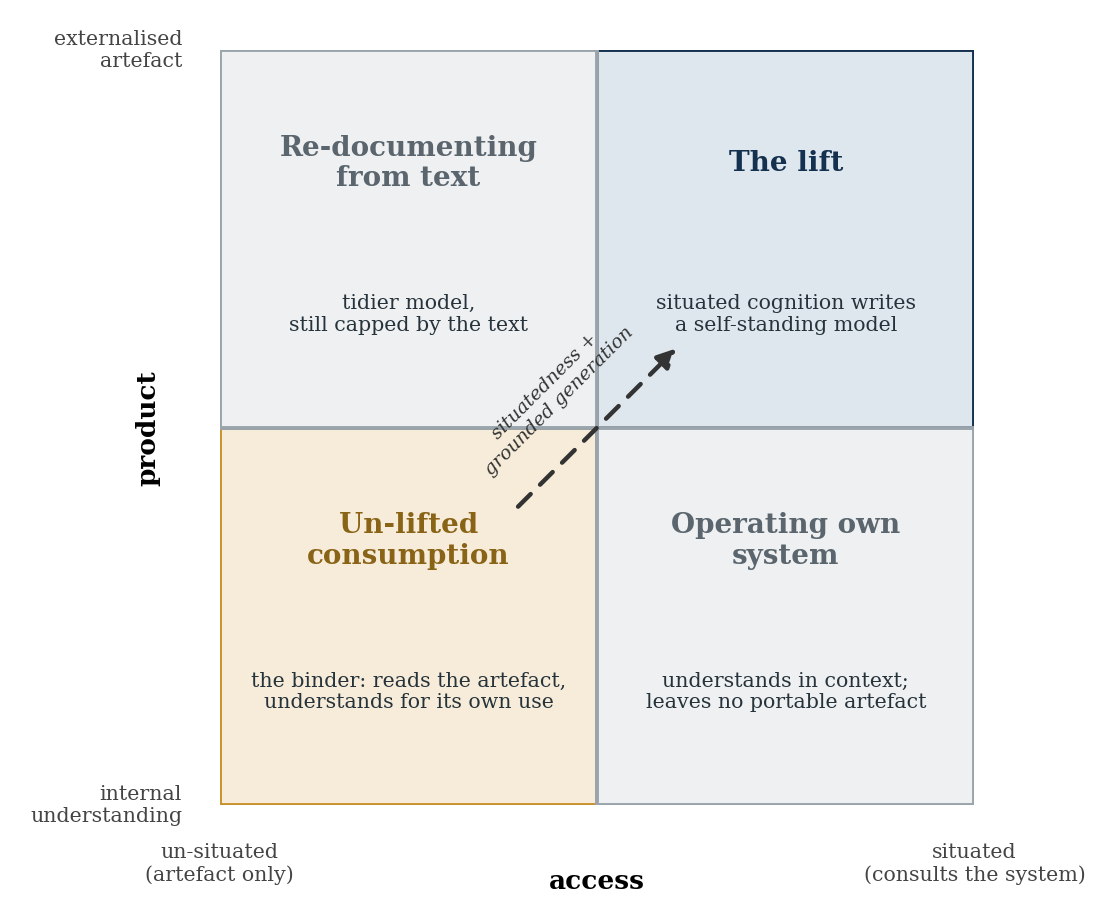
Figure 3. The quadrangle. Access (can the cognition consult the system, or only the artefact) against product (does it keep its understanding internal, or externalise a self-standing model). The lift is the situated-and-externalising corner. Un-lifted consumption is the un-situated, internal corner: a reader that has only the artefact and understands it for its own use — and, run over a model that was never lifted, a direct measure of that artefact’s portability without the lift. The other two corners isolate each half: a situated cognition that does not externalise is an agent simply operating its own system, understanding in context but leaving nothing portable behind; an un-situated cognition that does externalise is re-documentation from the text, which can tidy and normalise but stays capped by what the text already holds.
The diagonal is the point. At one corner an un-situated cognition reads a static artefact and understands it for its own use; at the opposite corner a situated cognition writes the meaning down so that such a reader succeeds. What the lift adds along that diagonal is two things at once: access, the situated reach into the system, and grounded generation, the writing-down of what it finds (§3). A companion synopsis in this repository frames the un-situated corner directly — an agent binding published YANG descriptions to a thin reference, with no lift — and it is useful precisely as the un-lifted baseline against which the lift’s value is the distance travelled up the diagonal.
This reframes §4’s limit as a cleaner claim. The place a static artefact defeats an un-situated reader, the fact its text never records, is most often not a true frontier but a missing-lift gap: the fact is present in the system, and a situated lift reaches it. The genuine residue is smaller, and is exactly what §2 set aside — the authority to set a contested value, and any underdetermination no fact settles, recorded nowhere and reachable by no lift. So what a concept needs partitions in three: what is implicit but present, made explicit by grounded generation; what is present but elsewhere in the system, supplied by situated access; and what is neither, the residue, referred to a person.
The quadrangle and the two spectra are complementary, and it is worth saying how they meet. A spectrum grades one of the quadrangle’s two axes, access: where the quadrangle asks a yes-or-no question, situated or holding only the artefact, a spectrum makes it a dial and splits it per participant. The lift-cognition spectrum above runs down the externalised row, from self-lift (situated) to an agent reading an inert surface (un-situated); the reconciliation spectrum of §13 (both-cognitive, one-inert, both-inert) is that same access axis applied to the counterpart rather than to oneself. What neither spectrum has an axis for is the quadrangle’s other dimension, product — externalise a self-standing model, or keep the understanding internal — and that is exactly the distinction that separates the lift from mere comprehension. So the two do not collapse: the quadrangle names which cognitive act is being performed and whether it leaves anything portable behind; a spectrum grades how far that act reaches as cognition recedes, along the access axis they share.
5. The reference: how critical it is, and where it comes from
A reference, introduced in §2, helps supply the meaning a lift cannot recover on its own. What it is matters: not a reconciliation device but a common-ground anchoring device — it ties a model’s local terms to ground a competent reader already holds, useful to any consumer, not only to a second model. It is deliberately “thin”: a flat set of entries, each an identity anchor plus a few descriptive fields (a label and synonyms, a shallow class, a one-line definition, a canonical example). It has no ontology of its own — giving it one would turn it back into the universal standard the approach exists to avoid — and a bare identity pointer carries no usable meaning by itself: the reference works through its descriptive content, tying a model’s terms to common ground the reader already holds rather than restating the domain in full. That is exactly why it can be thin. Two independent things about it then matter, and conflating them invites confusion: how critical it is, and where it comes from. The figures this section cites are results established by the measurements that follow — portability in §6, the reconciliation cases in Part 2 — pointed forward as they arise.
How critical it is — and this tracks the lift-cognition spectrum of §4. The reference is not uniformly important; its criticality is highest exactly where cognition is weakest. When a strong agent lifts a rich source, the model comes out self-describing and the reference is nearly redundant — the baseline in §6 shows a solid lift staying portable with the reference not available at consumption. When the source is inert or its surface is meaning-poor, the reference becomes the thing that makes the lift portable at all — §6’s degradation result has a reference used in the lift pulling a broken lift’s meaning score (§6’s comprehensibility measure) from 0.64–0.74 back up to 0.79–0.85, against a solid-lift baseline of 0.94. The same shape appears on the consumption side across the reasoning ladder: a strong reader needs no glossary, a weak one is rescued by it. One anchor, its value concentrated wherever the cognition around it runs thin.
Where it comes from — a second, independent spectrum. A reference may be pre-existing — an authored standard taken off the shelf — or constructed by cognition as part of the lift itself, where no standard exists (the construct-then-bind result, §19.6), with a possible middle ground of adapting or extending an existing reference to fit. That cognition can manufacture common ground at all is not mysterious once portability is the frame: common ground is not a formal shared ontology but what competent agents already hold in common — both sides reconciling transport-network models, for instance, already share the notions of a bearer, a committed rate, and a protection scheme, even when their own models name them differently. This is also why anchoring is capability-independent where live elicitation — drawing meaning out of a party by questioning it in real time — is not: anchoring meets a reader where it already stands, while elicitation demands the cognition to ask the right questions and read the answers. And it is why the constructed reference is load-bearing precisely in the standard-free scenarios, where there is nothing on the shelf to reach for.
When it acts brings the two spectra together, and here one apparently natural case drops out. A reference can act at production (used by the lifter, while the model is built) or at consumption (handed to the reader alongside the finished model), giving three meaningful conditions — no reference at all; a reference used in the lift only and not available at consumption; and a reference in the lift and at consumption. The fourth (a reference handed to the reader at consumption but never used in the lift) adds nothing where it matters. Using it means the reader must work out for itself how the raw, unimproved model maps onto the reference, and only a strong reader can do that. But that reader could already read the raw model with no reference at all, so a consumption-only reference helps only those who did not need help. A reference earns its keep at production. This sharpens the portability criterion into something testable. A good lift makes each concept’s meaning recoverable without reaching outside for it — it can dissolve the reference into each concept’s own description, or point to a reference that is itself accessible; either way nothing needed goes missing. A poor lift leaves dangling pointers — bare tokens with no meaning recoverable behind them — that go slack the moment the reference is absent. The middle condition — the model comprehensible with the reference used in the lift but not available at consumption — is the clean test of the self-contained form: proof that meaning was baked in rather than left hanging. It is the measurement Part 1 takes up next.
The reference plays two roles, not one. To a single consumer it supplies meaning — the monadic, portability role, the one a good lift can dissolve away. To a pair of models being reconciled it is also shared common ground: when both anchor to the same entry, their correspondence becomes directly derivable — a dyadic role, on the divergence axis of §10, that good lifting does not dissolve and that matters most where cognition is weak or the models diverge sharply. Because of this, dissolving the reference away is an option, not an obligation: a self-contained model and a model that points to an accessible reference are equally portable, the portability criterion requiring only that nothing a consumer needs is out of reach. So a producer who could fully dissolve the reference for a strong solitary reader may still ship or point to it deliberately, to serve downstream uses it cannot foresee — a weaker consumer it rescues, a reconciliation it makes cheap. Portability is achieved either way; the shared reference simply buys more.
6. Does it actually work? Assessing comprehensibility
A claim that lifts produce portable models is empty unless portability can be measured directly, decoupled from any downstream use. It can, and the rest of this section is the evidence.
The instrument. We turn the definition into a measurement by assessing comprehensibility: the share of a model’s concepts that an independent agent can correctly explain from the package alone. One lifted model is handed to a consumer agent of a specified reasoning tier that did not author it and holds no insider knowledge of the system. The consumer explains each probed concept in its own words; it is explicitly permitted to answer that it cannot determine the meaning from what it was given, because an honest abstention is a desired response, not a forced guess. A fixed strong judge, one model held constant across the study, grades each explanation by meaning, not wording against an authored answer key. It returns one of four verdicts:
| Verdict | What it means |
|---|---|
| faithful | captures the true meaning |
| partial | right direction, but hedged |
| abstained | the consumer declared the meaning could not be determined from the package — a virtue when the meaning is genuinely absent, not a failure |
| invented (confabulated) | the consumer states a meaning the authored answer key marks incorrect; the common example is accepting a planted false cognate. This is the failure the confabulation_rate counts. |
Table 1. The four verdicts the fixed judge returns when grading a consumer agent’s explanation of a probed concept, by meaning rather than wording.
From the
per-concept verdicts we report three fractions: meaning_score (fraction faithful — the
comprehensibility measure), abstention_rate (honest deferral), and confabulation_rate (the
hazard). The consumer runs across a reasoning ladder — a strong (gpt-5.6-sol, sol), a mid (gpt-5-mini, mini), and a
weak (gpt-5-nano, nano) model, three tiers of a single family (OpenAI’s gpt-5.x line) — chosen
to isolate reasoning strength rather than provider or architecture. The
full protocol, ground-truth authoring, and worked examples are in the methods section.
The findings below are stated once as headlines, then supported. Read the headlines for the story; the paragraphs beneath carry the evidence.
A solidly lifted model is almost always fully comprehensible from the package alone. Comprehension is perfect for a strong reader everywhere, and for every reader on routine material; it softens only for weaker readers on the hardest material, and even there it never collapses.
On a solid lift with no reference at consumption, meaning_score across the ladder is near the ceiling
and softens only on the hardest material: on the cross-domain seam (concepts from two unrelated domains, with no shared vocabulary to lean on), sol 1.00 / mini 0.87 / nano
0.73; on the large, deliberately hard case, 1.00 / 0.94 / 0.89; on the routine case, 1.00 / 1.00 /
1.00. Even the weak reasoner comprehends a good lift from the package alone — perfectly on routine
material, around 0.9 on hard material, softening to 0.73 only on the very hardest. Portability holds
nearly capability-independently, a soft gradient on hard material rather than a cliff. The consumption-
time reference, added on top, is a small and capability-dependent top-up exactly where the bare lift
fell short (cross-domain mini 0.87→1.00, nano 0.73→0.93) and does nothing where the lift already
sufficed. The reference did its real work at lift time.
The result holds across six independent cases, not one.
The same assessment run over three further scenarios — carrier-Ethernet service, fault/observability, and L3VPN — returns bare meaning_score 0.98 and anchored 1.00 in every one, with confabulation near zero, matching the original three. “Solid lifts are portable” rests on six cases spanning configuration, standard-free, and observability, not on a single worked case.
Portability is not an artefact of one model family — it tracks reasoning, not lineage.
The most direct objection to a within-family result is that a model is simply reading its own kind of output. To close it, we held the judge fixed on the original family and varied only the consumer’s family. A strong consumer from another family (DeepSeek) comprehends the same lift cold — bare 0.98, anchored 0.96, confabulation near zero — matching the in-family strong tier and beating the in-family weak tier’s bare 0.87. An open weak model (Qwen-2.5-7B) does markedly worse — bare 0.56, anchored 0.69 — and confabulates: its per-trial scores are bimodal, either nailing a case or missing it entirely. That contrast is the point, not an embarrassment. Portability is capability-banded — and the capability that sets the band is the consumer’s: the reasoning power of whatever model reads the lifted package. The band is set by that reasoning, not by family — a strong consumer from another family comprehends a lift as well as the home strong one, while a weak consumer is unreliable whatever its lineage — exactly what the operational definition predicts, and the honest floor beneath the claim.
Portability is a capability-banded property of the lift: a meaning-poor surface breaks it, and a reference used in the lift recovers much of the loss.
Holding the lifter fixed (so any change is the surface, not the lifter), we lift from progressively poorer surfaces and re-assess. Against a solid-lift baseline of 0.94, stripping the meaning-bearing surface and lifting without a reference drops comprehensibility to 0.64–0.74 — the negative control that keeps the claim honest: lifts can fail to be portable, and we can say when. Lifting the same poor surface with a reference restores it to 0.79–0.85 at every level of degradation, and having the reference again at consumption adds almost nothing beyond that — the reference does its work at production, once more. This is portability repair on the production side: where the surface is too thin to carry meaning, cognition rebuilds the common ground from the reference during the lift and bakes it into the result.
One degradation finding is sharp enough to keep visible, because it corrects an intuition:
A bare name is a trap. It is not the amount of surface that makes a lift portable, but whether the surface carries meaning.
The degradation is not monotonic in how thin the surface is. A surface that keeps concept names but strips their glosses is no safer than a fully opaque surface of anonymous identifiers and raw instances — if anything slightly worse (0.64 versus 0.74), consistently across all three reasoning tiers. The reason is clean: a bare name with no meaning behind it invites confabulation — the lifter reads a plausible-but-wrong sense off the label — whereas opaque identifiers with concrete instances give the lifter grounding and no misleading name to over-read. A name is not meaning; a name without meaning behind it is a hazard.
Finally, the measure itself must not be a house artefact:
The comprehensibility metric is judge-independent.
Freezing each consumer answer and grading it with two judges — the home strong model (sol) and a cross-family model (DeepSeek) — leaves the reported meaning_score identical (0.900 versus 0.900). The judges agree on 90% of individual faithful/not-faithful calls and never once disagree on the clear cases (no answer one judge calls faithful the other calls a fabrication); the residual disagreement falls entirely on the weakest consumer’s hedged, borderline answers and cancels in aggregate. (A raw four-label Cohen’s κ of 0.27 looks low but is the well-known κ-paradox of a 90%-prevalent label; the binary κ is 0.44, and the identical scores and absence of clear-case disagreement are the load-bearing evidence.) The metric is not lenient toward its own family — neither on the consumer side nor on the judge side.
Taken together, portability is real (the baseline), broad (six cases), family-independent (a strong reader from another family), capability-banded with an honest floor (the weak open model) and an honest failure mode (the meaning-poor surface), repairable by a reference baked into the lift, and measured by a judge-independent metric. Every limit doubles as a credibility signal: cognition here is powerful and bounded, and knowing exactly where it is bounded is what makes the powerful part usable.
7. Lifting from structure alone
§6 already sat an agent in the lifter’s seat, varying the surface to show that surface quality, not the lifter, is what makes a lift portable. The question it left open is whether an agent, given a full surface, reproduces the authored fixtures the rest of the study relies on — and does so by reasoning from structure, not by recognising familiar names. Given one side’s surface alone — its labels, synonyms, kinds, relations, and instances, with the explanation layer, any reference, and the other model withheld — an agent produces each concept’s gloss and worked example.
It does. Across all eleven schema cases (the full lift corpus, broader than the six comprehensibility cases of §6) and the full capability ladder — a strong, a mid, and a deliberately weak model — every agent-produced lift came back complete (a gloss and worked example for every concept) and structurally identical to its fixture, with the false-cognate traps caught at every rung: even the weak model, in a relabelled-identity control where the recognisable names are stripped away, told the concept that originates a conduit from the one that terminates a span, reasoning from the relations alone (the box below). What capability moved was not correctness but verbosity: the weak model wrote about fifteen words of gloss per concept, the strong twenty-two, the mid twenty-six, and, against first intuition, the tersest model tracked the (terse) fixture wording most closely. This is a lift-only spot-check, one trial per case, but across eleven cases the reading is steady: the structural layers of the lift are recovered well at every capability, and the one thing recovered at no capability is the pragmatic layer. That is not a shortcoming of the lift; it is the more important half of the story, and §8 takes it up.
The box below is the lift caught in the act, on the relabelled-identity control, where the recognisable names are replaced by invented ones so that nothing but the structure is left to reason from. Asked to record, per concept, the surface signals it used and the look-alike it ruled out, the strong agent reports (its own stated reasoning, with concept ids rendered as their names):
The lift in the act (relabelled control, strong agent).
flux-span, kind link;betweentwo vertices,terminated-bya cap-point; instancefluxspan-R1-R2. “A topology link; ruled out the flux-conduit, which is a service over the wider fabric rather than a single inter-vertex link.” → a direct link between two vertices.
cap-point, kind termination;on-vertex,terminatesthe flux-span; instancecp-R1-R2. “A span termination; ruled out the conduit-cap-point, which originates a conduit rather than terminating a span.” → the point where a span ends at a vertex.
conduit-cap-point, kind termination;on-vertex,originatesthe flux-conduit; instanceccp-A1 (conduit head). “A conduit-origin termination; ruled out the cap-point, which terminates spans, and the conduit-circuit-endpoint, which is an endpoint belonging to a conduit.” → the head from which a conduit originates.
flux-conduit, kind service;fromthe conduit-cap-point,overthe fabric; instanceconduit-a1a3-grd2. “A network service; ruled out the flux-span, a single link rather than an end-to-end service.” → a service that originates at the conduit head and is carried across the fabric.The two look-alike terminations are told apart by a single relation: the cap-point terminates a span, the conduit-cap-point originates a conduit. The reading of the conduit then leans on the head that originates it, so a lift is relational, not concept-by-concept in isolation. Nothing here is recognition: the names are invented, and the readings are built from kinds, relations, and instances alone. The evidence is the agent’s own stated reasoning, shown as such.
Two things in the box are worth drawing out. The reading is genuinely structural, not a memory of a known
standard, which is what the relabelling was built to test: with span and conduit and cap-point
carrying no public meaning, the only thing separating the two terminations is that one terminates and
the other originates, and that is exactly the distinction the agent names. And the lift is relational:
to read the conduit the agent leans on the head that originates it, and to read the span it leans on the
termination that anchors it, so the flow of a lift runs along the model’s own relations rather than
concept by concept. This is the schematic layer being recovered by reasoning, and it is the counterpart,
for the lift, of the negotiation and the decisive experiment that Part 2 shows inside reconciliation
itself.
One further check belongs with the reconciliation evidence rather than here: because the agent-produced lift is this faithful, reconciling over it lands where reconciling over the authored one does, so none of the reconciliation results rest on the lifts being authored in advance (§19.8).
8. Pragmatics across the lifecycle: what the lift holds, and what only a live operation can supply
The result just seen, that an agent lifting from the bare schema recovers the structure but never the pragmatic layer, is easy to read as a limitation and is not one. It points instead to a distinction inside the semantic model that is worth drawing precisely, because it is the distinction a modelling tradition centred on the schema most easily misses: pragmatics are not a harder part of the ontology, they are a different kind of thing.
The cleanest way to tell a lifted model’s parts apart is not by what each contains but by how a consumer obtains it, and doing so separates the ontology’s schematic and concrete layers (§3) and sets the pragmatics clearly apart from both. The schematic layer is the concepts, their kinds, and their relations, the TBox: a standing structure that changes only when the model is re-lifted. The concrete layer is the instances that populate it now, the ABox: dynamic, but obtained by observation, a determinate re-reading of the live source that even a non-cognitive consumer can perform. The pragmatics are neither a schema axiom nor a recorded fact. They are the interpretation over both: whether a state matters, whether a degraded offer is acceptable, whose authority governs a contested field, what a correct translation must preserve. They are obtained not by lookup but by judgement, inferred from the schema and the instances and the current context, defeasible, and context-relative. So the pragmatic layer is not the dynamic cousin of the ABox. An alarm’s current state is read; whether it warrants action here and now is judged. The ABox is observed; pragmatics are resolved.
That distinction fixes exactly what a lift can hold. It holds the schematic layer in full, because that is structure, and structure is what the agent-lift recovers from the surface at every capability, even with the names stripped. It holds the concrete layer as a snapshot, which goes stale, but staleness is cheap: anyone can refresh it by re-observing the source. The pragmatic layer it can only describe. An owner that knows its context can write down the rule and its dependency, “the concern score is recomputed from the current context, and is lower during a maintenance window,” but it cannot freeze the resolved value, because that value is a judgement against a context not fixed at lift time. A stranger lifting from the bare surface cannot even describe it, because the rule is not in the structure, which is precisely what the eleven cases show: the pragmatic nuance absent at every rung, and rightly so, since to invent it would be to fabricate it. The lift, then, holds the schematic layer fully, the concrete layer as a refreshable snapshot, and the pragmatic layer only as a standing description of a situated thing.
This is not an artefact of our JSON encoding. OWL and RDF can carry the full semantic model as well as our JSON does; the two are alternative serializations of the same content. The structural fields of a lifted concept map natively to OWL:
| lifted-model field | OWL / RDF |
|---|---|
| concept | owl:Class |
| label | rdfs:label |
| synonyms | skos:altLabel |
| kind | a class annotation |
| gloss | skos:definition |
| example | skos:example |
| ref | skos:closeMatch to a reference entry |
| relations | typed object properties |
| instances | owl:NamedIndividual, typed to the concept |
Table 2. A lifted concept’s structural fields, mapped to OWL/RDF.
Pragmatics and provenance ride as annotation in OWL, exactly as they do in our JSON, and provenance has a dedicated vocabulary, PROV-O. The observability concern score, a pragmatic, becomes a class carrying a definition string:
:concern-score a owl:Class ;
  rdfs:label "concern-score" ;
  skos:definition "a dynamic concern score, recomputed from the current
                   context, lower during a maintenance window" ;
  rdfs:subClassOf [ a owl:Restriction ; owl:onProperty :annotates ;
                    owl:someValuesFrom :anomaly ] .
:concern-78 a :concern-score .
Figure 4. Pragmatics in OWL: the observability concern-score as an annotated class with a definition string, provenance riding the same way via PROV-O. A description-logic reasoner acts on the class and the individual concern-78, but treats the definition text as inert.
What matters for the pragmatic layer is not the serialization but how the model is consumed. A
description-logic reasoner over either form can act on the class and on the individual concern-78, but
can only treat “recomputed from the current context” as inert text, since deduction cannot resolve a
defeasible, context-relative judgement: there is no TBox axiom and no ABox assertion for it. A cognitive
reader of either form resolves that same rule, reading it against the live context. Both serializations
hold only a description of the pragmatics; the resolution is not in the artefact at all. The limit
belongs to the pragmatic layer, not to the format: any static artefact, our JSON, an OWL graph, or a YANG
module, carries a description of a pragmatic rule but never its resolution. And because pragmatics is the
content’s context of use, resolving it is nothing other than resolving context of use, which only a reader
that reasons about context can do.
If no lift can hold the resolved pragmatic layer, then something must supply the resolution, and that something is a live operation over the model — reconciliation, in this study, but the mechanisms are general. There are four. An operation can pull in a pragmatic fact the lift never carried, by interrogating a live peer with the open question what facts do you have? It can refresh a dynamic value, by re-observing the current context and re-resolving against it: the concern is low because the maintenance window is open now. It can create certainty where description leaves a candidate uncertain, by a decisive virtual experiment: provision the candidate, operate it, and read back whether the invariants a correct result must preserve still hold. And it can resolve the pragmatic verdict itself — the significance, the acceptability, the authority call — by judgement against the current context, the one place where judgement, not lookup, decides. These are operations over any lifted model, not tricks of reconciliation particularly; reconciliation is only where this study instruments them most fully (Part 2).
Seen this way, the static artefacts are not rivals to the live operation but frozen outputs of it. A published reference or lexicon is a frozen pull-in: a description someone interrogated out of a system earlier. A snapshot — the ABox the lift holds — is a frozen refresh: an observation taken at lift time. And a pre-placed policy is a frozen resolve: a verdict judged once and carried forward. Each stands in for its live mechanism, and each holds only until the context it assumed drifts, exactly the point at which the live mechanism would have had to run again. You can freeze a past judgement, but not the judgement for a context not yet met — the irreducible reason a static model can describe pragmatics but never carry them resolved for an unforeseen case. Two things gate the mechanisms. The first is liveness: pulling in needs a live peer, refreshing a live source, creating certainty a live substrate, so as liveness is withdrawn these fall away in order, until only the frozen description survives and every verdict must be referred onward. The second is capability: even with a live source present, pulling in and refreshing are close to mechanical, while judging significance, acceptability, or authority is capability-gated. The framework does not merely extend to operations beyond the lift; it predicts their signatures — which Part 2 then measures.
Part 2 puts three pragmatic operations individually under test, and each bears the prediction out with its own regime: pragmatic resolution (a significance verdict) is sharply capability-gated, attribute pinning (fixing a shared field’s operative meaning) acts as a weak-model compensator, and correlation — the one structural operation — holds across the whole capability ladder, with the numbers and the cross-scenario checks in §19.9.
The whole picture, then, is this. The lift is powerful and, as the eleven cases show, robustly performable by an agent for the layers that are structural, at every capability. But the pragmatic layer is not something a lift, however careful, or an ontology, however standard, ever holds resolved. It is pulled in, refreshed, made certain, and resolved by a live cognitive operation reading the current context. That is why performing the operation live is not an overhead to be optimised away but the very mechanism by which meaning that no artefact can hold is supplied on demand; it is why the pragmatic layer is the frontier the descriptor methods never reach; and it is the half of the semantic model that a schema-centred tradition most easily overlooks, because it does not live in the schema at all.
When a system exposes none of this. The lift can recover the structural layers from a rich enough surface, accessible documentation or external artefacts can stand in for some of the rest, and instances and live probes can ground uncertain readings; but none of these guarantees recovery of the system-specific pragmatics, authority and provenance that are neither in the schema nor exposed anywhere else. The honest limit is therefore a scoped one: where a system exposes none of its system-specific meaning, pragmatics, authority and provenance, autonomous reconciliation cannot be guaranteed — the missing content must be derived from another authoritative artefact, elicited from a live interface, or supplied by a person.
What that asks of standards. This points away from standardising one universal domain model and toward standardising how a system describes itself and answers questions: how it exports its structural surface, how it explains its local concepts, how its current facts can be discovered, how authority and provenance are declared, and how a consumer can ask open questions when it does not know the local schema in advance. The object such an interface exposes is less a data payload than a portable knowledge object — values and structure carried together with the concepts, relationships, context and pragmatic qualifications an agent needs to use them — assembled at runtime rather than fixed at design time, and carrying its own provenance, confidence, and the licence to defer when the evidence is insufficient. That complements the programme’s move away from pre-agreed schemas: it standardises how a system explains itself, not the model it must use inside.
9. From one portable model to two: the bridge to reconciliation
If a single lift can be made portable, the sharpest test of the idea is what happens when two portable models must be made to work together across a seam — a service intent a business support system (BSS) commits, set against the technical realisation an operations support system (OSS) delivers; a circuit that underlies a service; an alarm that is not quite an anomaly. That is reconciliation, a flagship use of a portable model, and the subject of Part 2.
It belongs in the same document rather than a separate theory for a reason Part 2 makes precise: reconciliation is an operation performed on portable models — it consumes them — and how portable each lift is governs part of how hard the operation gets. The measurements of this Part are therefore the foundation the next one builds on. Part 2 opens with the landscape of where models diverge, then works through the operations and the evidence, over the same instrument and reasoning ladder established here.
Part 2: Reconciliation as a use of portable models
10. What is reconciliation, once the models are portable?
Part 1 ended on a claim it is now time to cash out: the portable model a lift produces has many possible consumers, and reconciliation is a demanding one — a flagship use, and a hard one. Seeing it as a use, rather than as the purpose the lift exists to serve, changes what the rest of this report is doing. It is no longer cataloguing a bespoke procedure; it is studying what happens when the portable models of Part 1 are put to their flagship job.
Reconciliation aligns two lifted models: it works out which concept on one side denotes the same thing, or stands in a definite relation to, which concept on the other; fixes the shared attributes so they cannot be misread; aligns the individuals; and confirms the result. Structurally it is a dyadic operation — one holding between two parties, as against the monadic (single-model, stands-on-its-own) property that Part 1 defined portability to be — with a specific shape. Each system is at once a consumer of the other’s model — reading it exactly as the independent consumer of Part 1 read a single lift — and the authority over its own, the only party entitled to ratify what the other proposes about its concepts. A correspondence closes only when the owner accepts it: by declaration (the owner says “yes, that is what I mean”) or by evidence (a decisive virtual experiment — provision the candidate through the proposed correspondence, operate it, read it back, check the invariants).
The reading each side does ties Part 2 back to Part 1, and it is worth stating plainly:
To reconcile, each system must first consume the other’s model — the same monadic portability measured in Part 1, now exercised across the seam. Reconciliation rests on two such reads, but it is not reduced to them.
What it adds to the two reads is the actual work: bridging the places where the two models genuinely differ, and ratifying, on the authority of each owner, that a proposed correspondence is accepted. That work does not disappear when the models are portable. Two fully portable models are each perfectly understandable and still diverge — one calls a thing a circuit, the other a bearer; one carries a grade that is a false cognate of the other’s — and bridging that divergence is exactly what reconciliation is for. Portability removes one obstacle, a model too meaning-poor to read at all; it does not remove the difference between two well-formed models.
So the difficulty of reconciliation has two independent sources. One is how far the two models genuinely diverge — the intrinsic distance a correspondence must span, present even at full portability, and closed only by cognition. The other is how far either lift fell short of portability — a burden layered on top, because a poor lift forces the consumer to reconstruct meaning the lift left implicit before it can even attempt the bridge. A shared reference bears on both: it supplies common ground and external fact for the first, and it stands in for the meaning a thin lift failed to carry for the second. What no reference reaches — the authority residue Part 1’s definition already carved off — reappears here as the irreducible human or authoritative act at the end of an otherwise autonomous process. The next section maps the first of these two sources — the divergence itself, charting where two models differ and what each kind of difference needs — with the portability shortfall the burden that rides on top of it.
11. Where do models diverge, and what does each kind of divergence need?
Reconciliation is not one problem. The temptation is to meet that variety with a list of tricks; the better move is a map, because the ways two models can diverge fall along two axes that tie directly to the lifted-model architecture of Part 1 — and, laid out, the map does three jobs at once: it predicts what each kind of divergence needs, it places the study’s scenarios as samples of a space rather than a grab-bag, and it doubles as a coverage map that shows what has been tested and what has not.
The first axis: identity ↔ relation. At one end, the two models hold the same thing in different representations, and a correspondence is an identity — this term simply is that term. At the other end, the two models hold different but related things that meet at a seam, and a correspondence is a relation: one concept realises, governs, abstracts, or intends another. This axis matters because it sets what “getting it right” even means. An identity can be checked by round-trip; a relation cannot, and must be confirmed against the specific relation that holds (a bound is satisfied, not equalled; an underlay is ridden, not renamed). The study’s easy corner is pure identity; its hard cases all live at the relation end.
The second axis: where the divergence sits. A divergence is of one of two kinds. It lies either in how the two models represent the same world — their vocabulary and structure — or in the modelled system itself, in facts about the world the two sides must come to agree on. Each kind, and each place within it, calls for its own way of bridging, and this is the axis that turns the map into a prediction:
In how the models represent the world:
- Schematic (labels, synonyms, concepts, kinds, relations). Bridged by a shared-category reference, taken off the shelf where a standard exists or constructed where none does.
In the modelled system itself:
- Instance (which live individual is which). Bridged by entity resolution over keys, attributes, and topology, with the hardest look-alikes settled only by probing the live system or by a decisive virtual experiment on the models — provisioning a candidate co-reference, operating it, and reading back whether the invariants hold.
- Provenance (which authority is the source of record for a shared value). Bridged by authority ratification — a declaration, or a derivation from an interconnect artefact.
- Pragmatic (what a reconciled thing is for, whether a trade-off is acceptable, whether a signal matters). Bridged by live elicitation or a pre-placed policy that carries a party’s judgement to where it is needed — and the one layer no reference can reach, because what is missing is judgement, not information.
- Cross-layer (a property of the modelled system, not the model — the same situation at different levels of its real stack: an optical-layer fault and the IP-service symptom it causes). Bridged by a structural dependency map along which separately reconciled parts compose (scenario 4).
Cutting across both axes is the cardinality of a correspondence — whether one concept maps to one, or to many. A granularity (one-to-many) mismatch, where one side bundles what the other separates, is bridged by a three-step path: decompose the coarse concept into its constituents, co-refer each constituent to its counterpart, then compose the parts back along a structural dependency map. Scenario 4 is the worked case — a legacy alarm decomposes one-to-many into the NMOP alarm-State and the fault it implies, and separately reconciled symptoms compose into one incident along the dependency map.
One reading of cardinality runs the other way, to zero. A concept can map to one counterpart, to many — or to none at all: present in one model and simply absent from the other, because the two cut the world at different joints. This one-to-zero case is distinct from a granularity mismatch, where the content is present on both sides and only carved differently; here it is present on one side and missing from the other, as when one system reasons in services and the other holds only the resources a service is realised over. The map already meets this seam once — Scenario 3’s constructed underlay is exactly a service meeting the transport circuit that carries it — but it is worth naming as a divergence in its own right, because its treatment splits on one question: does the exchange need the absent concept? Where it does not, the gap is benign and the honest move is to leave it uncovered, returning it unmatched rather than inventing a partner (the “no counterpart” outcome of Figure 5 and §13). Where it does, the gap must be bridged, and there are two disciplined ways. The first is to derive the missing concept: because the gap is a seam between related things, the deficient side can often synthesise it from what it does hold — a service recovered as a binding over the resources that realise it — the same move by which the study already derives a dependency map from raw inventory and an authority from an interconnect artefact (§19.8), rather than taking either as hand-authored. The second, where derivation is unavailable, is to extend the shared ground — adding one entry to the reference both sides bind through, not writing the concept into either native schema, which would be the heavyweight re-documentation Part 1 sets aside. Naming the one-to-zero case this way tightens §13’s finding rather than loosening it: even a concept absent on one side is not an unbridgeable correspondence — it is either out of scope and correctly left unmatched, or in scope and closed by derivation or a reference extension.
The payoff of drawing it this way is that the study’s four scenarios stop looking like four topics and start looking like a deliberate traverse of the space (Table 3):
| Scenario | Identity ↔ relation | Layer(s) foregrounded | What the case exercises |
|---|---|---|---|
| 1 · Configuration (TAPI ↔ TEAS) | identity (equivalence) | schematic | shared reference substitutes for cognition; instance co-reference |
| 2 · Intent (intent ↔ realisation) | relation (refinement / satisfaction) | pragmatic + provenance | pre-placed movable policy; the limit at authority |
| 3 · Standard-free (Meridian ↔ Cascade) | relation (underlay) | schematic + provenance | constructed reference (no standard); authority attribution |
| 4 · Observability (alarm ↔ anomaly) | relation (ontological; one-to-many) | instance + pragmatic + cross-layer | reference pins meaning; pragmatics carry significance; dependency map composes |
Table 3. The four scenarios placed on the landscape’s two axes — identity↔relation, and the layer(s) each scenario is chosen to foreground, not the only one present. Each is worked in full, one section apiece, in §15–18.
Two folded studies extend the reach past the scenarios’ headline corners. Authority derivation and conflict (§19.8) exercise the provenance layer directly — deriving which realm is the source of record for a contested field from an interconnect artefact, and deferring when it is co-owned — which is why pure provenance-divergence, easy to mistake for a gap in the map, is in fact sampled. And active verification (§19.7) is the worked case of the relation/schematic corner bridged by evidence: where a constructed correspondence is a plausible cognate that description alone cannot settle, the decisive virtual experiment closes it.
Read as a coverage map, the traverse is broad: both ends of the identity–relation axis, and every layer of divergence, appear at least once, with the hard relation-end cases carrying the weight. The honest edges are the ones the map makes visible rather than hides — the pure abstraction/layer corner is touched only through observability’s correlation task, and the pragmatic layer’s authority residue is, by construction, the place the work stops and hands to a person.
Every reconciliation is two portable models meeting under a relationship, and its difficulty is set by two independent things: how far the two models diverge — the layer of that divergence is what this map charts — and how far either lift fell short of portability. That is what makes Part 2 one argument rather than four case studies, and it is why Part 2 builds on Part 1.
The rest of Part 2 works down from this map. It first names the operations a reconciliation is built from (the bridging steps, made concrete), then takes each scenario in turn as a measured sample of the space — configuration and the identity corner, intent and the pragmatic layer, standard-free and the constructed reference, observability and significance — and closes with the conclusions: what works, how far, and exactly where the automation hands off.
12. Reconciliation over lifted models: the operations
The alignment §10 described — deciding which concept denotes which, pinning the shared attributes, aligning the individuals, confirming the result (Figure 5) — is not one act but a small family of operations over the inputs each side brings. The inputs are the two lifted models (§3, §7) and, where the two sides need shared ground to bind through, a reference — constructed by the agents where no standard exists (§5, §17), taken off the shelf where one does, or not needed at all where a good lift has already dissolved it. Given those inputs, the operations, named once so the findings can later be mapped to a precise where, are:
- Schema binding: align the concepts themselves, the lexical operation (names and synonyms) and the ontological/structural one (kinds, relations, decomposition).
- Attribute pinning: fix the meaning of a shared field, so a committed payload rate is not read as a line rate, a bound not as a measured value.
- Instance co-reference: decide which individual on one side is which on the other (entity resolution over keys, attributes, and topology, sometimes only settled by probing the live system).
- Verification: confirm a proposed correspondence, by round-trip, by invariant, by a virtual provision-and-read-back, or, where the relation is a refinement, by a satisfaction check.
- Pragmatic resolution: settle what the reconciled thing is for, whether a degraded offer is acceptable, whose realm governs a shared field, whether an anomaly warrants a page (an alert raised to an on-call human operator).
- Composition (correlation): assemble separately reconciled parts into a composite whole, in scenario 4, correlating several symptoms into a single incident by following the resource-dependency structure.
- Lifecycle recurrence: re-reconcile as the live situation changes over time.
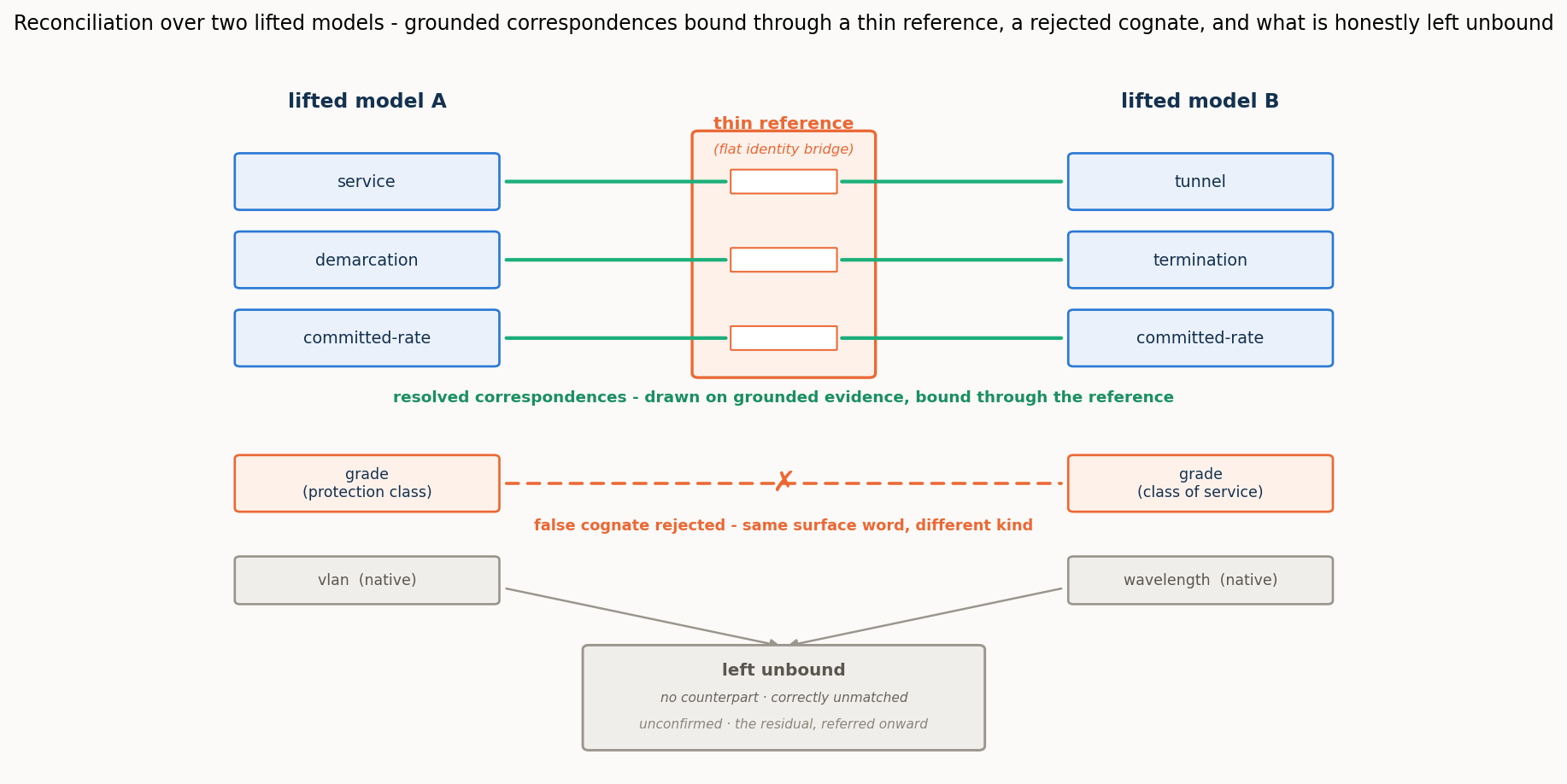
Figure 5. Reconciliation over two lifted models. Correspondences are drawn on grounded evidence and bound through a thin reference that anchors the shared common ground; a look-alike that shares only a surface word is rejected as a false cognate on its kind, attachment, and instances; a concept with no counterpart in the other model is, when the exchange does not need it, correctly returned as unmatched — a resolved outcome, not a gap; and a correspondence the evidence cannot *yet confirm is left in the residual, referred onward. A bare identity pointer carries no meaning of its own; the reference works through its descriptive content and by tying into the two grounded models it connects.*
Two features of Figure 5 recur in every scenario. The first is the false cognate: two concepts that share a surface word but denote different things, an optical signal-grade and a commercial service-grade, a transport grade and an IP grade, a legacy alarm and an NMOP anomaly. Reconciliation must draw the true correspondences and refuse the look-alikes, and it refuses them on grounded, non-lexical evidence (kind, attachment, instances) which a purely lexical matcher, keying on the shared label, cannot do. The second is the residual: the correspondences a pass does not close. A residual is not an error; it is what a reconciliation honestly refers onward rather than guessing: to further machine cognition where the agents are live to continue, or to a person where they are not. How large the residual is, and what drives it, is one of the programme’s central measurements.
13. The reconciliation cognition spectrum, and the two faces of the residual
The master control across all four scenarios is where the cognition sits: the reconciliation cognition spectrum. It runs from both sides live and interrogable, through one side inert, to both inert:
- both-cognitive: each side is a live reasoner, the authority on its own model, able to explain itself and answer questions;
- one-inert: one side is a mute snapshot exposing only its structure and instances; the live side must reconstruct its meaning;
- both-inert: neither side can explain itself; a third party reconstructs both from structure and data, and can only propose candidates for external adjudication.
A structural fact about this spectrum organises every result that follows. In the fully-cognitive case, resolution of any reconciliation question is total in principle, for two reasons that are themselves functions of live cognition on each side. First, the agents can exchange unbounded further information: each is the live authority on its own model, so whatever is ambiguous the other can ask about and get an authoritative answer. Second, because reconciliation operates on the models rather than the live network, the agents can run decisive experiments in virtual space: provision a candidate through a proposed correspondence, operate it, read it back, and check the invariants. Any question is therefore confirmed, refuted, or authoritatively decided, and nothing need be left unresolved. Both mechanisms are functions of live cognition, so as cognition recedes they fall away: with one side inert the live agent can probe but not interrogate or co-design an experiment; with both inert there is no one to ask and no joint experiment to run. The residual a reconciliation must leave and refer onward has, in this sense, a part that is the shortfall from full cognition’s reach, and that part grows as the reach recedes — not a fixed floor the fully-cognitive case merely reaches, but a gap that, between two fully-cognitive agents, is in principle none. What does not close with cognition is the irreducible pair §2 and §9 set aside — the authority to set a contested value, and any genuine underdetermination no fact can settle — which remains to be referred onward at any capability.
This is worth stating as a finding in its own right. Across the four scenarios we found no semantic gap that a sufficiently capable, sufficiently reaching cognition could not close. What remains once two fully-cognitive agents have exchanged everything they can and run every decisive virtual experiment is never an unbridgeable correspondence: it is a concept with no counterpart that the exchange does not need (correctly returned as unmatched), a fact not yet realised in the running network (an absence in the world, not in meaning), or one of the two irreducible residues — a question of authority rather than of fact, or a genuine underdetermination no fact can settle (§2, §5). None of these is a gap cognition gets stuck on, and the first two a human reasoner would leave exactly where a machine does. What varies from one agent to the next is therefore not the kind of cognition but its power and reach, which is precisely what the capability gradient (§19.2) and the probe-reach study (§19.5) measure.
The claim the scenarios test is simple to state. Lexical and descriptor methods carry a reconciliation to roughly ninety percent (names, then names plus a gloss) and there such methods have historically stopped, the remainder left to an agreed standard or to human judgement. What the spectrum shows is that the remainder need not wait for either: where both systems can reason, the reconciliation completes autonomously, and only as cognition recedes does closing the gap fall back to a reference or a person. It is cognition that completes a reconciliation, and the reconciliation spectrum is the measure of how far the automation reaches before it must hand off.
14. The instrument
Every scenario is measured in the same harness. A case is two lifted semantic models plus a gold-standard reconciliation derived from the models by a script and validated before any run, so the gold cannot drift from the models it scores. The lifted models in each case are the materialised lifts of §7 — each concept’s gloss and worked example, the self-explanation a cognitive side would volunteer — authored and validated as adequate before any run. Fixing them is deliberate: it holds lift quality constant, so that what the four scenarios measure is the reconciliation and not the lift, with §19.8 the check that this fixing hides no work — a live agent that performs the lift itself reconciles as the fixture does. The one qualification is that the self-lift is held fixed only on the cognitive sides: where a side is inert (§13), the live or third party reconstructs its meaning inside the run, and that reconstruction is itself part of what reconciliation is tested on. Producing these inputs — the lift itself, and aligning, reusing, and deriving the rest — is studied directly in §19.8. In the fully-cognitive case the reconciliation is an exchange between two live agents: each holds only its own lifted model and a surface catalogue of the other’s, and they alternate turns: advertising, asking and answering, proposing correspondences, and ratifying the other’s proposals about their own concepts (a correspondence is confirmed only when one side proposes it and the owner accepts it, or both propose it independently), and may run joint decisive experiments in virtual space. With a side inert the live agent reconstructs the mute one; with both inert a third party reconstructs both. The harness scores the outcome against the gold and records both quality and cognitive effort. Quality is measured by precision (of what it proposes, the fraction correct), the resolved fraction (of the true correspondences, the fraction it actually commits, the rest referred to the residual), surviving false cognates (planted traps taken), and the residual itself; effort, for a language-model stack, by reasoning tokens (hidden deliberation), total tokens, and latency. Throughout, a resolved fraction below one is not by itself a failure; it is reach deliberately traded for honesty, the unconfirmed correspondences referred onward rather than guessed.
The reconciling agents are run over the same model ladder (§6) — sol, mini, nano — now applied across all four scenarios. The four scenarios test the same hypotheses, stated by the first and inherited by the rest:
- cognitive agents can reconcile divergent models ad hoc — the concept holds;
- the placement of cognition governs what a reconciliation achieves, costs, and can verify;
- a thin reference partly substitutes for cognition, capability-dependently, and prevents errors where cognition is weakest;
- reconciliation work scales linearly with a shared reference, quadratically without one.
What each scenario adds is a new operation brought under test (verification and instances, then pragmatics as a movable policy, then the standard-free bind, then pragmatics as significance, whether an observation matters at all) against the same frame and the same instrument.
The four scenarios that follow each take this frame to a new operation, and each is a sample of the landscape of §11. They are distilled to a common rhythm — what is new against the first scenario, the case in one paragraph, the operations put under test, what was proven, and what it means — and each points to its own report for the full evidence.
15. Scenario 1, Configuration: two standard models of one network
Full report: 1/4 · Configuration.
In the landscape of §11: the identity corner at the schematic layer — two vocabularies for the same network, the clean place where a reference can substitute for cognition.
What it establishes. This is the founding scenario: it puts the whole idea to its first empirical test and fixes the frame the others inherit. Two independently authored public standard models of one optical transport network (ONF TAPI on one side, IETF TEAS/ACTN on the other) describe the same nodes, links, and services, each in its own vocabulary. A TAPI connectivity-service is a TEAS tunnel; a TAPI link-termination-point looks like a TEAS tunnel-termination-point but is a different thing: a link end, not a trail head. Because both models are public standards the agents recognise, cognition can lean on that recognition to bridge them, which makes this the cleanest place to isolate the mechanism.
Operations under test. The reconciliation as an equivalence (this term is that term): the lexical and ontological/structural binding, verification run as its own step, and instance co-reference, with the pragmatic operation left untouched here, deferred to the later scenarios. The thin reference is a lexical one, switched on and off across the spectrum.
What was proven. The concept holds, measured across conditions rather than shown once: cognitive agents reconcile the two models correctly and ad hoc. Within that, the reference substitutes for cognition: for the strong agent it yields a perfect, verified reconciliation (precision and resolved fraction of one) at both-cognitive and holds it as a side goes inert, collapsing the hidden deliberation a single reconstructing agent would otherwise spend severalfold. The benefit is capability-dependent and not monotonic: for a weak agent the reference can add effort when a side is inert, and the naive “reference helps more as cognition recedes” hypothesis is refuted for effort even as it holds for correctness. At both-cognitive the two-agent negotiation itself holds precision at one and refuses the planted traps through bilateral ratification; the reference’s error-prevention value shows where a single agent must reconstruct an inert side, raising the weaker agents’ precision and pre-empting the cognates they otherwise commit. Verification runs as its own step, keeping only the correspondences it can confirm and referring the rest onward. It rejects the false cognates that slipped into the proposal, so precision climbs toward one across the spectrum. But confirming a correspondence draws on live cognition, which recedes along the spectrum. Without the reference, as a side goes inert, the verifier can still reject a wrong pairing yet can no longer confirm every correct one; those unconfirmable-but-correct pairings are deferred to the residual rather than asserted, so the resolved fraction falls. The reference supplies the missing confirmation, holding the resolved fraction at one. Reconciliation work scales linearly with a shared reference against quadratically without one (verified by construction to N = 12). And two folded sub-studies carry the point past the schema terms: at the instance level the resolvability of same-looking individuals is budget-limited at full cognition (driven to a full resolve with more probing) but becomes structural once a side goes inert (no budget helps, because the inert side cannot be interrogated); and the deterministic controls confirm the lift itself is the lever: a reference-blind matcher seeing only the bare lexical surface resolves about two-thirds of the correspondences and takes a trap, and it is cognition over the lifted models that closes the rest and refuses the look-alikes.
What it means. The founding claim is in hand: cognition completes the reconciliation, a reference partly substitutes for it, saving cognitive effort and preventing errors, and the spectrum governs both. Everything after this builds on that frame; scenario 1 does not touch pragmatics at all; that is the thread the remaining three scenarios pick up.
16. Scenario 2, Intent: refinement, negotiation, and a service that renegotiates itself
Full report: 2/4 · Intent.
In the landscape of §11: a relation (refinement) at the pragmatic layer, reaching into provenance — where a reference reaches information but not the authority to decide, and a pre-placed policy carries that judgement.
What is new. The first scenario reconciled by equivalence; this one reconciles a declarative intent against a concrete realisation by refinement. “Latency below 5 ms” is not equal to any service on offer; it is a bound that a service either clears or does not, and many services may clear it. Once the relation is refinement, everything the first scenario left untouched comes into play at once.
The case. A customer’s agent O holds an intent (a New York–Frankfurt connection, ≥ 8 Gbit/s, ≤ 5 ms, four-nines, protection not required), every clause a bound. An operator’s agent N holds a catalogue of concrete optical services, each with a real bandwidth, latency, availability, protection scheme, and cost. Neither speaks the other’s language; they must work out which realisation satisfies the wish.
Operations under test. Verification becomes a satisfaction check (you cannot round-trip a lossy refinement, so you test the chosen realisation against every bound); a negotiation appears when no service meets every bound (N offers a best-achievable alternative, O must decide accept or reject); the pragmatic operation enters for the first time, carried in a small, portable movable policy the customer holds: a priority ordering, hard bounds, an affordability floor, a flow-class rule; and the whole exchange recurs across the service’s life.
What was proven. The central insight, now measured on a real negotiation: with both agents live, the reconciliation (negotiation included) completes autonomously (decision accuracy 1.0 for sol and mini), with no human in the loop. The spectrum gains a new rung that turns out to be a striking result: remove the customer’s live judgement, and a pre-placed movable policy still closes the decisions it was authorised for (1.0), while a mute customer with no policy cannot: accuracy falls to zero and the agents correctly refer all three decisions onward rather than guess. The pre-placed policy is a concrete mechanism for pushing the hand-off boundary: the customer’s cognition, placed in a portable artefact ahead of time, closes autonomously what a mute description must refer. The second finding draws the reference’s limit: where a side is inert, a published reference supplies information (the strong agent, blind at both-inert, refuses to affirm satisfaction and scores 0.29; publish the invariant guarantee floor and it has an anchor to check against, rising to 0.71); but it cannot supply authority: at both-inert no reference moves the negotiation, because what is missing is the customer’s judgement itself. The capability gradient is steep (to reach its decisions the strong agent spent ~150 reasoning tokens, the mid ~860, the weak ~5,400, thirty-six times the strong agent’s effort, for lower accuracy), and a four-hop lifecycle (bought, self-healed, referred, restored) is walked correctly end to end by the strong model (hop accuracy sol 1.0, mini 0.88, nano 0.62).
One further result makes the negotiation genuinely two-sided. With the provider N modelled as a catalogue oracle, replacing it with a live reasoning agent changes almost nothing — the exchange is one-sided refinement against a checkable menu. But give N its own deliverability to judge against a live capacity state, and it diverges from the oracle exactly where capacity binds (near zero while paths are clear, rising to 1.0 as they saturate): the naive oracle offers a service it cannot deliver in 52% of saturated cases, while every reasoning provider across the ladder offers none (§19.7).
What it means. Cognition completes a negotiation, and the pragmatic operation is now a measured axis rather than a fixed backdrop. A thin published reference can stand in for the information an inert side would otherwise supply, but not for the authority to decide. A pre-placed policy is shown able to carry a party’s authority to where a person or live cognitive system would otherwise have to stand.
17. Scenario 3, Standard-free: reconciling with no public standard
Full report: 3/4 · Standard-free.
In the landscape of §11: a relation (underlay) at the schematic layer with no standard beneath it — the constructed-reference corner, where building the shared ground is the work — reaching into provenance (whose realm governs a shared field).
What is new. The deliberate complement to the first scenario. There, two different models faced each other, but both were public standards the agents already knew, so cognition could lean on recognition. Here that crutch is gone: both models are home-grown and private, recognisable to no one in advance. The operations are the first scenario’s (lift, bind, a thin reference) but with the standard removed, the execution diverges, and that divergence is the subject.
The case (Figure 6). Meridian, a home-grown transport OSS, thinks in circuits, bearers, wavelengths, protection grades. Cascade, a home-grown IP/VPN controller, thinks in services, attachments, VLANs, classes of service. Their worlds touch at exactly one seam: a Cascade service must ride a Meridian circuit as its underlay. One order across that seam needs five bindings: circuit↔underlay and hand-off↔attachment (the same object under two names), and three requirements pinned (a committed rate not a line rate, a latency bound, protection against a path failure). And one look-alike is refused: both models carry a grade, but Meridian’s is a transport protection class and Cascade’s an IP class of service. Same word, unrelated meanings, and no standard to consult.
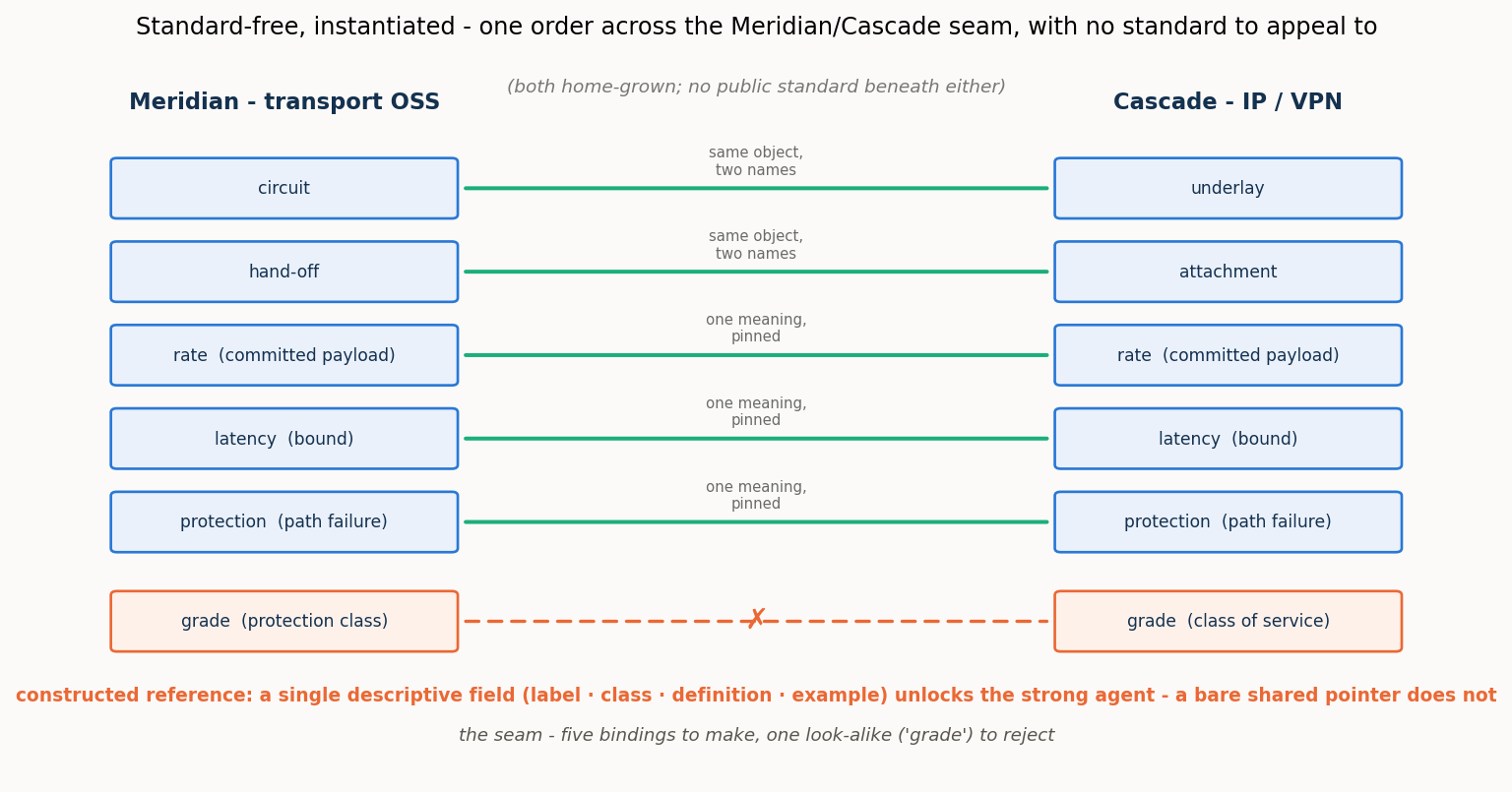
Figure 6. One order across the Meridian/Cascade seam. Five bindings to make (two renamings and three pins) and one false cognate, “grade”, to reject, across two private vocabularies with nothing public beneath them. A constructed reference supplies the shared ground; a single descriptive field in it is enough to unlock a capable agent.
It is worth seeing the shared ground the two agents actually build, because its exact contents are the argument. The reference below is what they construct for this one exchange — not adopted from any standard, one entry per shared seam category, each fixed by a canonical example both sides can instantiate:
{
  "id": "ref.crossdomain.adhoc.v1",
  "kind": "lexical",
  "reference_type": "ad_hoc_by_example",
  "note": "Constructed between just these two agents for just this exchange, not adopted from any
           standard. One entry per shared seam category the exchange needs, each fixed by a canonical
           example. It deliberately does NOT cover either side's native concepts (grade, bearer, vlan,
           service), which is how it pre-empts the cross-domain 'grade' false cognate.",
  "entries": [
    {"id": "transport-underlay", "label": "transport underlay",
     "synonyms": ["underlay circuit", "carrier circuit"], "class": "seam",
     "definition": "The transport circuit that carries an IP service as its underlay — the one object
                    both domains share, owned by transport and consumed by IP.",
     "example": "Meridian circuit CIR-7 is the underlay of Cascade service SVC-42"},
    {"id": "demarcation", "label": "demarcation point",
     "synonyms": ["hand-off", "attachment"], "class": "endpoint",
     "definition": "The single point where the transport circuit hands off to, and the IP service
                    attaches at, the customer site — one demarcation seen from both sides.",
     "example": "the NY demarcation: hand-off ho-NY-CIR7 is the same point as attachment att-NY-SVC42"},
    {"id": "service-rate", "label": "committed service rate",
     "synonyms": ["committed rate", "CIR"], "class": "requirement",
     "definition": "The committed client payload rate the service guarantees — NOT the bearer line
                    rate. Pinned to committed payload to prevent the line-rate / committed-rate confusion.",
     "example": "5 Gbit/s committed (not the 100 Gbit/s bearer line rate)"},
    {"id": "latency-bound", "label": "latency bound",
     "synonyms": ["delay bound", "latency tier"], "class": "requirement",
     "definition": "The one-way latency the service must not exceed, however each side expresses it — a
                    number of milliseconds on the transport side, a named tier on the IP side. Pinned to
                    a bound, not a measured metric.",
     "example": "<= 8 ms one-way is the same requirement as latency tier T2"},
    {"id": "protection-requirement", "label": "path protection",
     "synonyms": ["resilience", "protection"], "class": "requirement",
     "definition": "Protection of the service against a failure of the transport PATH (a fiber cut or
                    bearer loss) — pinned to a path/underlay failure, distinct from an IP scheduling class.",
     "example": "survive a single fiber cut on CIR-7's primary path by switching to the diverse path"}
  ]
}
Figure 7. The ad hoc reference the two agents construct for one cross-domain exchange: one entry per shared seam category, each fixed by a canonical example. It deliberately omits each side’s native concepts, which pre-empts the cross-domain ‘grade’ false cognate.
Two things about this listing carry the scenario. First, every entry is thin: an identity plus a
label, a shallow class, a one-line definition, and a single canonical example — no relationship axioms,
no cardinalities, no attribute schema. It is a lexicon, not a model of either domain. Second, what the
reference omits is as deliberate as what it carries. There is no grade entry, because grade is
each side’s native concept, not shared ground; with nothing for the two grades to bind to, the
false cognate is pre-empted at the reference itself, before any agent reasons about it. This is the
whole reference the resolved-fraction climb below (0.20 → 0.80 → 0.90) is built on, and the field
ablation pulls apart entry by entry.
Operations under test. A single, early schema-binding pass (deliberately isolated from the rest of the process) measured across the spectrum with and without the reference the two agents would themselves construct; plus a reference-field ablation and the pragmatic operation of authority attribution (whose realm owns each shared field). The instance operation is bracketed, on the argued grounds that it reproduces the first scenario’s result.
What was proven. The central result is a pair of mirror-image failures: the strong and weak agents failing in opposite ways, and where each failure shows depends on how the cognition is placed. The strong agent will not guess across two private vocabularies; it binds only the names that already coincide (resolved fraction 0.20 at both-cognitive, around 0.4 once a side is inert), at perfect precision and with no false cognate taken: this is omission, deferral not error, throughout the spectrum. The weak agent’s error is commission (binding freely and taking the cross-domain “grade” trap) but it emerges where a single agent must reconstruct a side: at the inert placements its precision never clears 0.83 and falls to 0.57. At both-cognitive the weak agent cannot bind unilaterally (its partner must ratify) so the negotiation refuses its over-commitments: it under-resolves (0.40) rather than mis-commits, and the trap does not survive. Commission is real, but it is a property of a single reconstructing agent, not of two agents negotiating. A single thin reference remedies the omission: constructed, it lifts the strong agent to a full close and disciplines the weak agent’s precision at the inert placements. Stripping the reference’s fields one at a time shows what it must carry: any single descriptive field (a shared label, a class, a definition, or an example) is enough to unlock the strong agent’s commitment (each drives it to a near-perfect close), while a bare shared identifier with no description is worse than nothing (precision 0.50, below the no-reference floor), because the agent binds by an opaque token and binds wrongly. The reference does not work through the shared pointer; it works through the shared description, and even the thinnest description suffices. On the pragmatic axis, the same boundary the intent scenario found appears again: the reference reaches meaning but not authority (it can pin that a rate is a committed payload, but not whose realm governs it) and a characteristic “transport owns everything it carries” bias marks the weaker models.
What it means. With no public standard beneath two models, cognition still closes, but only once it has built the shared ground, and building that ground is the work. The strong agent’s low reference-absent numbers are not a limit of cognition; they measure the worth of the one step the study held back (constructing the shared reference) by running the binding without it. Run end to end (the two agents constructing the shared reference themselves from their models and then binding through it, with none pre-given) the protocol confirms the reading: the strong agent lifts from a no-reference resolved fraction of 0.20 to a constructed-reference 0.80, and to 0.90 when the agents also run a decisive virtual experiment on the candidates, approaching the reference-given 1.00, at perfect precision and with no false cognate, so constructing the ground is the work and a capable agent does it. Even a very thin ground suffices for a capable agent, provided it carries meaning and not merely a pointer.
18. Scenario 4, Observability: an alarm is not an anomaly
Full report: 4/4 · Observability.
In the landscape of §11: a relation (an alarm is not an anomaly) spanning the instance and pragmatic layers, with a cross-layer divergence — meaning pinned by the reference, significance carried by the pragmatics and gated by capability, and cross-layer symptoms composed into incidents.
What is new. The scenario where the pragmatic operation moves from the wings to the centre. The descriptor level (what a thing is) is settled by a standard, and the entire operational question is one of significance: whether an observed deviation matters, and how observations compose. It also carries a deep ontological false cognate.
The case (Figure 8). Agent F, a legacy fault manager, emits an alarm: one object bundling an event, an undesirable state, a fixed severity, and a static probable-cause. Agent G, an IETF NMOP agent, speaks the RFC 9940 ladder, which separates what legacy conflates (event, anomaly, symptom, fault, alarm, problem, cause, incident) and annotates each anomaly with anomaly-semantics metadata (a concern score, a confidence score, a plane, a pattern, a lifecycle stage, a season). The worked example is one live anomaly: a pre-FEC bit-error-rate reading on a wavelength begins to rise. In the legacy world it fires an alarm and a page; in the NMOP world nothing is decided yet: whether it warrants a page depends on its concern and confidence and its context (a maintenance window makes the same deviation expected), and whether it is one incident or many depends on correlating it, across layers, with the symptoms it causes.
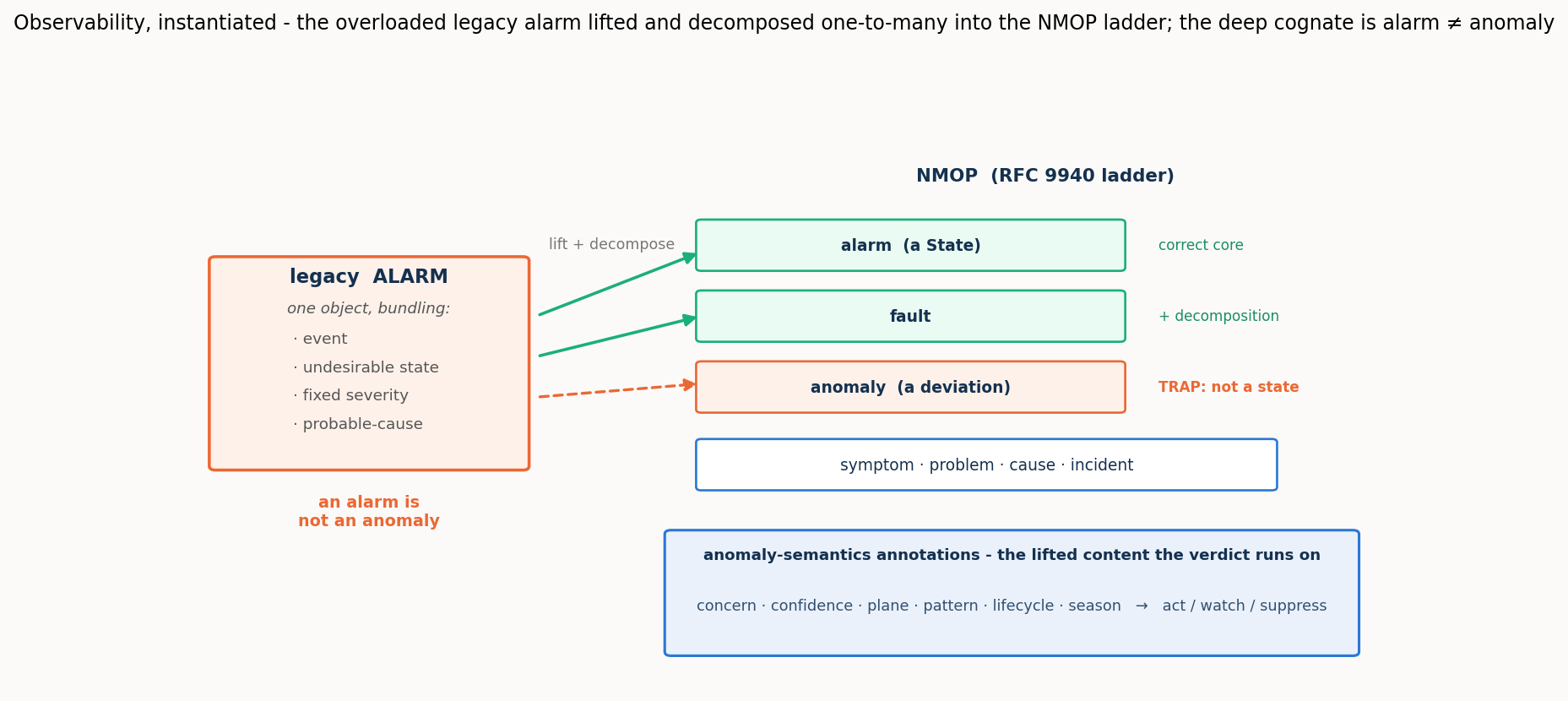
Figure 8. The overloaded legacy alarm is lifted and decomposed one-to-many into the NMOP ladder: its correct core is the NMOP alarm-State (and the fault it implies), while the trap is the anomaly: an alarm is a State, an anomaly is a deviation, and conflating them is a category error, not a mislabel. The anomaly-semantics annotations are the lifted content the significance verdict runs on.
Operations under test. Two acts. Act 1 is a schema binding carrying the ontological false cognate (alarm↔anomaly, which no structural cue separates) and a granularity (one-to-many) decomposition (the legacy alarm maps to both the NMOP alarm-State and the fault). Act 2 is pure pragmatic resolution and composition, each run with the anomaly-semantics ON and OFF: a verdict task (act / watch / suppress for each anomaly under a context) and a correlation task (group cross-layer symptoms into incidents and name each cause).
What was proven. Three results complete the arc. First, the ontological cognate is a clean three-rung capability gradient: the strong agent never conflates alarm with anomaly (with or without the reference); the mid agent conflates them once a side is inert, and the RFC 9940-anchored reference rescues it completely (the cognate vanishes, precision returns to 1.0); the weak agent conflates them with or without the reference, beyond rescue. The lexicon pins the ontology for the middle of the ladder, not the bottom. (The honest hard edge of Act 1 is the decomposition: even the strong agent tends to map the alarm to the alarm-State but miss the fault constituent, so the resolved fraction sits near 0.75.) Second, in the verdict task the pragmatics carry the operative meaning: with the semantics ON the strong and mid agents suppress correctly during maintenance and the false-page storm disappears (verdict accuracy 1.0 and 0.83, essentially no false pages); with them OFF the legacy pipeline pages nearly everything (accuracy 0.17 and 0.08, roughly four and three-and-a-half false pages); but the payoff is capability-gated: handed the identical annotations, the weak agent barely moves (ON 0.53 vs OFF 0.50). Third, correlation behaves differently: given the resource-dependency map, every model (the weak one included) folds an optical degradation and the IP loss it causes into one correctly rooted incident (perfect partition ON), and without that map every model fails. The difference is the lesson: correlation’s pragmatic is a structural input and even a weak agent applies it; the verdict’s pragmatic demands judgement, and there capability decides.
What it means. Meaning (what an anomaly is, pinned by the reference) and significance (whether it warrants a page and how it composes, carried by the pragmatics) are separable, both necessary, and each gated in its own way. The pragmatic layer the descriptor methods never reach is real and decisive, and itself bounded by the agent’s capability. The through-line reaches its end: cognition completes the reconciliation; a thin reference supplies the information it needs and stops at what it does not; and the pragmatic layer is the frontier, decisive for meaning and gated by capability.
19. The findings in depth: readings across the scenarios
The four scenarios above are the evidence, case by case; this section reads across them. It takes the cutting axes the scenarios share — the cognitive load an operation costs, the model power the gradient demands, what the reference buys, and what changes with position on the reconciliation spectrum — and then follows the mechanisms into their particulars: reach, the economics of the reference, the negotiation and the decisive experiment, and what it takes to produce the inputs a reconciliation runs on. Each reading cuts across all four scenarios; together they are the detail that the Part 3 theses compress into single lines. Two of these readings — the lift check within §19.8, and §19.9 — also read back to Part 1, supplying the reconciliation-side evidence for the lift’s reach (§7) and its pragmatic limit (§8).
19.1 Cognitive load: what each operation costs, and who pays
The most consistent number in the programme is what a weak agent costs. A decision here is a single judgement within a reconciliation — one accept-or-reject of a degraded offer in the intent negotiation, or one act/watch/suppress verdict on an anomaly in observability — not a whole reconciliation. To reach the same decisions the weak agent spends one to two orders of magnitude more reasoning than the strong one, in every scenario that measures effort (Figure 9): about 36× in the intent negotiation (sol ~150 tokens, mini ~860, nano ~5,400) and about 20× in the observability verdict (sol ~60, mini ~520, nano ~1,200). Capability buys economy as much as correctness: a weak agent does not merely make more mistakes, it burns far more cognition making them.
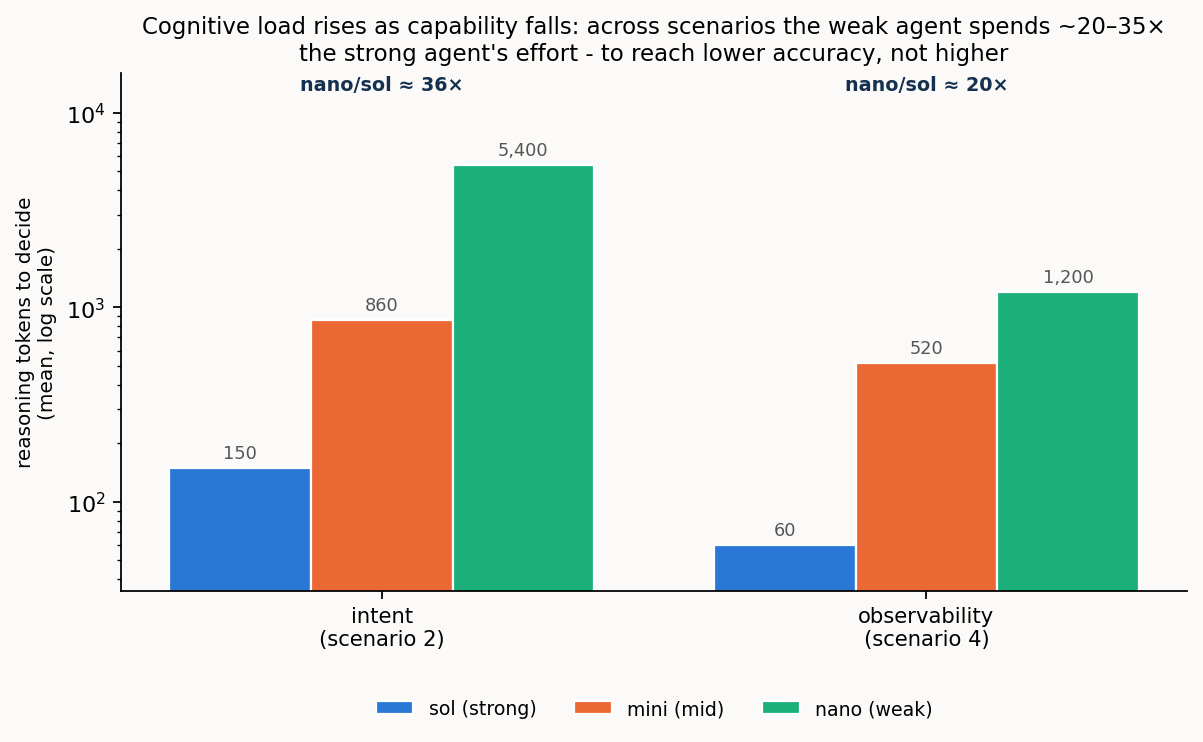
Figure 9. What you are looking at is the reasoning tokens (a model’s hidden deliberation) each model spends to reach one such decision — one accept-or-reject of a degraded offer in the intent negotiation, or one act/watch/suppress verdict on an anomaly in observability — in the two scenarios that measure effort directly (log scale). The gradient is steep and consistent: the weak agent spends ~20–35× the strong agent’s effort, and, as the scenarios showed, to reach lower accuracy, not higher.
The load also depends on the operation and on reference support. Where the operation is a lookup and cognition is fully present it is cheap; where it demands search (interrogating a live oracle to separate look-alike individuals, as in scenario 1’s instance study) or judgement (weighing a degraded offer, or an anomaly’s concern against its context) it is dear. And for a strong agent a thin reference is an effort substitute: given the anchor, sol’s hidden deliberation collapses severalfold (Figure 10: about 3.7× at both-cognitive, 6× at one-inert, 2.4× at both-inert). But that effort saving is capability- and placement-dependent, and it can invert: for the weak agent with a side inert, the reference adds effort; nano spends roughly 5,500 tokens more with the reference than without, straining to reconcile an inert side’s meaning against the extra material. The reference’s effort benefit peaks with strong, live cognition and turns to a burden at the weak, inert corner.
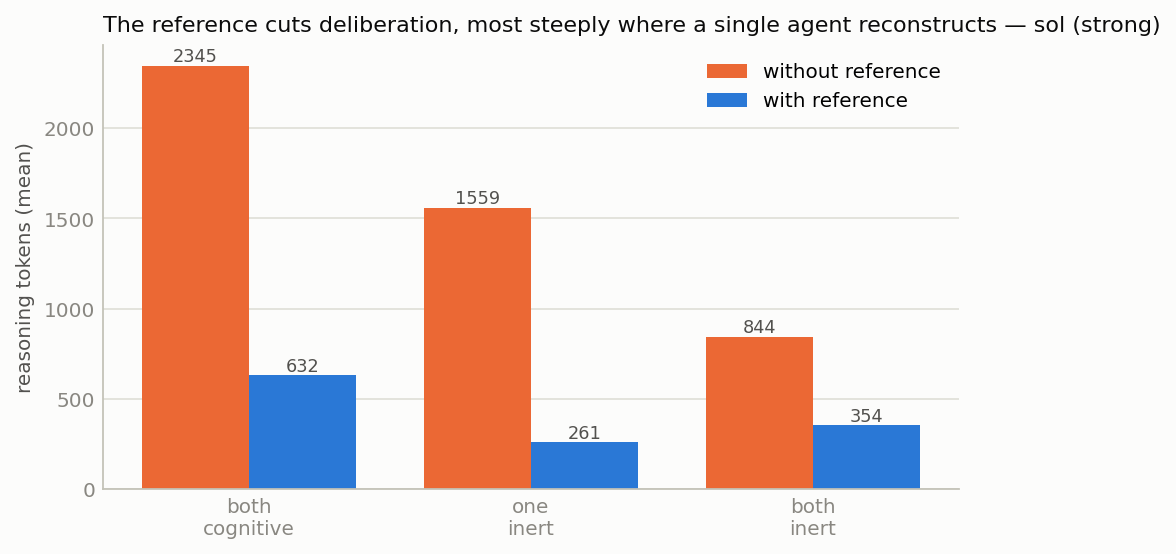
Figure 10 (scenario 1). The bars show the reasoning tokens (a strong agent’s hidden deliberation) spent binding two standard schemas (configuration), with and without a shared reference, at each point on the reconciliation cognition spectrum — both sides live (a two-agent negotiation), one side inert, then both inert (a single reconstructing agent). Given the anchor, deliberation collapses severalfold — about 3.7× at both-cognitive, 6× at one-inert, and 2.4× at both-inert: the reference doing the reasoning’s work.
One feature of Figure 10 looks paradoxical and is worth reading carefully. The strong agent spends more reasoning at both-cognitive (2,345 tokens without the reference) than at both-inert (844), the count falling monotonically as sides go inert. This is not because reconciling live sides is intrinsically harder — the placements are not like-for-like. The both-cognitive point is a two-agent negotiation (two agents, several rounds each of interrogating, proposing, and ratifying; the count is their total deliberation), reaching a complete, verified close. The both-inert point is a single agent making one reconstructive pass that can only propose candidates for external adjudication (§13). So the tokens measure how much deliberation a placement can productively spend — greatest where cognition is fully live and can be used — not the difficulty of a task held fixed across the spectrum; the cheaper inert end comes with a weaker close, not a free saving. This does not contradict Figure 9, which varies a different thing: Figure 9 holds the task fixed and varies capability — a weaker agent burns far more reasoning to reach the same, lower-accuracy decision, so there more tokens mark inefficiency; Figure 10 holds capability fixed and varies placement, where more tokens mark a placement that can spend deliberation productively and reach a fuller close. Reasoning tokens are not a fixed good or bad — whether more means worse (a weak agent grinding) or better (a live placement doing more) depends on what is held fixed.
19.2 Model power: the shape of the capability gradient
Capability does not turn a single dial; it changes the kind of failure. The cleanest place to watch this is scenario 3, the standard-free bind (Figure 11): Meridian, a transport OSS, and Cascade, an IP/VPN controller, are two independently authored private models with no public standard between them, so no ready-made reference exists; the agents must construct the shared ground themselves. Run that bind with the reference withheld and capability alone decides the outcome. The strong agent defers. Facing two private vocabularies with no constructed ground, sol binds only the names that already coincide and leaves the rest in the residual: a low resolved fraction (0.20 at both-cognitive), perfect precision, no trap taken. The weak agent’s failure is commission (binding freely and wrongly) and it shows where a single agent must reconstruct a side: at the inert placements nano’s precision never clears 0.83 and it takes the trap. At both-cognitive the two-agent loop checks it: nano cannot bind without its partner’s ratification, so it under-resolves rather than mis-commits and the trap does not survive. A single thin constructed reference then lifts the strong agent to a full close and disciplines the weak agent’s precision where it is a lone reconstructor.
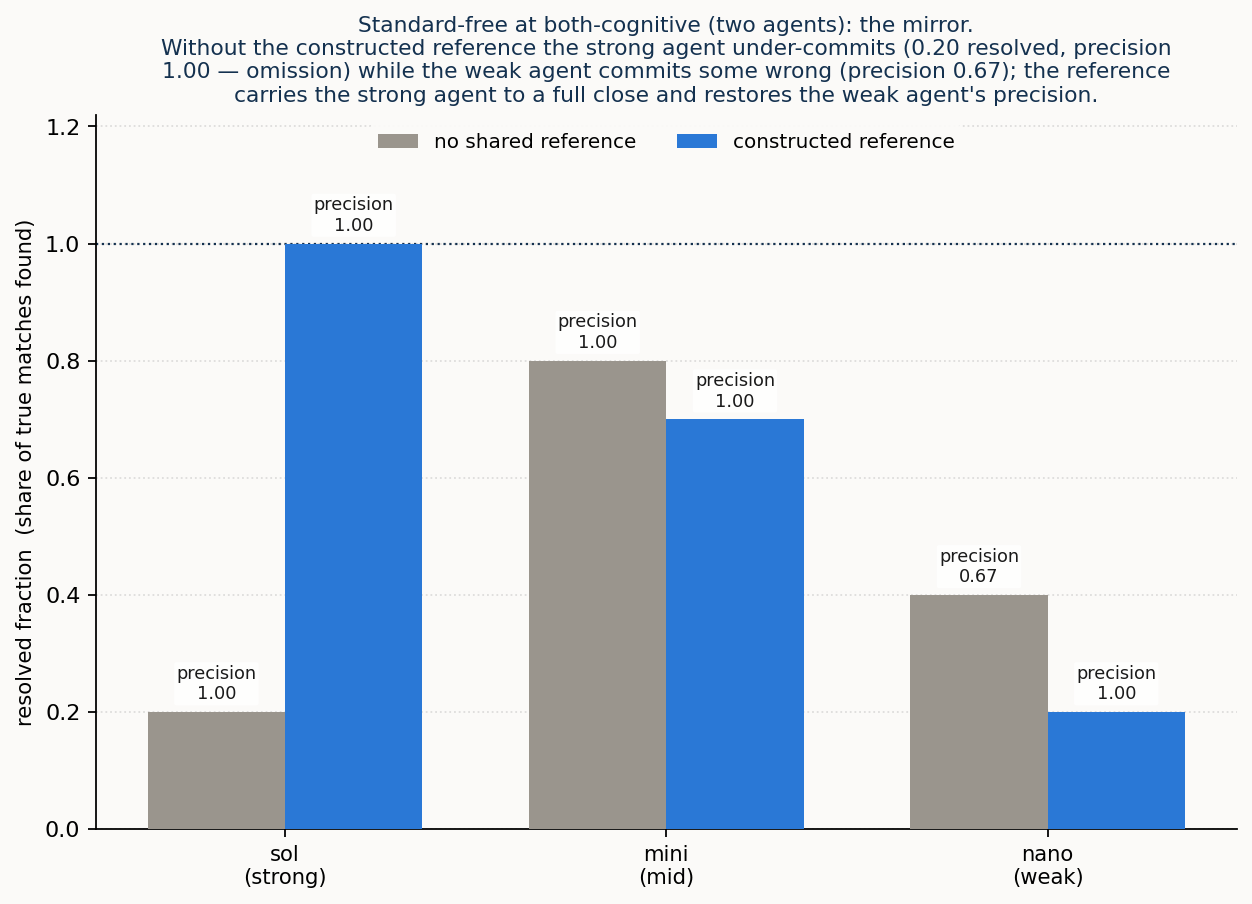
Figure 11 (scenario 3). Each point plots the precision (the share of what an agent commits that is correct) against the resolved fraction (the share of the true correspondences it finds and commits) of agents binding two private schemas across the cross-domain seam, at both-cognitive, with the constructed reference off (hollow) and on (filled). Without the reference sol sits top-left (commits little, all of it right) and nano lower-right (commits much of it wrongly); the reference pulls both to the corner.
Swept across a six-model ladder on the schema cases at both-cognitive (Figure 12), two-agent negotiation compresses the gradient a lone reconstructing agent would show. Precision does not fall as capability drops: bilateral ratification holds it high across the whole ladder (roughly 0.9 to 1.0), and surviving false cognates are driven to zero for every model but the weakest, where about a quarter of the traps survive. What the negotiation costs is resolution: the resolved fraction is uniformly lower (about 0.4 to 0.7) and rises then dips rather than climbing, because the weakest agents fail by non-convergence, grinding to the round limit without closing, rather than by confident over-commitment. The structure itself (each proposal ratified by the concept’s owner) supplies the discipline that a reference, or a stronger cognition, would otherwise have to.
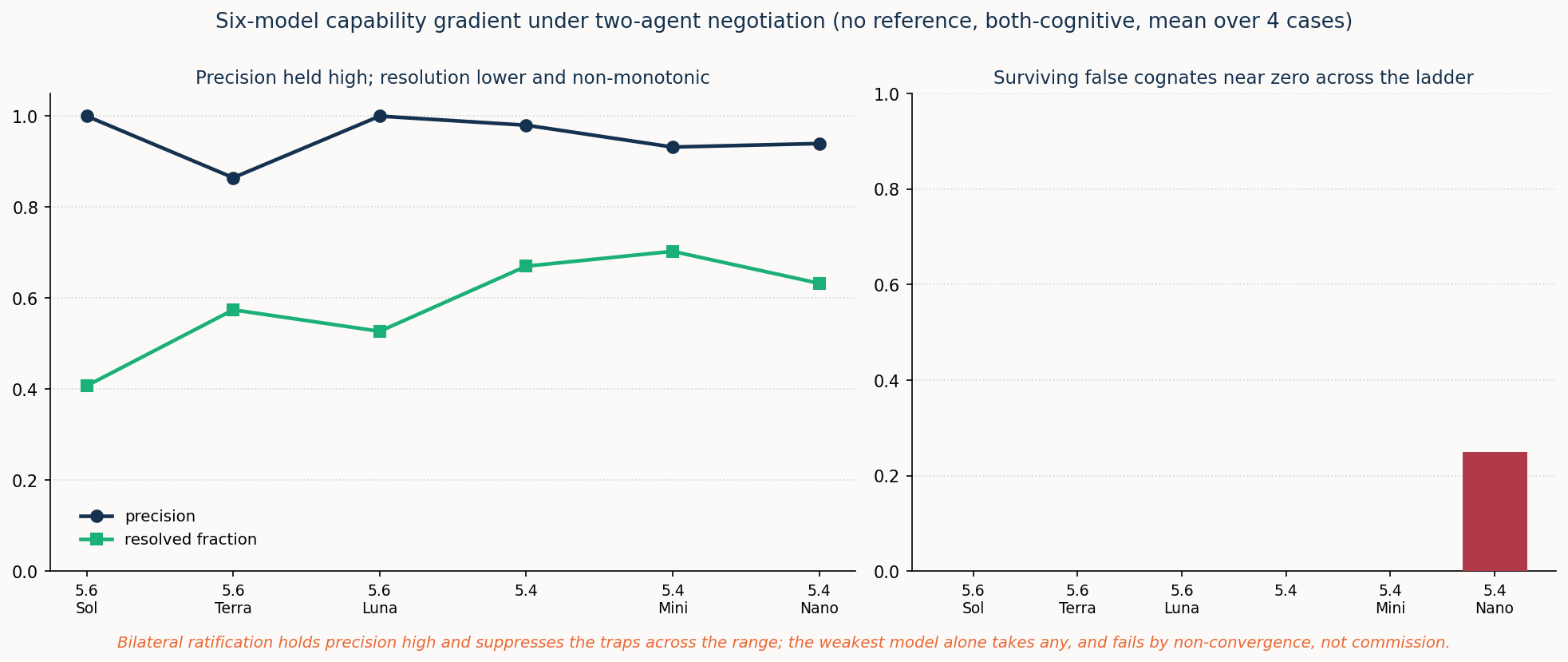
Figure 12. Across a six-model capability ladder, this tracks the precision, resolved fraction, and surviving false cognates of two agents negotiating schema correspondences by bilateral propose-and-ratify (both sides live, no reference, mean over the four schema cases). Bilateral ratification holds precision high and suppresses false cognates across almost the whole ladder; resolution is uniformly lower and non-monotonic, the weakest models failing by non-convergence rather than by taking the traps.
Where a standard can pin the distinction, capability decides who can use it, a clean three-rung gradient (Figure 13). On the ontological false cognate, alarm↔anomaly, the strong agent never conflates the two, with or without the reference (intrinsic mastery); the mid agent conflates them once a side is inert, and the RFC 9940-anchored reference rescues it completely (the cognate’s survival goes 1.00 → 0.00); the weak agent conflates them either way (0.75 with or without, beyond rescue). The lexicon pins the ontology for the middle of the ladder, not the bottom.
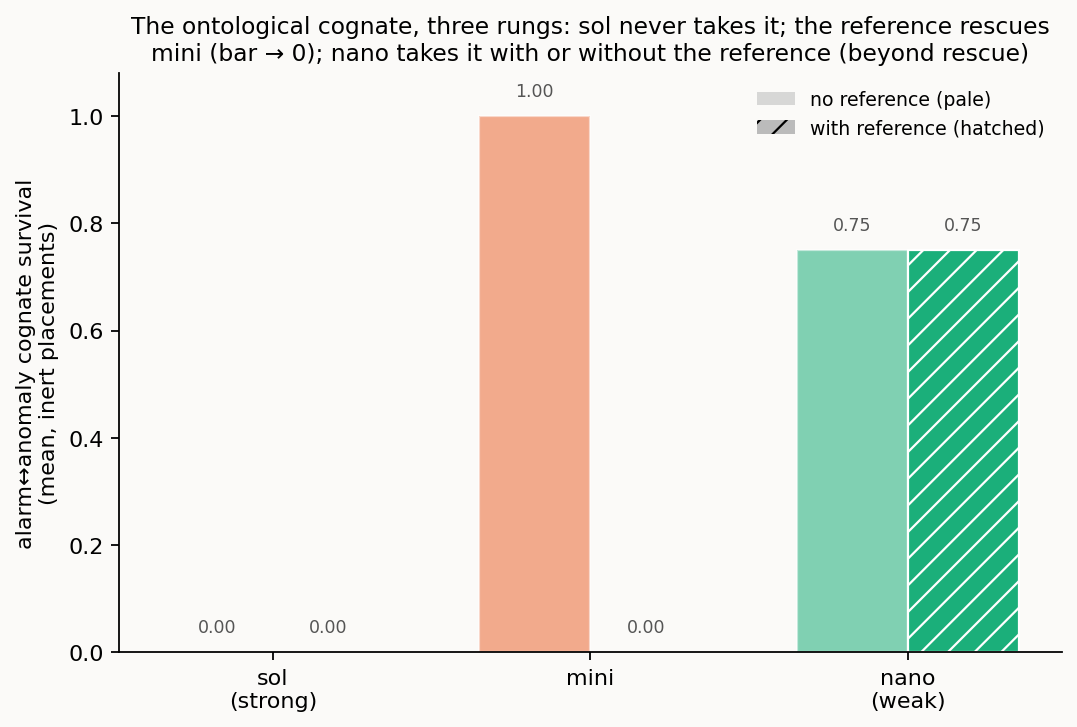
Figure 13 (scenario 4). This is the survival of the alarm↔anomaly false cognate (the share of runs in which it is wrongly taken) as agents bind schemas at the inert placements, without and with the reference. sol never takes it; the reference drives mini to zero; nano barely moves.
The gradient has a second reading, in the currency that governs whether a result is safe to act on unsupervised: the confidence a wrong answer is asserted with. Scoring every proposal by the agent’s own per-correspondence confidence, across all the cases and rungs, gives a clean confidence-sensitive picture. The rate of confident errors — wrong merges asserted at or above a high threshold (τ = 0.8) — rises about elevenfold down the ladder, from 0.004 at the strong agent through 0.031 at the mid to 0.046 at the weak one, and rises again as cognition recedes (the weak agent goes from 0.015 at both-cognitive to 0.075 at one-inert). Calibration degrades in step: the Brier score worsens monotonically, 0.009 → 0.049 → 0.067. So the dangerous failure is not spread evenly; it concentrates at the weak end and the inert placements, exactly where the reference and verification are meant to matter most. And crucially, confidence is a real but weak guard. Every agent is somewhat less sure when wrong than when right, but only somewhat: the confidence on wrong merges sits at 0.73–0.85 everywhere, well above any threshold a consumer could use to filter them, and only about 0.12–0.21 below the confidence on right ones. A downstream system cannot separate right merges from wrong ones by the confidence number alone — the agents assert their mistakes almost as surely as their correct answers. This is the quantitative form of the same failure the qualitative results keep meeting (the confident false cognate, the verifier’s over-pass), and it is the argument for an explicit abstain path — a scored “insufficient evidence” outcome, reported apart from honest deferral — rather than a confidence cut, as the discipline a weak or inert-facing reconciliation needs. The harness now carries both the confidence-sensitive metrics and that abstain path.
19.3 The reference: what it buys, by component and by placement
Two things a reference might do are easy to conflate — carry meaning the agent can bind by, and share an identity both sides point at. What binds correctly is meaning, supplied either by the reference or by the agent’s own cognition; a bare pointer never does.
Not every thin reference is equal, and the difference is measurable. Ablating the reference’s descriptive fields (scenario 3, strong agent, opaque identifiers) shows that any single field (a shared label, a class, a definition, or an example) is enough to unlock a full close, while a bare shared identifier with no description is worse than nothing (precision 0.50, below the no-reference floor): the reference works through shared description, never through the pointer. And the same field can harm the agent it was meant to help. This shows up in scenario 1, the configuration reconciliation whose look-alike terms are the programme’s richest source of false cognates: there a shallow class tag is, for the weak agent, the single worst condition in the programme (Figure 14), driving cognate survival above even the no-reference floor, because a class surface reads as evidence for the very cognate it should block.
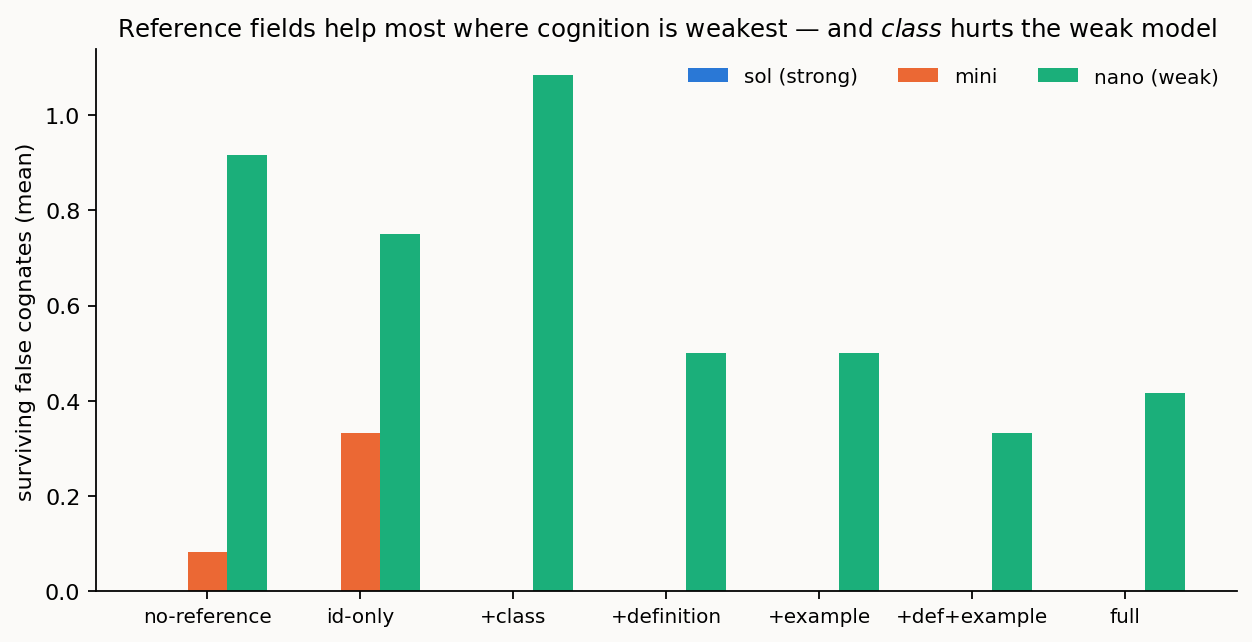
Figure 14 (scenario 1). The bars are the surviving false cognates (traps wrongly taken) as an agent binds two schemas with a shared reference of varying content, per model. The strong agent is immune (no bar); for the weak agent the lexical field helps most and the shallow class tag actively hurts: the tallest bar, above the id-only floor.
There is a sharper way to see what part of a shared reference is doing the work, and it separates two jobs the reference had been doing at once. On the benchmark’s shared reference both sides bind to the same entry, so a planted false cognate is pre-empted by shared identity alone: every model, strong to weak, reaches precision 1.00 and the traps do not survive. Re-represent the same two models with two independently authored lexicons — the same concepts and the same true correspondences, but no reference id shared across sides — and that mechanical pre-emption evaporates. The agent must first align the two lexicons by meaning, and only a capable agent does: the strong agent holds precision 1.00 with zero confident errors, doing the harder task as cleanly as it used the shared one, while the weaker agents fall to about 0.88–0.89 precision with the reference still present, mis-aligning and committing a wrong correspondence. So a shared reference was supplying two things — meaning (the monadic meaning-supply role of §5), and a mechanical guard against false cognates by shared identity — and the second is exactly what independence removes, turning it back into a capability-gated cognitive act.
That raises the obvious question of how thin such a reference can be before it stops protecting, and the answer relocates the axis. A full factorial ablation of the reference’s descriptive fields, run on the independent-lexicon case, shows the capable agent’s precision is independent of the reference’s descriptive text altogether — not because description is useless, but because a capable agent supplies the meaning itself, reasoning the alignment from the concepts rather than reading it off the reference. The description still carries that meaning where an agent is too weak to reconstruct it, and it buys resolved fraction; a capable agent simply does not depend on it. It holds at 1.00 from the full reference down to a label-less, id-only entry and even to no reference at all, while those fields buy only a little resolved fraction (1.00 with them present, easing to 0.94 at id-only and 0.90 with none). Field-richness, then, is not the reference- quality axis one might fear — a reference can be stripped almost to the bone without a capable agent losing its discrimination. What governs whether independence defeats the guard is not how thin the reference is but how far the two vocabularies have diverged — the gap the agent must cross to align them — which is the axis a divergence sweep is built to trace. So the two ablations agree rather than conflict: a bare shared pointer is a trap, and the meaning that avoids it can come from the reference or from the agent — the more capable the agent, the less the reference must spell out.
Sweeping exactly that axis — progressively independently lexicalising the two sides, from one fully shared reference through to two fully independent lexicons, with everything else fixed — the result is, for a capable agent, a robustness one: its precision holds at 1.00 across the whole sweep, with the reference and without it, and it takes no planted false cognate at any level (Figure 15). Nor does any model take a planted cross-lexicon cognate at any point on the sweep: the guard holds throughout, and the mid and weak agents’ residual precision gap is spurious over-proposal, not trap-taking. What divergence does move is confined to the weak end and shows up in the confidence signature rather than in the guard: the weak agent’s confident-error count roughly triples across the sweep even as its trap-taking stays at zero. So lexicon divergence, at least on this case, is not an axis that defeats a capable agent’s alignment; its cost is a graded rise in the weak agent’s confident, spurious assertion — the pathology §19.2 measured, now shown to grow with divergence rather than to open a hole in the guard. The threshold the field ablation redirected us to look for is, within a full sweep here, not reached for a capable agent at all; locating one, if it exists, is now a question for more divergent domains, not for this one.
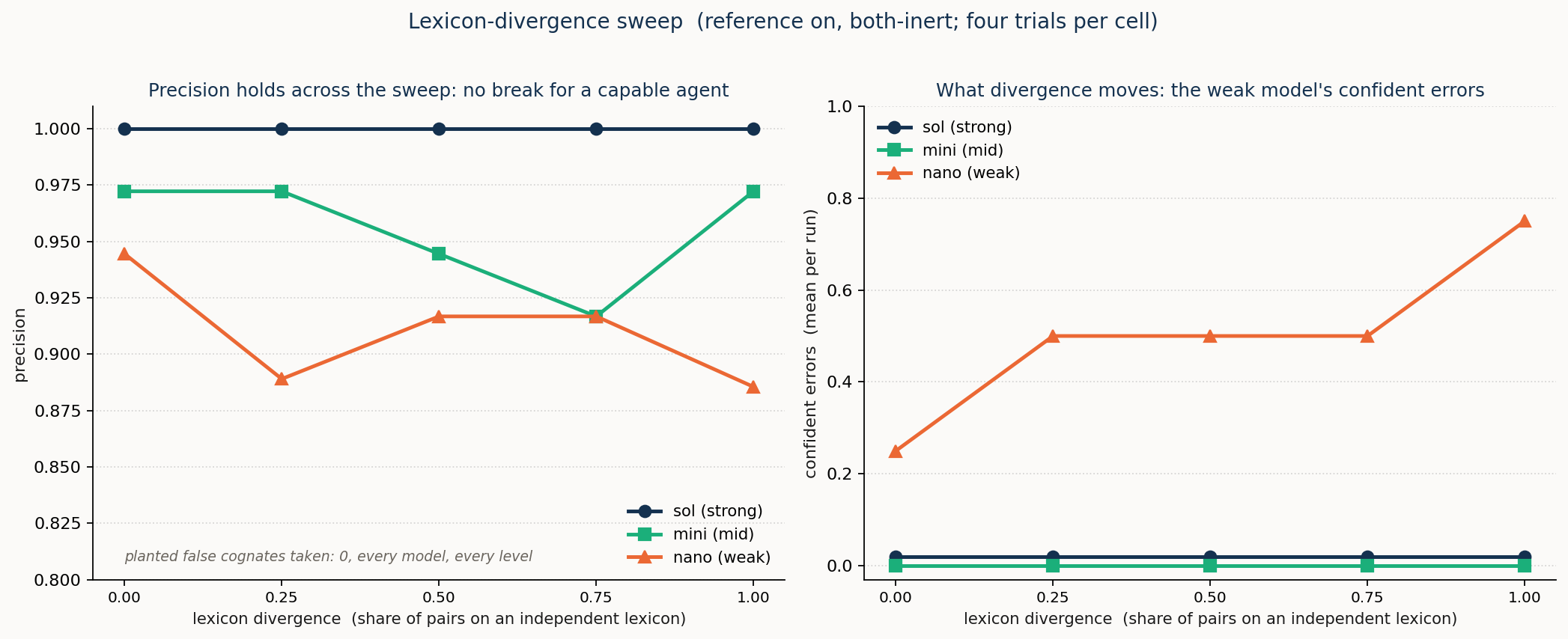
Figure 15. The two panels show the precision (left) and confident-error count (right) of agents aligning two independently-lexicalised schemas as their divergence grows, at both-inert (reference on, four trials per cell). Left: precision is flat at 1.00 for the strong agent, and no model takes a planted cross-lexicon false cognate at any level, so the guard never fails; the mid and weak agents vary in a narrow high band (spurious over-proposal, not trap-taking). Right: the one quantity divergence moves is the weak model’s confident-error count, which roughly triples across the sweep while the stronger two stay at zero.
The reference’s two roles run in opposite directions along the spectrum: its effort benefit peaks with strong, live cognition (§19.1), while its correctness benefit concentrates where cognition (and so verification) is weakest, disciplining the committing agent exactly where it would otherwise err. And independent of any per-reconciliation effect, a shared reference changes how the work scales with the number of systems: reconciled pairwise, every system must be aligned with every other (N(N−1)/2 operations, growing as N²); bound instead to one shared reference, each system is reconciled once against the anchor and any two then interoperate through it (N operations, linear). This is verified by construction to N = 12 (§15), and §19.8 puts it on real effort rather than a graph count.
19.4 Position on the reconciliation spectrum: what degrades, and how
Position on the reconciliation spectrum is the master variable, and moving along it degrades a reconciliation in a specific, measured way. This is sharpest in scenario 2, the intent scenario, where a consumer and a provider negotiate an intent to a workable deal, and the crux is a pragmatic judgement: whether a degraded counter-offer is acceptable to the customer. Across the reconciliation spectrum (Figure 16) that decision closes autonomously while the customer’s judgement is present (live at both-cognitive, or pre-placed as a portable policy) and falls to the floor at the mute and both-inert placements, where the correct behaviour is to refer the decision to a person. The pre-placed policy is the mechanism that holds the line where a mute customer cannot: cognition placed in a portable artefact ahead of time closes autonomously what a mute description must hand off.
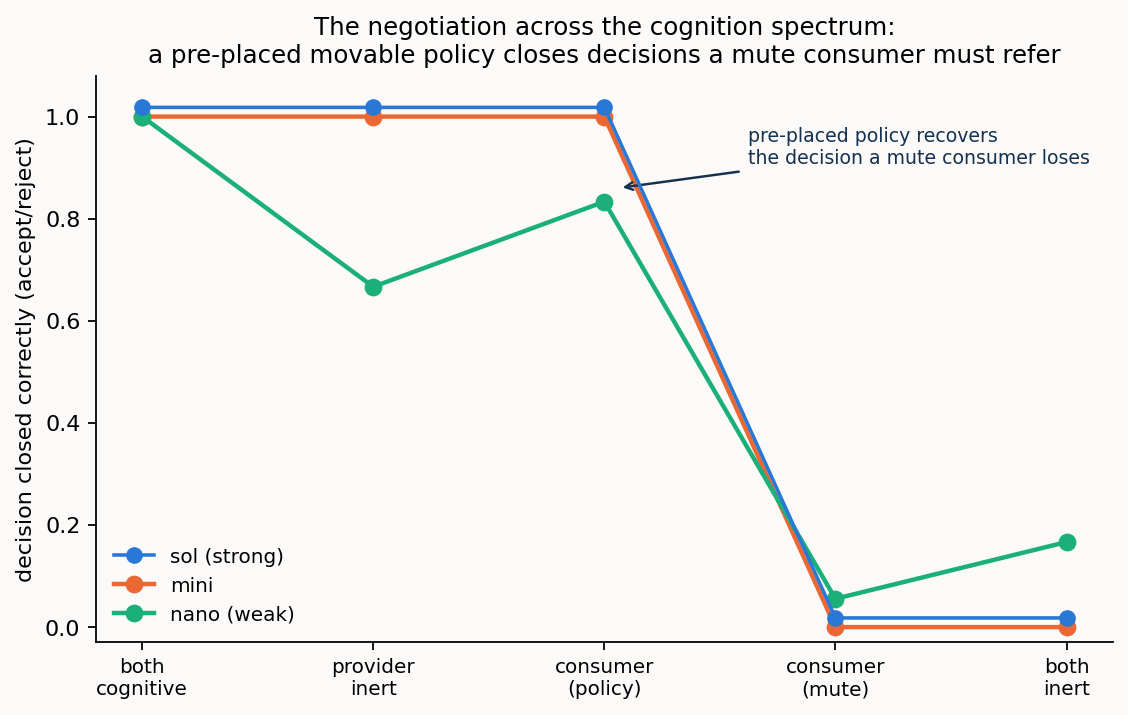
Figure 16 (scenario 2). This traces the decision accuracy of the customer side deciding whether to accept or refer a negotiated offer, across the reconciliation cognition spectrum. It holds high while the customer’s judgement is present (live, or pre-placed in a movable policy) and collapses to referral at consumer-mute and both-inert, where the correct behaviour is to hand the decision to a person.
The same logic reaches down to the instance level in scenario 1. Instance co-reference is deciding which individual on one side is the same as which on the other. Most pairs are settled from the models alone, but some are genuine look-alikes (structurally identical devices, or same-named but distinct services) that the static descriptions simply cannot separate. Telling those apart means acting on the live system: interrogating it, or provisioning something and reading it back. The number of such live probes the agent is permitted is its probe budget.
Whether spending that budget actually resolves the hard cases depends on placement, and Figure 17 shows why by crossing the two: it sweeps the probe budget (none, bounded, unbounded) at each of two spectrum placements. At both-cognitive the live side is there to be interrogated, so more budget resolves more: the residual falls to zero at unbounded budget. This is what budget-limited means: enough probing closes it. At one-inert the inert side is a static description with nothing live to interrogate, so the same unbounded budget barely moves the residual (it reaches only 0.08). This is what structural means: no budget can close it.
The two are crossed, not confounded (the identical budget sweep is run at both placements) so the curves isolate their interaction: probing pays off only where cognition is placed to be interrogated. That is the master-variable claim made concrete on a measured curve: the residual is fixed not by how hard the agent works but by where the cognition sits: at both-cognitive, effort (budget) buys a complete close; at one-inert, no effort can, because the thing that would answer the probe is not there to answer it.
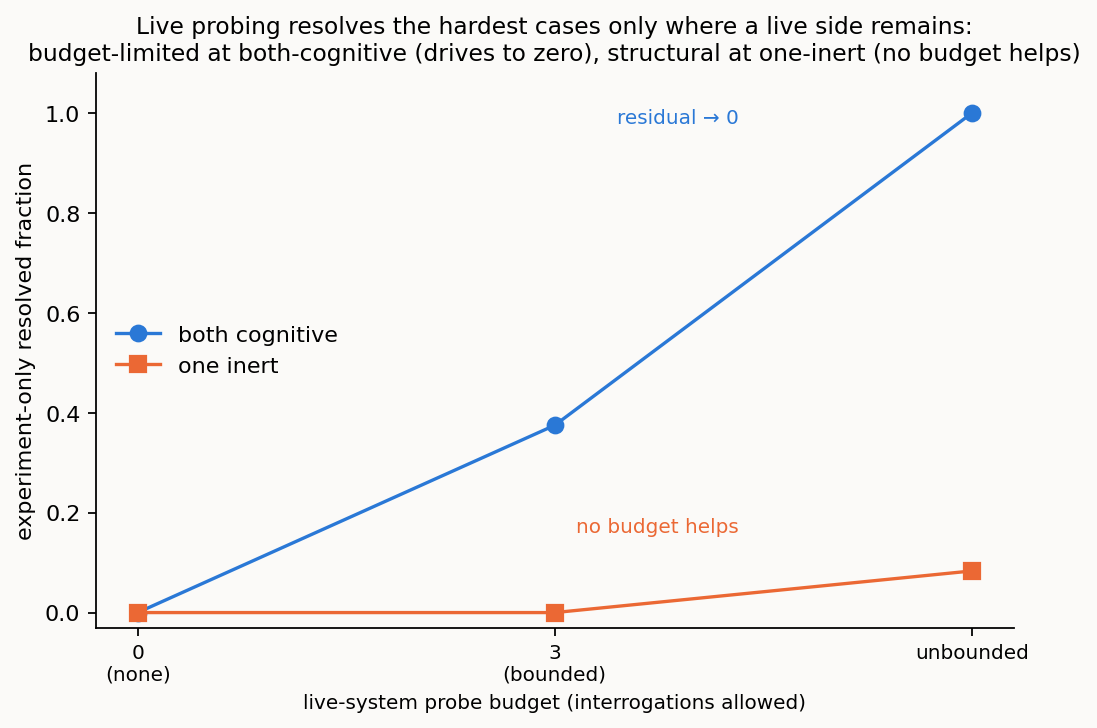
Figure 17 (scenario 1). The curves show the resolved fraction of the hardest look-alike individuals for the strong agent doing instance co-reference — deciding which individual on one side is which on the other — as the live-side probe budget is swept from none through bounded to unbounded, at two spectrum placements. Budget (the x-axis) and placement (the two lines) are crossed, so the curves isolate their interaction. At both-cognitive a live side can be interrogated and the residual is budget-limited: it drives to zero as probes are spent. At one-inert there is nothing live to probe and it is structural: no budget helps. Same sweep, opposite outcomes, decided by placement, not by effort.
19.5 Probe reach: how far an agent can question the live system
The instance result above raises a question worth separating out. When an agent must act on the live system to settle the hardest cases, what limits how far it gets: how capable the agent is, or how much it is allowed to see and to ask? These are not the same thing. A brilliant investigator handed only a one-line summary cannot do much; a modest one who may interview the witnesses can do a great deal. To tell the two apart, this reading holds the agent at its strongest and holds liveness at the top (both systems reasoning), and varies only what the agent is given to work with, along two axes.
The two axes separate a passive channel from an active one. The first, what it can see, is the passive floor: how much of each individual’s record is exposed to it, from just an opaque identifier, to that plus a name, plus its attributes, up to the full record including how it connects to its neighbours (its topology) — all of it static, read as given. The second, probe reach — what it can ask of the live system — is the active dimension: from nothing at all (decide from the record as given), to asking about a named attribute (where the agent must already know the field name to ask for it), to discovery (where it may ask the open question “what facts do you have?” and be told), up to running a small live experiment. As before, the measure is the share of the hardest cases settled correctly (the look-alike pairs that are identical on paper and can be told apart only by questioning the live system, which the study calls the experiment-only cases) reported alongside precision, the share of what the agent commits that is right.
The result (Figure 18, left panel) is clean, and because precision stays at 1.00 across the whole grid it is a real gradient, not an artefact of guessing. Seeing more helps, but only up to a point: given no ability to ask, the agent settles none of the hardest cases when it sees only an identifier, and rises to just half of them (0.50) even when it can see the entire static record. Static evidence, however complete, cannot separate twins that differ only in a fact the record does not carry. Being allowed to ask about a named attribute barely improves this: the agent has to know in advance which field to ask for. The jump is at discovery: the moment the agent may ask the open question “what do you have?”, every level of visibility goes straight to a full close (1.00). The decisive reach is not seeing more, and not even asking more, but being able to ask the question you did not know in advance to ask.
The same access lands differently depending on the agent’s power (Figure 18, right panel). Handed identical access, the strong agent converts it into a perfect close at perfect precision. The mid agent uses it but plateaus part-way, around 0.67 to 0.75. The weak agent posts high numbers that are not the same achievement: its precision slips (to 0.97–0.98) and it begins committing look-alikes, so its apparent resolution is partly indiscriminate binding rather than genuine settlement; read its resolved fraction without its precision beside it and you would misjudge it — a caution worth keeping in view. Power sets the ceiling that probe reach cannot exceed.
Two further probes sharpen the what it can ask axis by restoring the capability dimension the probe-reach study held fixed, and both land the same way. The first asks whether an agent that has noticed a record underdetermines a match can issue a targeted request for exactly the attribute that would settle it — the deliberate form of the discovery move above. Recognising the shortfall is easy for everyone: every agent asks rather than guesses, against a surface control pinned at the 0.50 guessing floor. Targeting it is not. The strong agent asks for the one disambiguating attribute and resolves every item (request accuracy 1.00); the mid agent usually finds it (0.89 of the time, resolving 0.94); the weak agent asks but cannot aim, requesting the wrong or a superfluous field and landing back at the guessing floor (0.50). Knowing a question is needed is not the same as knowing which question to ask. The second probe concerns the decision to escalate: when the cheap evidence a match needs is withheld, will the agent spend a probe — run the decisive experiment — to recover it? Denied the key, the strong agent roughly triples its probing and recovers essentially all the lost ground (resolved fraction 0.97); the weak agent barely escalates, probing about as much with the key gone as with it present, and its resolved fraction collapses by a third, to 0.46. And the escalation is reach-gated as well as capability-gated: a probe budget lifts the strong agent from a resolved fraction of 0.64 to a perfect close where a side is live to be interrogated, but buys almost nothing where the side has gone inert and there is nothing to ask. Both probes carry the caution the surprises below make general — the weak agent’s apparent restraint is not judgement but an inability to aim or to escalate, conservatism rather than competence.
The lesson is as much a design one as a scientific one. How far ad hoc reconciliation carries is not fixed by the agents alone; it is set jointly by how capable they are and by how interrogable the thing they meet is: whether the interface on the other side lets a capable agent ask the open questions it needs to.
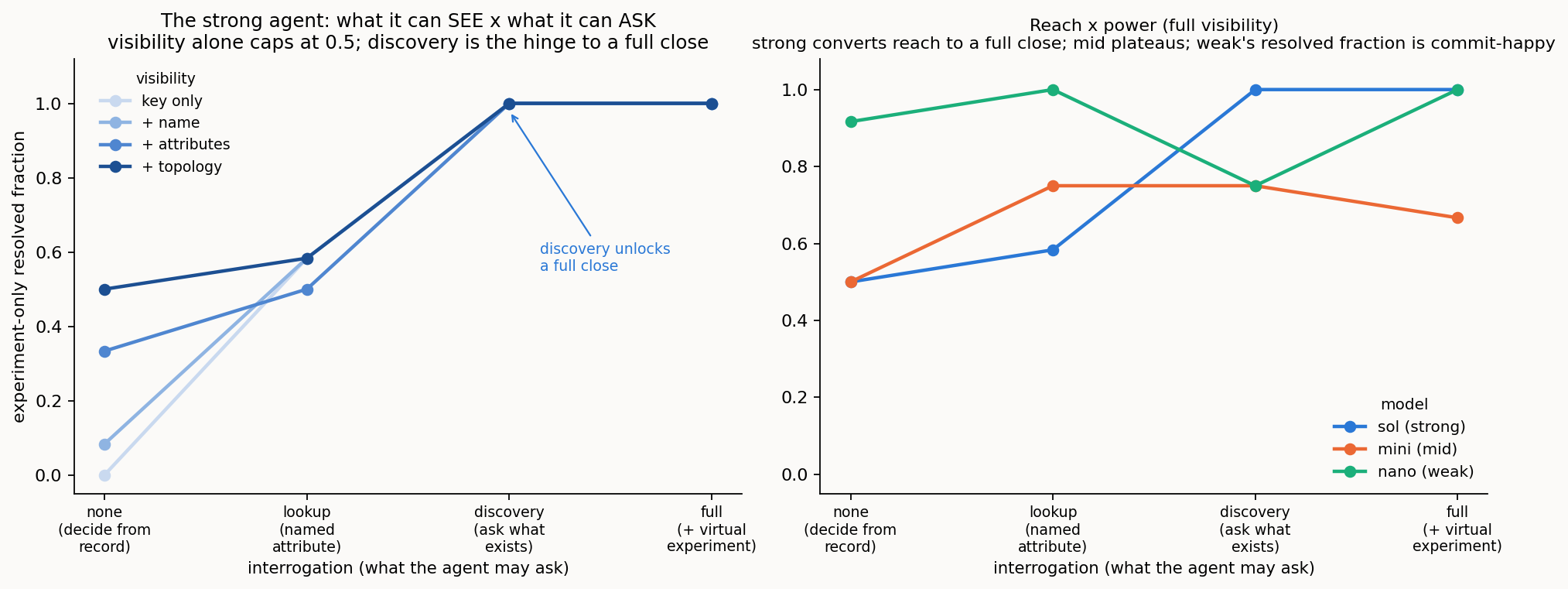
Figure 18 (probe reach). This is the share of the hardest (experiment-only) look-alike individuals settled correctly by the strong agent doing instance co-reference at both-cognitive, as its probe reach widens. Left: liveness held at the top; each line is one level of visibility (how much of the record it can see), and moving left to right widens what it may ask, from nothing, through asking a named attribute, to discovery (asking what exists), to a live experiment. Seeing more (higher lines at the left) caps at one-half; discovery collapses that spread to a full close, at precision 1.00 throughout. Right: the same left-to-right axis, now one line per agent at full visibility. The strong agent reaches a perfect close; the mid agent plateaus; the weak agent’s high values come with slipping precision (noted in the text), so they are not the same achievement.
19.6 The economics of the reference: when constructing it is worth the cognition cost
The reference weighed here is the dyadic shared common ground two models bind through to be reconciled (§5’s second role) — not the meaning-supply reference a single lift may absorb. The standard-free scenario (§17) showed that where no standard exists, the two reconciling agents can jointly build the thin shared reference themselves and then bind through it, lifting a stalled reconciliation to a near-complete close. Building a reference is, however, itself an act of cognition, and that cognition is not free. So a sharper question follows, and it is the one an operator would actually ask: is it worth building a reference every time, or only sometimes? To answer it we ran the same reconciliation three ways on each of the three schema scenarios, and (this is the new measurement) recorded not just the close each reached but the cognition each spent, counting the cost of constructing the reference separately from the cost of binding through it. The three ways are: no reference (the agents bind with nothing shared to lean on, the floor); constructed (the agents build the reference themselves, then bind, the standard-free protocol, whose cost we are weighing); and given reference (the agents bind through a small, already-published reference, a standard, the cheap upper bound). Two plain reminders, since they carry the result: resolved fraction is, of the true correspondences that exist, the share the agent finds and commits, the completeness of the close; and reasoning tokens are the model’s hidden deliberation, a direct measure of how hard it worked.
The answer is a rule, not a blanket habit, and it has three parts (Figure 19). Constructing the reference is load-bearing only where no standard exists and the agent is capable. In the standard-free scenario (two private models, no shared standard) the two agents with no shared reference reach only a fifth of the true matches (resolved fraction 0.20, because they honestly refuse to guess a seam they cannot be sure of) and constructing the reference themselves carries them to 0.80, and to 0.90 when they also run a decisive experiment on the candidates, for a few thousand reasoning tokens of construction. There is no cheaper route, because there is no standard to bind through; the construction spend is what buys the close. Where an effective reference already exists, constructing one is redundant. In the configuration and observability scenarios, binding through the given reference reaches the same close for a fraction of the cognition: the strong agent binds through the given reference to a full close for a few hundred reasoning tokens, where constructing one spends several thousand for no better result. Building what you already have is wasted effort. And construction is capability-gated. A weak agent cannot build a good reference cheaply: the same non-convergence that makes weak two-agent negotiation expensive, grinding to the round limit at tens of thousands of tokens, makes weak construction expensive too, and for a worse close. Handing construction to a weak agent is maximum spend for minimum return.
Two things this sharpens. First, it puts a number on how cheap a given reference is for a capable agent (tens to low hundreds of reasoning tokens to bind through) which is exactly why a pre-agreed standard is worth so much: someone paid the construction cost once, and everyone binds through it cheaply thereafter. Second, it keeps one honest caveat in view. “Redundant for this one close” is not “worthless”: a constructed reference is a durable, reusable, auditable artifact, and a standard is simply a constructed reference that has been amortised across everyone who binds through it. So the rule has two regimes: for a one-off reconciliation between capable live agents, build the reference only where no standard exists; but at scale, or over time, building it once and keeping it pays even where any single close did not need it. That, in the end, is the argument for lightweight shared references (constructed ad hoc when none exists, reused when they do) over either a heavy universal standard agreed in advance or paying the construction cost afresh on every exchange.
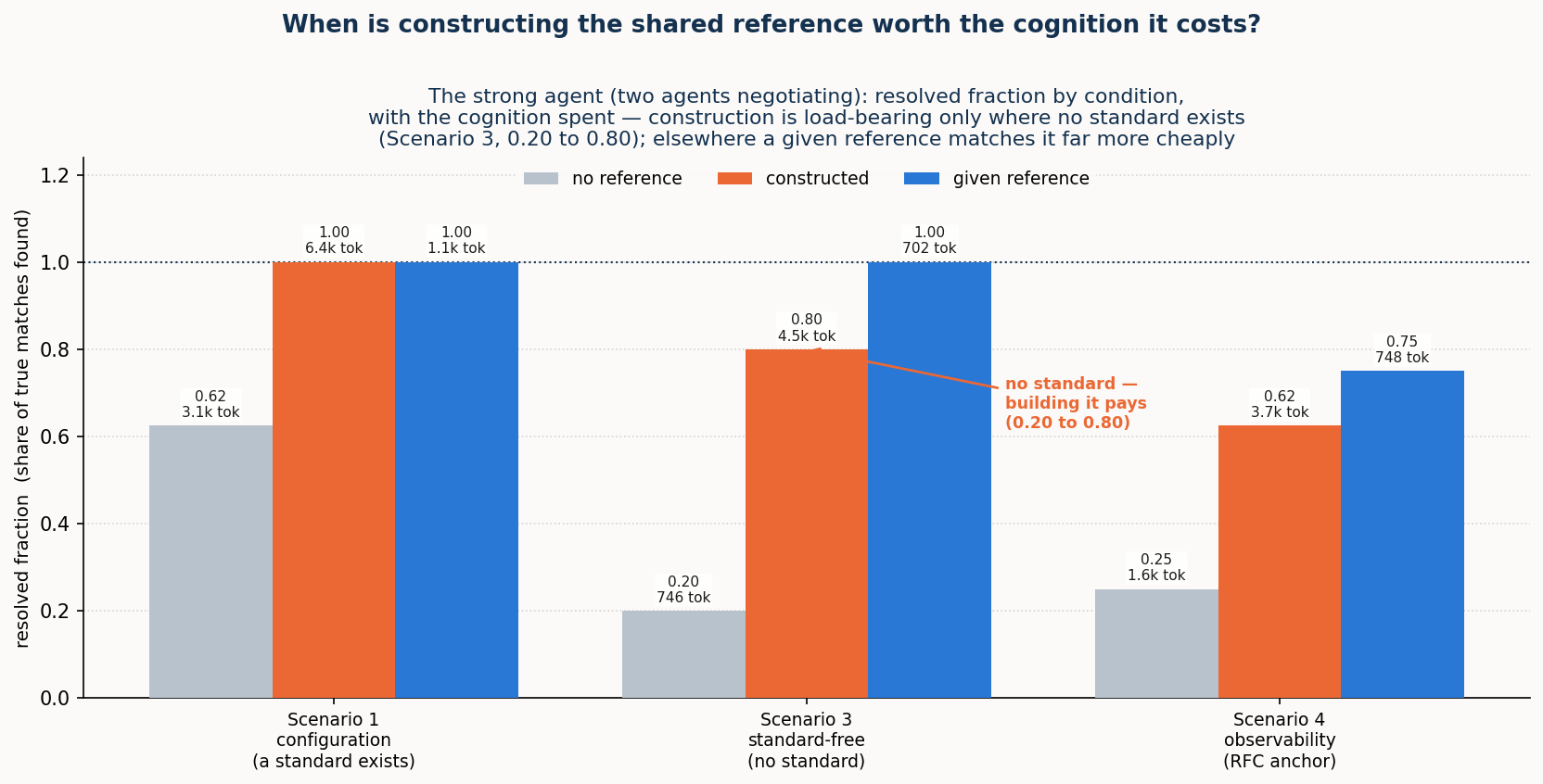
Figure 19 (when constructing a reference is worth it). The bars give the strong agent’s resolved fraction under three reference conditions — no shared reference (grey), one the agents construct themselves (orange), and a given, already-published reference (blue) — across the schema scenarios, with the reasoning each condition spent noted on each bar. In scenario 3, where no standard exists, constructing the reference lifts the two agents from 0.20 to 0.80 (0.90 with a decisive experiment on the candidates) and is the realistic path; in scenarios 1 and 4 a given reference reaches the same close for a fraction of the cognition, so constructing one is redundant. Construction is capability-gated: a weak agent pays far more to build a worse reference, as the six-model ladder’s non-convergence at the weak end shows.
19.7 The negotiation in the act, and the decisive experiment
The numbers above are outcomes; the process that produces them is itself a result, because it is a window
into machine cognition reconciling. The box below is a verbatim excerpt, lightly trimmed, of two live
agents reconciling the cross-domain seam: Agent A holding only the transport model (the m.* concepts),
Agent B only the IP-service model (the c.* concepts), each seeing the other only through a surface
catalogue and the answers it volunteers.
Without a shared reference — interrogate, then defer. A → B: “Is
ratethe guaranteed end-to-end client payload rate, a physical bearer line rate, or an IP-service commitment?” … (eight questions, one per concept). B → A:m.rate= “the committed client payload rate guaranteed end to end by the transport circuit”;c.rate= “the committed information rate guaranteed to customer traffic by the IP service”. A proposes, B ratifies — one correspondence:c.underlay ↔ m.circuit, “both denote the transport circuit itself.” Accepted. Everything else — rate, latency, protection, the attachment point — is a transport-domain view set against a service-domain view; neither side asserts the pairing without more ground, so all are referred onward. Confirmed 1 of 5; precision 1.00, resolved fraction 0.20.With a thin shared reference — bind through it. Same interrogation; then, each concept now carrying its binding to a shared entry, A proposes five correspondences at confidence 1.00 and B ratifies all five:
m.rate ↔ c.rate,m.latency ↔ c.latency,m.protection ↔ c.protection,m.handoff ↔ c.attachment,m.circuit ↔ c.underlay. The stated rationale names exactly what the reference settled: “Although A represents a measured propagation value and B represents its SLA tier, they correspond.” Confirmed 5; precision 1.00, resolved fraction 1.00.Refused in both conditions.
m.grade ↔ c.gradeis never proposed: a transport quality grade (protection and restoration class) is not an IP class of service (scheduling and drop priority). The planted false cognate is declined with or without the reference.One illustrative run of one case; the rationales are the agents’ own stated reasons, presented as such.
Two things in the box are the programme’s claims caught in the act. The interrogation is real, not asserted: the agents ask and answer about each concept before deciding, and because each is the authority on its own side a correspondence is confirmed only when one proposes it and the other ratifies. And the behaviour is honestly conservative: without a shared reference two careful agents confirm only the one identity they are sure of and defer the rest rather than guess across the transport/service divide, and a thin shared reference is exactly what lets them bind the pairs they otherwise defer.
Where the agents are unsure, though, they need not defer. At both-cognitive they can run a decisive virtual experiment: provision a candidate correspondence in virtual space, operate it, and read back whether the invariants a correct translation must preserve still hold, so the question is settled by operation rather than by argument. The box below is that experiment firing, verbatim, on the configuration case with no reference.
The decisive experiment settles what dialogue defers (configuration, no reference). Two agents reconcile TAPI (
t.*) with TEAS (i.*). Where a candidate is uncertain, an agent provisions it in virtual space and reads the verdict back: A: provisiont.sip ↔ i.ttp? (does a service-interface point translate to a tunnel-termination point?) → REFUTE [no-correspondence] — both sides then mark those concepts no-counterpart. A: provisiont.cs ↔ i.tunnel? (does the external connectivity-service abstraction translate to the tunnel that realises it?) → CONFIRM [identity]. A: provisiont.lpq ↔ i.otnlabel? → CONFIRM; andt.translink ↔ i.stp→ CONFIRM. The agents then ratify citing the verdict verbatim — “the decisive experiment confirmed identity” — and the reconciliation closes fully: nine confirmed, precision 1.00, resolved fraction 1.00, four experiments spent, no reference. The correspondences dialogue would have deferred — a service abstraction against the tunnel that realises it — are settled by operation, and a look-alike is refused the same way. Given that power, two agents reach the reference’s close without a reference on three of the four schema scenarios, and refute a suspected false cognate by operation. The one exception is the cross-domain seam above: there the correspondences do not exist in either agent’s private model as candidates to test — they live only in a constructed shared frame — so the experiment settles the candidates the agents can pose but cannot, by itself, surface the ones a construction must first make visible. Construction surfaces the candidates; the experiment settles them; a shared reference amortises both. That is the completion the fully-cognitive case promises, shown rather than argued.
Measured apart, the decisive experiment and the agent’s own record-reading verification prove to be genuinely different authorities, and the difference is one of reach. Where an independent graph oracle (one that needs no gold key) can act, it is faithful — perfect where both sides are live; the agent’s verifier, judging the same proposals, agrees with it about 64% of the time, and every disagreement is the agent over-passing a byte-clean wrong pair the experiment refutes (every split goes the oracle’s way). But the oracle’s authority is bought with liveness, and its reach recedes exactly as it is most needed: its coverage falls from 11 of fourteen proposals to 3 to 0 as the sides go inert, while the proposals the agent must adjudicate alone rise 3 → 11 → 14. So the decisive experiment is the better authority where cognition is already strong and absent where the agent is most alone — distinct from negotiation in kind, and more sharply in reach. (An independent graph oracle is used here; a full operational emulator or digital twin, which would extend the experiment’s reach into the inert placements, remains ahead.)
A matching pair of results locates where the negotiation is, and is not, two-sided. The intent scenario is framed as a two-sided negotiation, and how much of the outcome the second party’s reasoning carries can be measured directly, by replacing the deterministic best-achievable oracle with an actual second reasoning agent and watching what moves. In the scenario as first built, almost nothing does: the live provider agent reproduces the oracle’s offers (0.89 to 1.00 across the ladder) and its accept-or-refer outcomes more closely still (0.96 to 1.00). But that is a property of how the provider’s side was posed, not a general truth. There the provider chooses from a fixed catalogue of concrete offers, so “the best-achievable offer” is a solved optimisation with nothing left to reason about, and a reasoning agent in that seat simply recomputes it. The honest scope of the null is therefore narrow: the two-sided language is unearned where the provider reduces to selecting from a fixed menu.
Give the provider something to reason about and the second agent begins to matter. A real provider must also judge whether it can deliver a realisation against its own network state, and may decline or counter-propose. Adding a live capacity state — each realisation runs on a bearer path, and a path can be saturated, so an attractive realisation may be undeliverable now — turns the provider’s task from a menu pick into a feasibility judgement. Now a reasoning provider diverges from the catalogue oracle exactly where deliverability binds: its divergence is ~0 while every path is clear (the earlier regime reproduced) and rises to 0.56 and then 1.0 as paths saturate, because it must counter-propose a deliverable alternative or decline. The naive catalogue oracle, ignoring capacity, offers a service it cannot deliver in 52% of those cells; every reasoning provider, across the whole ladder, offers offers none (Figure 20). In that figure, divergence from the catalogue oracle is the share of cells where the reasoning provider’s chosen offer differs from the naive catalogue pick, read across three regimes of increasing path saturation — clear, constrained, outage. So the negotiation is genuinely two-sided wherever the provider must weigh its own deliverability — and, unlike the sharply capability-gated pragmatic verdict, this particular reasoning is robust: even the weak model avoids undeliverable offers, its only slippage a little optimisation error. The “two-sided negotiation” language is thus not retired but scoped: unearned over a fixed catalogue, earned once deliverability is live.
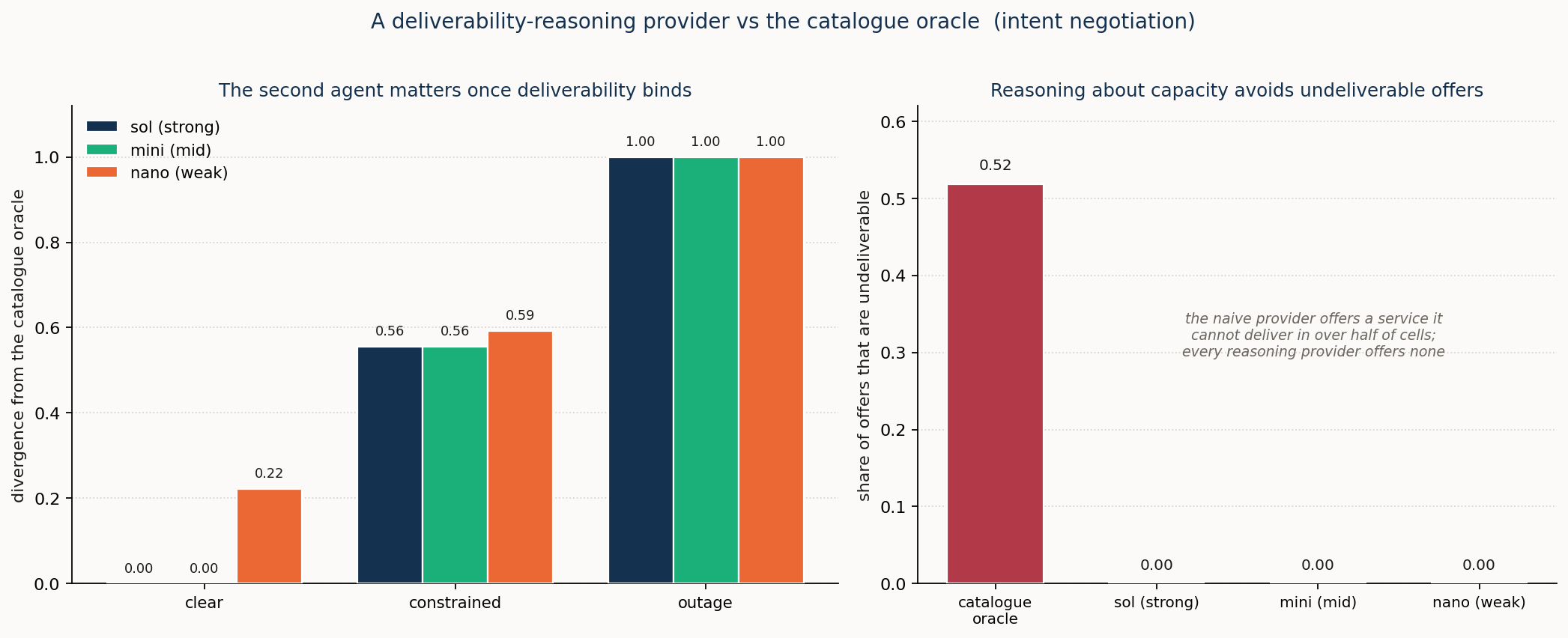
Figure 20 (scenario 2). This sets a deliverability-reasoning provider, judging its own deliverability within the intent negotiation (both sides live), against a naive catalogue oracle. Left: the provider’s divergence from the catalogue oracle (the share of cells where its chosen offer differs from the catalogue pick) by regime — near zero while paths are clear (where a second agent changes nothing), rising as paths saturate and the provider must counter-propose or decline. Right: the share of offers that are undeliverable — the catalogue oracle offers an undeliverable service in 0.52 of cells, while every reasoning provider across the ladder offers none. The two panels are the same cells seen twice: the catalogue’s 0.52 is the average of the provider’s per-regime divergence, because the provider diverges from the catalogue precisely where its pick cannot be delivered, and diverges toward a deliverable alternative — so its own undeliverable rate is zero. The weak model diverges a little even while paths are clear, harmlessly swapping one deliverable option for another, which is why its left bar runs higher while its undeliverable rate stays at zero.
19.8 Producing the inputs: the lift, alignment, reuse, and derivation
A reconciliation needs inputs — two lifted models, and often a shared reference or a settled authority to bind through — and a fair challenge is whether the study has shown only reconciliation given those inputs while the hard part is producing them. Put under test, the inputs prove more often producible than assumed, under the same capability caveat that governs everything else.
Start with the most basic input, the lift itself. Every scenario above ran over authored fixture lifts, and §7 showed an agent can produce an equally faithful lift from the schema surface alone — which leaves open whether the reconciliation results lean on that authoring. They do not. Reconciling over the agent-produced lift, under the same conditions, lands in the same regime as over the fixture, and for the capable agent binding through a reference — the mainline condition the study leans on — it is identical across all four scenarios (Table 4). The divergences that do appear are the study’s own capability-gating, not a new failure: at mid capability the agent-lifted standard-free case slips the same false cognate the strong agent and the fixture avoid, while on the configuration cases the agent’s own glosses make the mid agent a little more conservative, holding precision at 1.00. The agent’s glosses overlap the fixture’s only weakly in wording (a lexical fidelity of 0.13 to 0.23), yet reconciliation stays in the same regime: the lift need not reproduce the authored phrasing to carry the same meaning. So the most fundamental input is producible too, and, like consuming a lift, producing one is gated by cognitive power — a few hundred reasoning tokens for the strong agent, several thousand for the mid. (The lift here is from the curated schema surface; the lift from raw schema text and a cold start with no instances remain for real-data work, §23.)
| scenario | model | no-ref: fixture | no-ref: agent-lift | ref: fixture | ref: agent-lift |
|---|---|---|---|---|---|
| configuration (flagship) | strong | 0.56 (1.00) | 0.56 (1.00) | 1.00 (1.00) | 1.00 (1.00) |
| configuration (hard) | strong | 0.83 (1.00) | 0.75 (1.00) | 1.00 (1.00) | 1.00 (1.00) |
| standard-free | strong | 0.20 (1.00) | 0.00 (0.00) | 1.00 (1.00) | 1.00 (1.00) |
| observability | strong | 0.25 (1.00) | 0.50 (1.00) | 0.75 (1.00) | 0.75 (1.00) |
| configuration (flagship) | mid | 1.00 (0.90) | 0.78 (1.00) | 1.00 (1.00) | 0.78 (1.00) |
| configuration (hard) | mid | 1.00 (0.92) | 0.86 (1.00) | 0.92 (1.00) | 0.92 (0.92) |
| standard-free | mid | 1.00 (1.00) | 0.80 (0.80)† | 0.80 (1.00) | 1.00 (0.83)† |
| observability | mid | 0.50 (1.00) | 0.75 (1.00) | 0.75 (1.00) | 0.75 (1.00) |
Table 4. Resolved fraction (precision in parentheses), fixture lift versus agent-produced lift, at both-cognitive, with and without the shared reference, on the strong and mid agents. Coverage 1.00 throughout: the agent glossed every concept. †the agent-lift committed one false cognate the fixture avoided (surviving false cognate = 1); false cognates were zero in every other cell. The no-reference columns are the deliberately hard, construction-bracketed condition; their sub-one values are that hard case rather than the method failing — the reference columns are the mainline result.
Aligning two independently authored lexicons — no reference id shared across sides, the harder half of the schema bind — is tractable for a capable agent: it holds precision 1.00 by aligning the two vocabularies on their meaning, where a shared reference would have supplied the alignment for free (§19.3). The hard half is doable; it is doable by cognition, and it is capability-gated.
Reuse turns the scaling argument from a structural count into a measured economy. Onboarding a genuinely new system against an established shared reference is linear where pairwise integration is quadratic, and the effort bears it out: reuse is 2.0 to 2.7× cheaper in total tokens and holds the resolved fraction where the pairwise route lets it slip — cheaper and more accurate at once. the scaling claim is now exercised on real effort, not only counted on the interoperability graph.
And the two structured inputs a reconciliation leans on turn out to be derivable rather than necessarily hand-authored. The observability dependency map the correlation operation runs on can be derived by an agent from raw inventory through a multi-hop join, resolving a bundle indirection and refusing a name lure, so this structured input too is producible rather than hand-authored (that correlation runs as well on the derived map as on a given one is §19.9). Cross-domain authority, whose realm owns a contested field, can be derived from an external artefact such as an interconnect agreement: structure-only attribution is sharply capability-gated (a correct attribution 1.00 of the time for the strong agent, 0.47 and 0.40 for the mid and weak, the weak agent taking a transport lure), but the artefact lifts every agent to a full, correct attribution while the agent still defers on the field the artefact leaves co-owned. And when two authority sources contradict each other, every agent along the ladder surfaces the conflict rather than silently choosing a side — the failure one might fear does not occur when the disagreement is visible.
The line these results draw is sharper than “reconciliation works given its inputs”: producing the inputs is itself often achievable, an external artefact or reference is the reliable route to it, and the residual risk is the capability-gated confident error the rest of this section has traced — which is why an abstain path and a floor on reference quality matter as much as the reconciliation they protect.
19.9 The pragmatic operations, individually
§8 argued that the resolved pragmatic layer is supplied not by any lift but by a live operation over the model, and predicted that the operations would split by capability. Put individually under test, the three bear it out, each with its own regime. Pragmatic resolution — the significance verdict — delivers a large gain for capable agents and almost none for the weak one: +0.33 and +0.58 verdict accuracy for the strong and mid agents, +0.03 for the weak. The operation is real and the context changes the right action, but only an agent strong enough to carry the pragmatics collects the benefit. Attribute pinning — fixing a shared field’s operative meaning, a committed rate against a line rate — runs the opposite way, as a weak-model compensator: it buys the strong agent essentially nothing (it already drew the distinction) and the weak agent about +0.19 in the accuracy of that distinction, standing in for a discrimination it could not make itself. And correlation — grouping reconciled parts into wholes, several symptoms into one incident — is the structural input the framework predicts is robust: unconditionally needed (with it off, the two weaker agents resolve none of the multi-symptom structure) and, once on, holding across the whole ladder. Two further results show correlation is a genuine, portable operation rather than an observability artefact: it returns the same partition-exact result in the configuration scenario, so it generalises beyond the scenario it was found in; and it survives a self-derived dependency map: on a map an agent derived itself from raw inventory (§19.8), correlation matches the given-map baseline. The structural pragmatic does not depend on a hand-fed input any more than the descriptive reference did.
Part 3: Conclusions
20. What works, and how far
Read against the two-part frame, the results say one thing at two scales.
At the scale of a single lift, portability is real, and directly measured. A model lifted with care is comprehensible to an arbitrary reasoner from the package alone — not inferred through a downstream use such as reconciliation — across the strong and middle tiers and, on all but the hardest of six independent cases, the weak tier too (meaning scores at or near the ceiling, softening only to 0.73 for the weakest reasoner on the single hardest seam). It holds across model families, a strong reasoner from another family reading a lift as well as the home one; it is capability-banded, with an honest floor where a weak open model confabulates and an honest failure mode where a meaning-poor surface breaks the lift; a reference used in the lift repairs that failure; and the measure that shows all of this is judge-independent (§6). That is the object the programme produces.
The lift that produces it is itself agent-performable, within stated limits. An agent asked to lift a side from its schema surface alone produces a model that reconciles as the authored one does — identically, for the capable agent binding through a reference, across all four scenarios (§7, §19.8). But the qualifications are real and measured: the cost is capability-gated (a few hundred reasoning tokens for the strong agent, several thousand for the mid); the agent’s own glosses carry the meaning without reproducing the authored wording (a lexical fidelity of 0.13–0.23); one soft cell remains, where a mid agent’s self-lift took a cross-domain cognate the fixture avoided; and what stays ahead is the lift from raw schema text and a cold start with no instances yet to read (§23). Within those limits, who performs the lift does not change the object.
Put two such objects to use, and the plain thing holds too: ad hoc reconciliation works, largely as laid out, with a handful of instructive exceptions (§22). Reconciliation is an operation with its own objective — bridging the genuine divergence between two adequate models — with any shortfall in either lift’s portability adding burden on top rather than being what the operation is. Two cognitive agents reconcile independently authored, divergent models correctly and with no bridging standard agreed in advance: completing an equivalence between two standard models (scenario 1), refining and negotiating an intent against a catalogue (scenario 2), binding across a private domain boundary once they have built the shared ground (scenario 3), and reading an observability world for what its signals mean (scenario 4), measured against a validated gold across the reconciliation spectrum, not shown once by hand.
The same exploration says, more sharply, where the reconciliation needs no help. At the fully-cognitive end of the spectrum it completes autonomously: no bridging standard agreed in advance, no human in the loop. For the schema bind the two live agents reach a full close through a shared or constructed reference, or by running a decisive virtual experiment on the candidates they are unsure of; negotiating alone they defer the hardest correspondences rather than guess, the honest behaviour, not a failure. And it completes autonomously on the two operations that look least automatable: a two-sided negotiation (scenario 2, decision accuracy 1.0 with both sides live) and the significance verdict, deciding, for each anomaly, whether to act, watch, or suppress (scenario 4, accuracy 1.0 with the pragmatics on).
The two-sidedness of that negotiation carries one scope caveat (§19.7). Where the provider merely selects from a fixed catalogue, replacing it with an actual second reasoning agent changes the outcome almost nothing — the exchange there is one-sided refinement against a checkable oracle. Give the provider its own deliverability to judge, and the second agent diverges substantially: the negotiation is then genuinely two-sided.
Across all four scenarios, then, the fully-cognitive end is the automatable end. That is the headline of these conclusions; everything else qualifies it — how the automation degrades as cognition recedes, what a thin reference buys back, and where an agent too weak for the task cuts the whole thing off.
Nor is the reconciliation confined to the case where its inputs arrive ready-made. The harder half — not reconciling two models that already share a reference, but producing and aligning the inputs themselves — is largely within reach of the same cognition: aligning two independently authored lexicons, onboarding a new system by reuse, deriving the dependency map from raw inventory, and deriving cross-domain authority from an external artefact are each tractable, each capability-gated, and each reliably rescued by an external reference or artefact where a weaker agent falls short (§19.8). And the whole pattern is not an artefact of one model lineage: the sharp findings replicate across three model families and two capability tiers — and, in one instance, a claim that looked like a structural law turned out to be a single family’s disposition, which only the cross-family check revealed (§23).
21. The findings, as theses, and mapped to where they act
The results gather into theses in two groups, matching the two-part frame: first the portability theses (the object a lift produces, Part 1), then the reconciliation theses (its flagship use, Part 2). Each is stated once here, with a pointer to where its evidence lives: the portability theses to the direct measurements of §6 and the lift studies of §7–8, and the reconciliation theses to the four scenarios (§15–18) and the cross-cutting readings of §19.
Portability: the object a lift produces
Thesis P1. A careful lift produces a portable model, comprehensible to an arbitrary reasoner from the package alone. Measured directly, decoupled from any downstream reconciliation: a solid lift scores at or near a perfect meaning-score across the reasoning ladder — the strong tier at the ceiling throughout, the middle and weak tiers at the ceiling on routine material and softening on the hardest (middle to 0.87–0.94, weak to 0.73–0.89), across six independent cases. The lift bakes portability in, and the model stands on its own.
Thesis P2. Portability is family-independent and capability-banded, with an honest floor: it does not require prior knowledge of the particular system or schema, and tracks the reader’s capability, not its model lineage. A strong reasoner from another family (DeepSeek) comprehends a lift as well as the home strong model (0.98 against 1.00), so portability is not an artefact of one model family; an open weak model (Qwen-2.5-7B) drops to 0.56 and confabulates. What sets the band is reasoning above a threshold, not who trained the reader or whether it had seen this system before — the operational definition of portability made visible.
Thesis P3. Portability is a capability-banded property of the lift: a meaning-poor surface breaks it, a reference used in the lift recovers much of the loss, and a bare name is a trap. Against a solid-lift baseline of 0.94, a lift from a meaning-poor surface falls to 0.64–0.74; giving the lifter a reference restores it to 0.79–0.85 at every level of degradation, baking the repair in at production. And the damage is not monotonic in how thin the surface is: a surface that keeps names but strips their meaning is no safer than an anonymous one, because a bare name invites the lifter to confabulate a sense for it. It is meaning-bearing surface, not surface volume, that makes a lift portable.
Thesis P4. The direct measure of portability is judge-independent. Grading the same frozen answers with a second, cross-family judge returns the identical meaning-score (0.900), the judges agreeing on nine in ten individual calls and never disagreeing on the clear cases; the residual sits on the weak reasoner’s hedged answers and cancels. The measure is not lenient toward its own family, on either the consumer’s side or the judge’s.
Reconciliation: bridging divergence between portable models
The reconciliation theses below describe what happens when two of these portable models must be made to work together — the flagship use, where cognition bridges the genuine divergence between the two models and, per §10, any portability shortfall in either lift adds burden on top.
Thesis R1. It is cognition that completes a reconciliation: descriptor methods carry it most of the way, then reach a ceiling and stop. Lexical and descriptor matching carry a reconciliation only so far (scenario 1’s deterministic controls: a reference-blind matcher on the bare lexical surface resolves about two-thirds and takes a trap); the remainder, historically left to a standard or a person, is closed by live cognition instead. This is the programme’s spine, and it holds at every operation the scenarios put under test. It holds against a strong classical matcher, not only the plain label baseline: a matcher using labels, synonyms, definitions, and structure with a 1:1 alignment reaches precision one and refuses the false cognates on the standard cases, but it cannot close (its resolved fraction stalls at 0.56 to 0.75) and on the standard-free case it fails like the weak baseline, taking the grade cognate, because with two private vocabularies there is no lexical or structural signal to lean on. The ceiling is real even for a good descriptor method; cognition is what passes it.
Thesis R2. The placement of cognition is the master variable: the further it recedes, the more the reconciliation leaves unresolved. What a reconciliation can achieve, cost, and verify is governed by where the cognition sits. Between two live agents, resolution is complete in principle (unbounded interrogation and decisive virtual experiment) so the cognition-closable residual is, in principle, none — the irreducible authority and underdetermination residues of §2 and §9 aside; as a side goes inert those mechanisms fall away and a cognition-shortfall residual appears, precisely the shortfall from full cognition’s reach. The same story holds at the schema level (scenario 1), the instance level (scenario 1’s budget-limited-becomes-structural curve, §19.4), the negotiation (scenario 2), and the standard-free bind (scenario 3). And it governs one thing that cuts across all four scenarios: whether a reconciliation can be verified to completion. This is the crux of the spectrum. With full cognition on both sides, the very mechanisms that close the residual (mutual interrogation and decisive virtual experiment) also confirm the close, so the agents verify their own result rather than assert it; as a side goes inert those mechanisms fall away, verification degrades to a check by satisfaction, and the assurance that the reconciliation is correct weakens with it. Full cognition is therefore not merely more accurate: it is what makes an ad hoc reconciliation self-verifying, and that (not accuracy alone) is what makes it safe to automate with no bridging standard and no person in the loop.
Thesis R3. A thin reference partly substitutes for cognition and supplies information, but never provides the authority to decide. For a capable agent on a lexical/structural task it substitutes for the reasoning (scenario 1, effort down severalfold, a perfect verified close); where a side is inert it supplies the facts interrogation no longer can (scenario 2, sol 0.29→0.71 with the invariant floor; scenario 4, the RFC 9940 reference rescuing the mid agent’s ontology); but where the missing ingredient is judgement rather than fact, no reference moves it (scenario 2’s authority gap, scenario 3’s authority attribution). Information has a published stand-in; authority does not.
Thesis R4. A strong agent’s failure is omission, a weak agent’s is commission, and two-agent negotiation suppresses commission by ratification. Denied the ground it needs, a strong agent defers: it leaves the unresolved in the residual at perfect precision (scenario 3’s under-commitment; scenario 2’s strong agent refusing to affirm what it cannot verify). A weak agent’s error is commission (binding freely and wrongly, taking the false cognate) but where it shows depends on how the cognition is placed. Where a single agent must reconstruct a side, at the inert placements, commission is unchecked: the weak agent takes the traps and its precision falls. At both-cognitive, though, no side binds unilaterally: each proposal must be ratified by the concept’s owner, and that bilateral loop refuses the weak agent’s over-commitments. Swept across a six-model capability ladder at both-cognitive, the negotiation holds precision high and drives surviving false cognates to zero for all but the weakest model (the two-agent structure itself doing verification work) while resolution is uniformly lower (deferral) and the weakest agents fail by non-convergence rather than by confident error. So the reference’s correctness value (pulling right the bindings that would otherwise go wrong) concentrates where a single weak agent reconstructs, exactly where negotiation’s discipline is unavailable; its effort value (the reasoning it saves) peaks where a single strong agent reconstructs an inert side. One thin artifact, a different benefit at each end of the spectrum, and at both-cognitive the negotiation supplies much of the discipline itself.
Thesis R5. The pragmatic layer (what a thing means in context and whether it matters) is the frontier the descriptor methods never reach: decisive and itself gated by cognitive power. What a reconciled thing is for, whether a degraded offer is acceptable (scenario 2), whose realm owns a field (scenario 3), whether an anomaly warrants a page (scenario 4), is where the operative meaning lives, and it is beyond the reach of names, glosses, and references. It is carried by cognition (or by cognition pre-placed as a policy), and its payoff is realised only by an agent strong enough to carry it, a matter of the agent’s power, not of where cognition is placed: handed identical annotations, the weak agent still cannot produce the verdict (scenario 4). The one exception proves the rule: where a pragmatic is delivered as a structural input rather than a judgement (scenario 4’s correlation dependency map), even a weak agent applies it.
Thesis R6. A shared reference makes reconciliation scale, and what makes a reference work is meaning-bearing description — not a pointer, and not field-count. Work grows linearly in the number of systems with a shared reference against quadratically without one (scenario 1, to N = 12; §19.8), so the reference’s advantage compounds with scale independent of any per-reconciliation effect. And not every thin reference is equal: a single descriptive field unlocks a capable agent, but a bare identifier with no description is worse than nothing (scenario 3), and a shallow class tag can actively mislead the weak agent it was meant to help (scenario 1’s field-by-field result). A reference is a safety rail carrying meaning, not a pointer and not a payload.
22. The surprises
Six results ran against the naive expectation, and they are worth stating as findings rather than smoothing away.
A strong agent scoring lower is often a strong agent behaving better. Blind at both-inert, the strong agent refuses to affirm what it cannot verify and scores below the mid agent (scenario 2’s satisfaction 0.29 vs 0.71; scenario 3’s under-commitment). This is not weakness; it is the honest deferral of Thesis R4, and it is exactly the behaviour a published reference or a live probe converts into a confident, correct close. A raw accuracy number, read without the precision beside it, misjudges it.
A bare shared pointer is worse than no reference at all. One might expect any shared anchor to help; scenario 3’s ablation shows an opaque identifier with no description dropping precision below the no-reference floor (0.50), because the agent binds by the token and binds wrongly. The reference works through shared description, never through the pointer, and the corollary (scenario 1) is that a shallow class tag, the thinnest description, can mislead the weak agent it was meant to help.
And a bare name is a trap in the lift, for the same reason. The production-side echo of the same law (§6): a lift built from a surface that keeps concept names but strips their meaning is no more portable — slightly less — than a lift from anonymous identifiers and raw instances, consistently across every reasoning tier. A name with nothing behind it invites the lifter to read a plausible, wrong sense off the label, exactly as an opaque pointer invites a wrong bind. In both the reference and the lift, a shared token without shared meaning is worse than no token at all.
The richer content that raises a weak agent’s reach also raises its exposure. The lifted content and instances that let an agent find more correspondences also hand a weak agent more surface to misfire on: its instances turn toxic, over-read as evidence of identity (scenario 1’s baseline). The lift is unambiguously the lever and unambiguously safe for the strong agent; for the weak agent it is double-edged.
Two operations in the same scenario place opposite demands on the agent. In observability, the verdict (a judgement over concern, confidence, and context) is sharply capability-gated, while the correlation (an application of a dependency graph) is robust across the whole ladder. Both resolve significance from the same pragmatic information and both are decisive, but one demands judgement and one is a structural input, and that distinction, not the label “pragmatic,” predicts whether a weak agent can do it.
A “capability-independent” law turned out to be one model family’s habit. The verifier’s apparent ceiling — a pass rate near 0.71 that did not move with capability — looked like a structural property of record-only verification. Replicating across three model families showed it was not: each family verifies with its own disposition (one permissive, the others less so), and capability does not explain the spread (§23). The cross-framing hardness a separate grader finds, by contrast, is family-independent. The lesson is a general one: a single family can make a disposition look like a law, and only replication across families tells the two apart.
23. Scope, threats, and what remains
The claims here are existential and mechanistic (this is how ad hoc reconciliation works, and here it is working), not population estimates. Each scenario is built around seeded cases, designed to exercise each mechanism and prove each trap rather than sampled from a distribution, with a small number of trials; the reported patterns are the ones stable across the model ladder and the treatment toggles, and the numbers are indicative rather than tight. To guard against any one case being, unknowingly, chosen to work, each scenario is exercised on three independently-built cases, not one; the breadth reading at the end of this section reports that the findings hold across them. The core ladder is three points spanning a capability range; a six-model sweep at both-cognitive shows how two-agent negotiation shapes the gradient: bilateral ratification holding precision and suppressing false cognates across the ladder, resolution lower and non-monotonic (§19.2). Golds are derived from the models and validated (internally consistent, and for the flagship case independently corroborated by a separate grader that rejects the same trap and cross-framing pairs across two model families — see the cross-family reading later in this section), which removes drift but leaves the modelling choices (including scenario 4’s verdict thresholds, stated openly) as authored rather than found. Public standards may have been seen in training, which could flatter the no-reference conditions; a relabelled-identity control isolates this directly: strip the TAPI/TEAS identity from the flagship case and reasoning alone reaches a resolved fraction of 0.67 where the recognisable case reaches 1.00, while a shared reference restores 1.00 either way, so recognition of a known standard accounts for part of the recognisable close but the reasoning is real and a reference substitutes for that recognition. The effect relied on throughout is the difference a treatment makes under identical inputs.
A single model family is itself a threat, and replicating across families both confirmed the findings and corrected one. Every result above uses one lineage, the gpt-5.x ladder, so the sharpest external question is whether a finding is a property of ad hoc reconciliation or of that family. Re-running the sharp experiments against two other families and tiers — an open-weights Qwen-2.5-7B served locally, and DeepSeek at the strong tier, reached through the same OpenAI-compatible client with a JSON-mode compatibility shim and at no cost beyond a few dollars of API — answered both ways. Most findings transferred: contradictory authority sources are surfaced by every model of every family, and the external-artefact remedy rescues every family and tier (Qwen 0.47 → 0.93, DeepSeek 0.40 → 1.00, matching the gpt-5.x mid and weak rungs lifting to a full close). But one apparent law did not hold, and its failure is the most valuable thing the replication produced. The record-reading verifier’s pass rate near 0.71 had looked capability-independent — identical across the whole gpt-5.x ladder, seemingly a ceiling set by what the records make visible. Across families it is not a ceiling at all: the three families verify with three dispositions — gpt-5.x permissive (over-passing byte-clean wrong pairs four times of four), DeepSeek intermediate (2.7), Qwen conservative (zero) — giving accuracies 0.71, 0.76, 0.84, and capability does not order them, since a strong different-family model and a weak one both over-pass less than the entire gpt-5.x ladder. What read as a structural law was one family’s disposition; only replication tells the two apart. Separately, an independent grader drawn from a second family, asked to re-judge the derived gold, rejects the same trap and cross-framing pairs the first does — so the gold’s negatives are trustworthy across families and its harder merges are the same identifiable pairs under any capable judge — while a grader too weak for the task cannot perform the role at all, the capability-gating story reappearing in the grader’s own seat. The honest bound is that this establishes cross-family transfer, not a full cross-family ladder: the breadth spans open mid-tier models plus one strong non-OpenAI model, not strong-tier breadth across many lineages.
The portability claim carries its own robustness checks, on the same three fronts. Because portability is measured by a model reading a model, the obvious worry is that a model merely reads its own kind of output; three checks answer it. First, breadth: the direct comprehensibility measure was run over six independent cases, not one, and the three added cases score at the ceiling (bare 0.98, anchored 1.00), so the baseline is not a single-case artefact. Second, consumer family: holding the judge fixed on the home family and varying only the consumer, a strong model from another family (DeepSeek) comprehends a lift as well as the home strong model, while an open weak model (Qwen) shows the capability floor — so what carries portability is reasoning, not lineage. Third, judge family: freezing each consumer answer and re-grading it with a cross-family judge leaves the meaning-score identical (0.900), with agreement on nine of ten individual calls and none of the clear cases split, so the measure is not an artefact of the grading model’s family either. The same caveat applies as for reconciliation: this shows the portability result transfers across families — the home ladder plus one strong model from another family and one open weak one — rather than establishing strong-tier breadth across many lineages.
Three further measurements bear noting on how they are made. Scenario 3’s schema-binding headline brackets the reference-construction step, isolating the worth of that step; the full construct-then-bind protocol (the agents building the reference themselves and then closing, with none pre-given) is also run, and it confirms the thesis in the hardest scenario: the strong agent lifts from a no-reference resolved fraction of 0.20 to a constructed-reference 0.80 (0.90 with a decisive virtual experiment on the candidates), approaching the reference-given 1.00, at perfect precision and with no false cognate, so constructing the shared ground works and building it is the work (§17). And instance-level co-reference is measured in scenarios 2 and 4 as well as scenario 1, reproducing the same budget-limited-then-structural pattern, with a capability gradient in which capable agents resolve fully where a live side can be interrogated while the weakest agent only partially resolves. And the lift itself is measured as an agent act, not only assumed: an agent producing each side’s explanation from its schema surface reconciles as the authored lift does (§19.8), identically for the capable agent through a reference, so the results do not rest on the lifted models being authored in advance; a spot-check across eleven cases and the full capability ladder (§7) finds the lift’s structural correctness holding at every rung, with capability moving verbosity rather than accuracy. What stays fixed on this axis, and is natural real-data work, is the lift from raw schema text (inferring the ontology’s structure, not only its explanation layer) and a cold start with no instances yet populated to read.
The single-case worry, answered as far as in-house work can. The sharpest threat to a mechanistic claim built on one case per scenario is that the case was, unknowingly, chosen to work. To test that, two further cases were built for every scenario (deliberately different in domain, vocabulary and traps) and the same agents were run on them under the same harness, so that three independent cases now stand behind each scenario. The findings reappear on the new cases (Figure 21). In configuration, the strong agent again reconciles two new pairs of standard models on its own, and the thin shared reference again mainly serves to prevent the weaker agents’ errors. In the standard-free scenario, the mirror returns on two new pairs of private, no-standard models: without a shared reference the strong agent under-commits (perfect precision on what it binds, but low resolved fraction because it refuses to guess the seam), and the constructed reference completes the close. In intent, working out which offers meet a customer’s wish and deciding accept-or-refer under a policy again complete for capable agents, while accuracy over the full multi-step service lifecycle again falls with agent capability. In observability, the deep alarm-versus-anomaly look-alike is again reliably avoided across two new fault domains. This moves each result from “here it is on one case” to “here it is again on cases built to be different”. It does not, and cannot, stand in for real network data: the same hand built the new cases too, so they test robustness to variation, not realism.
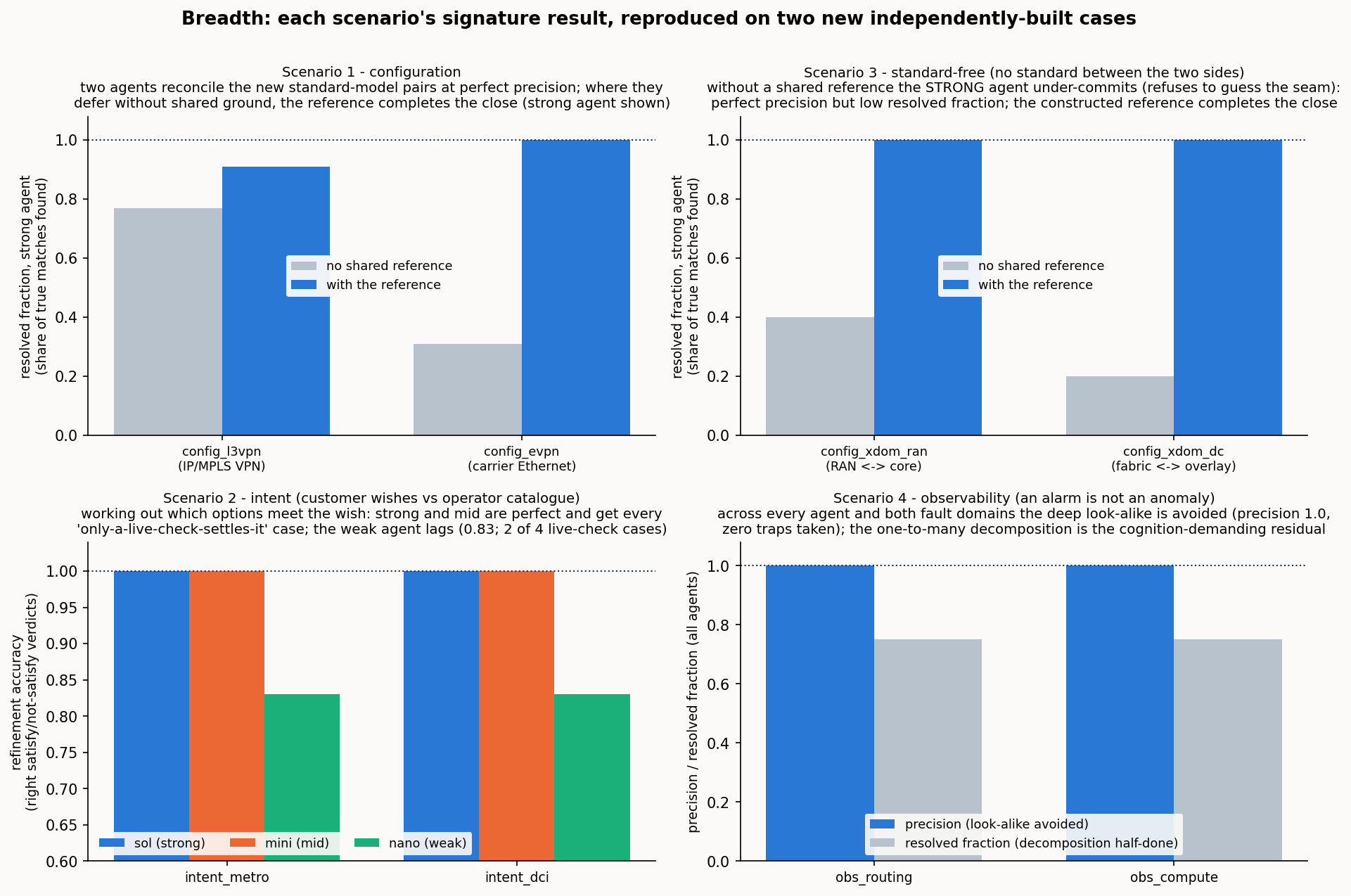
Figure 21 (breadth). One panel per scenario. Each shows the scenario’s signature result on the two new cases built for it, using the real agents scored against the validated answer key. Scenario 1: the weaker agent’s precision (share of committed matches that are correct) recovers to a clean close once the shared reference is added. Scenario 3: the strong agent’s resolved fraction (share of true matches found) is low without a reference (it is refusing to guess) and completes with one. Scenario 2: the agents’ accuracy at working out which offers satisfy the wish, high for the strong and mid agents and lower for the weak one. Scenario 4: precision stays at 1.0 (the look-alike is never taken) while resolved fraction sits at 0.75 (the one-to-many decomposition is the residual). The point of the figure is not any single bar but that all four signatures recur on cases built to differ.
One further case pushes past controlled variation toward the kind of mess real data brings. A deliberately structurally messier vendor model was built — the same service reconciled against a vendor dialect that buries the correspondences under proprietary containers and augmentations and plants a leafref false cognate — and run under the same harness. Surface matching collapses on it, losing two-thirds of the correspondences (resolved fraction 0.33 against 0.5 on the tidy cases); cognition absorbs the mess, the agents recovering to 0.89–1.00 at precision 1.00, resolving the configuration-versus-state distinction the vendor structure obscures, and never taking the leafref cognate. It is one reduced case, not a production module, but it is the first evidence the approach survives structural messiness and not only vocabulary variation — the direction real vendor data would push hardest.
What remains is therefore external: larger and more varied cases drawn from real networks, and the real-data grounding that only carrier and standards-body collaboration can supply.
The decisive next experiments: situated lifts on a live operator system
Everything measured above is either the un-lifted baseline or a lift from an authored or schema-surface fixture. The one region the study has not reached is the one the framework says matters most: the situated lift — cognition attached to a live system, performing the lift with real access to state, instances and pragmatics. It is worth saying plainly why this, and not more inert operator data. An inert export fixes cognition at the un-situated corner of the quadrangle (§4); a study over it, however large, refines the baseline and re-measures the same terse-source wall. It cannot separate a missing-lift gap from genuine irreducibility, because past the surface everything looks like one wall. Only a situated lift pushes the boundary to its true limit, and what remains unresolved after a maximally-situated lift is the real residue — the authority-and-underdetermination remainder that bounds automation, defined throughout this report but never yet measured. This is the experiment only an operator can run, and the one that would turn the account from demonstrated-in-fixtures to demonstrated-on-a-live-system.
Attaching cognition to an operating system. The target is a live management plane with a machine-readable operational view: an ONF TAPI controller, an IETF-YANG datastore reached over NETCONF or RESTCONF under NMDA, a gNMI-served state stream, or a controller such as ONOS or OpenDaylight. Begin below production, and climb: an emulated network (an OTN/ODU topology, or any lab fabric) behind a real controller, then a read-only mirror of a non-production controller, then, with an operator’s consent, a read-only view of production. The cognition is a capable agent equipped with read-only tools over that plane — datastore GETs on the running and operational datastores, topology and inventory reads, a context export (for TAPI, get-context), a telemetry subscription, and a bounded budget of read-only queries it may issue to settle a question — plus its own prior over modelling conventions, and optionally a thin reference. Safety is a first-class constraint, not an afterthought: read-only credentials, rate limits, an audit of every call, and no path to a write. Situatedness is a dial, and the experiment should sweep it: (i) the frozen export alone, the un-lifted baseline; (ii) plus structural and relational reads; (iii) plus instances read from the live datastore; (iv) plus live state, context export and bounded probes; (v) self-lift, where the system’s own agent authors its meaning.
How the cognition pursues the lift. For a chosen slice of the model, the agent proceeds concept by concept: enumerate the concepts from the schema surface (containers, lists, leaves, their kinds, relations and keys); for each, read its structure and relations, and read real instances from the operational datastore; where the authored gloss is thin or absent, generate a grounded gloss from structure, instances and prior, and check it against them; read the pragmatics — what the thing is for, and whose authority governs it — from the context export, from governance or configuration, or, where only a human holds it, by asking; record provenance, marking each fact’s method (live read, context export, human confirmation) and firmness; and propose a reference binding. A verifier pass then strikes any generation the material does not support, and every fact the agent can neither ground nor read is flagged as a residue candidate for an authority to settle. The output is a lifted model in the concept schema of §3 — ontology and lexicon, instances, pragmatics, provenance — one entry per concept.
How portability is measured. Portability is judged exactly as in §6, but now on a lift produced in situ: hand the lifted model, and only the lifted model, to an independent consumer cognition that has no access to the system, and measure the meaning score (the fraction of concepts a stranger explains faithfully) and the confabulation rate. The headline number is the value of the lift: portability(lifted) minus portability(un-lifted), on the same concepts, where the un-lifted baseline is a reader binding the same published descriptions with no lift. The companion synopsis in this repository is exactly that baseline, and its cases are a natural starting corpus. Crossing the situatedness dial with the measure is the core result: as access climbs the ladder, portability should rise and the unresolved set should shrink toward the residue, so that what remains after rung (iv), and the still-smaller remainder after (v), is the first measurement of the irreducible residue.
What a confirmation would mean. If cognition attached to a real, or realistically emulated, operator system performs the lift, and the result delivers portability to an independent consumer, the approach is demonstrated end to end on a live model rather than on fixtures, and the residue is measured for the first time. That is the result the whole line points to.
A concrete first target: the observability case, run with NMOP. The general experiment needs a host, and the observability scenario is the readiest one, and the one where a situated lift matters most. Its result is the reason: significance verdicts carry (verdict accuracy 1.00 and 0.83) only when the pragmatics are present, and collapse (0.17 and 0.08) when they are stripped, and the context that decides whether a rising measurement is an alarm, a benign maintenance effect, or a low-confidence reading lives in the running system rather than in any static model. It is also where the collaboration is already moving: the IETF NMOP work on network anomaly detection and its semantics (RFC 9940; draft-ietf-nmop-network-anomaly-architecture) is assembling exactly the operational data, the term ladder, and, through its hackathons, the venue such a run would need. A focused experiment would attach cognition to an operator’s alarm-and-anomaly system in that setting, lift its alarm model in situ with the live context that fixes significance, bind it to the shared anomaly-semantics reference, and measure both portability and the pragmatic verdict against the un-lifted baseline. The barrier to entry is low because the data, the framing, and the hackathon vehicle are already there; what it adds is the first situated test of the pragmatic layer on real observability data.
Recommendations, in priority.
- The operator experiment above: a situated lift on a live or lab-emulated system, measured for portability, sweeping the situatedness dial and reporting the residue — with the observability case, run with NMOP, as the readiest host.
- The source-ablation of the lift as the measurement instrument for it: lift from surface labels only, then add structure, instances, live state, and pragmatics and authority, scoring portability and confabulation at each rung — the producer-side complement to the un-lifted baseline’s name-only against definition-based contrast.
- The value of the lift as a single reported number, portability(lifted) minus portability(un-lifted), with the companion synopsis as the baseline.
- The effort-against-surface curve (reasoning tokens to lift a fixed concept as the surface degrades from intensional to boilerplate to raw schema), and the two starting surfaces still open — the raw-schema lift and the cold start with no instances.
24. In one paragraph
The object this programme produces is a portable semantic model: a system’s data lifted, by an act of cognition, into a self-describing form that any sufficiently-reasoning agent can pick up and use from the package alone, with no standard agreed in advance. Portability is real and directly measured — a careful lift is comprehensible to strong, middle, and even weak reasoners, across six cases and across model families, by a judge-independent measure — and it is a property of the lift: a meaning-poor surface breaks it and a reference used in the lift recovers much of the loss, while reasoning power, not lineage or prior familiarity with the system, sets who can read it. The lift itself is an act of cognition an agent can perform, recovering the ontology from a bare schema surface at every capability, even with the names stripped. Reconciliation — making two such models work together across a seam — is not the point of the exercise but its flagship use: an operation with its own objective, bridging the genuine divergence between two adequate models, with any shortfall in either lift’s portability adding burden on top rather than being what the operation is. Across four scenarios (configuration, intent, standard-free, and observability) that is what happens: at the fully-cognitive end the reconciliation completes autonomously in every case, negotiations and significance verdicts included, with no bridging standard and no human. Cognition is what completes it; descriptor methods carry it most of the way, then stop, and the placement of cognition governs how much of the remainder is closed by machine and how much is honestly referred onward. A thin published reference earns its place inside this frame (partly substituting for a capable agent’s reasoning, supplying a live agent the facts it can no longer get from an inert side, and, across many systems, making the work grow linearly instead of quadratically) but its reach ends at information: it never provides the authority to decide (whose value governs, whether a trade-off is acceptable), and it must carry meaning rather than a bare pointer to help at all. And the pragmatic layer (what a reconciled thing is for, whether it matters, who decides) is the frontier the descriptor methods never reach, and the one layer no static model holds: obtained by judgement rather than lookup, it is pulled in, refreshed, and resolved by a live cognitive operation against the current context, carried by that cognition or by cognition pre-placed as a policy, and realised only by an agent capable enough to carry it. That pragmatic layer, and the question of how capable an agent must be to work in it, are where the next work lies.