ad-hoc-semantic-reconciliation
The results — a completed four-scenario study
The empirical realisation of the research programme in ad hoc semantic reconciliation. Four operational scenarios, built, run against a validated gold standard, and reported, with a master report drawing them into one synthesis.
Part of the larger project — the theory and programme that motivate this study are in
../proposal/; the interactive demonstrations are in../demos/.
The central finding, established across all four scenarios: it is cognition that completes a reconciliation. Descriptor methods — matching names, then names plus a gloss — carry it to a ceiling and stop, historically leaving the rest to a standard or a person. Where both systems can reason, the remainder is closed autonomously, with no model agreed in advance and no human in the loop, and only as cognition recedes does a residual have to be referred onward. A thin, published reference can substitute for cognition, or supply an inert side the facts it lacks — but its reach ends there: it hands over information, never the authority to decide, whose value governs or whether a trade-off is acceptable. And the pragmatic layer — what a reconciled thing is for, whether it matters, who decides — is the frontier the descriptor methods never reach: decisive for meaning, and itself bounded by the agent’s capability.
Start here — the master report
reports/MASTER_REPORT.md · PDF · slides (PDF) · slides (PPTX) — the synthesis that sits atop the four scenarios. It introduces the idea once (the lift, portable semantic models, the family of reconciliation operations, and the cognition spectrum), distils each scenario to its essentials, and then gathers the findings so they can be read as one result: what works and how far, the six theses the scenarios establish, the evidence behind them along a set of cross-cutting readings (cognitive load, model power, the reference, placement and failure, reach, the pragmatic layer, and what it takes to produce the inputs the whole thing runs on), two tables mapping every finding to its placement and to the process stage it acts on, the surprises, and the scope. The slide deck carries the same synthesis for readers who prefer slides.
The Internet-Draft (IETF NMRG)
HTML · PDF · TXT · XML — draft-janz-nmrg-adhoc-semantic-reconciliation, the Internet-Draft that condenses this work for the IETF Network Management Research Group (NMRG): the lift and portable semantic models, the family of reconciliation operations, the taxonomy of where models diverge (including the one-to-zero true gap), the placement of cognition, and what a next step on a live operator system would involve. The XML is the xml2rfc source; the HTML, PDF, and TXT are its renderings.
The four scenarios
Each scenario takes the same frame to a new operation. Each has a report (renders inline), a
print-ready PDF, and an interactive demo (opens in your browser; see ../demos/
for download links too).
1/4 · Configuration ·
PDF ·
▶ demo —
two standard models of one network. ONF TAPI ↔ IETF TEAS/ACTN, seeded with false cognates and
opaque items. The founding scenario: it shows the thin reference substituting for cognition, the
benefit capability-dependent, verification catching the traps, and work scaling linearly with a
reference against quadratically without. Its four sub-studies are folded into the report and preserved
as method notes under notes/studies/.
2/4 · Intent · PDF · ▶ demo — refinement, negotiation, and a service that renegotiates itself. A customer’s intent reconciled against an operator’s catalogue by refinement, not equivalence; verification becomes a satisfaction check; a negotiation appears; the pragmatic operation enters as a portable movable policy; and the exchange recurs across a service’s life. Grounded in the IRTF NMRG draft draft-janz-nmrg-naas-agentic-negotiation.
3/4 · Standard-free · PDF · ▶ demo — reconciling with no public standard. Two home-grown, private models meet at one seam. The central result is a mirror: without the constructed reference the strong agent under-commits (defers at perfect precision) and the weak agent mis-commits (binds wrongly). A single descriptive field unlocks a capable agent; a bare shared pointer is worse than nothing. Building the shared ground is the work — and, run end to end, an agent that builds it itself lifts from 0.20 to 0.80 (0.90 with a decisive virtual experiment).
4/4 · Observability · PDF · ▶ demo — an alarm is not an anomaly. A legacy fault manager and an IETF NMOP agent (RFC 9940) reconcile two observability worlds, carrying the programme’s deepest false cognate and a one-to-many decomposition. The pragmatics carry the operative verdict — but only for an agent able to carry them; while correlation, a structural pragmatic, is robust across the whole ladder.
The reconciling agents are one model ladder for the whole study: gpt-5.6-sol (strong),
gpt-5-mini (mid), gpt-5-nano (weak) — “sol / mini / nano” — chosen so the ladder isolates
model strength rather than provider or architecture.
How it works
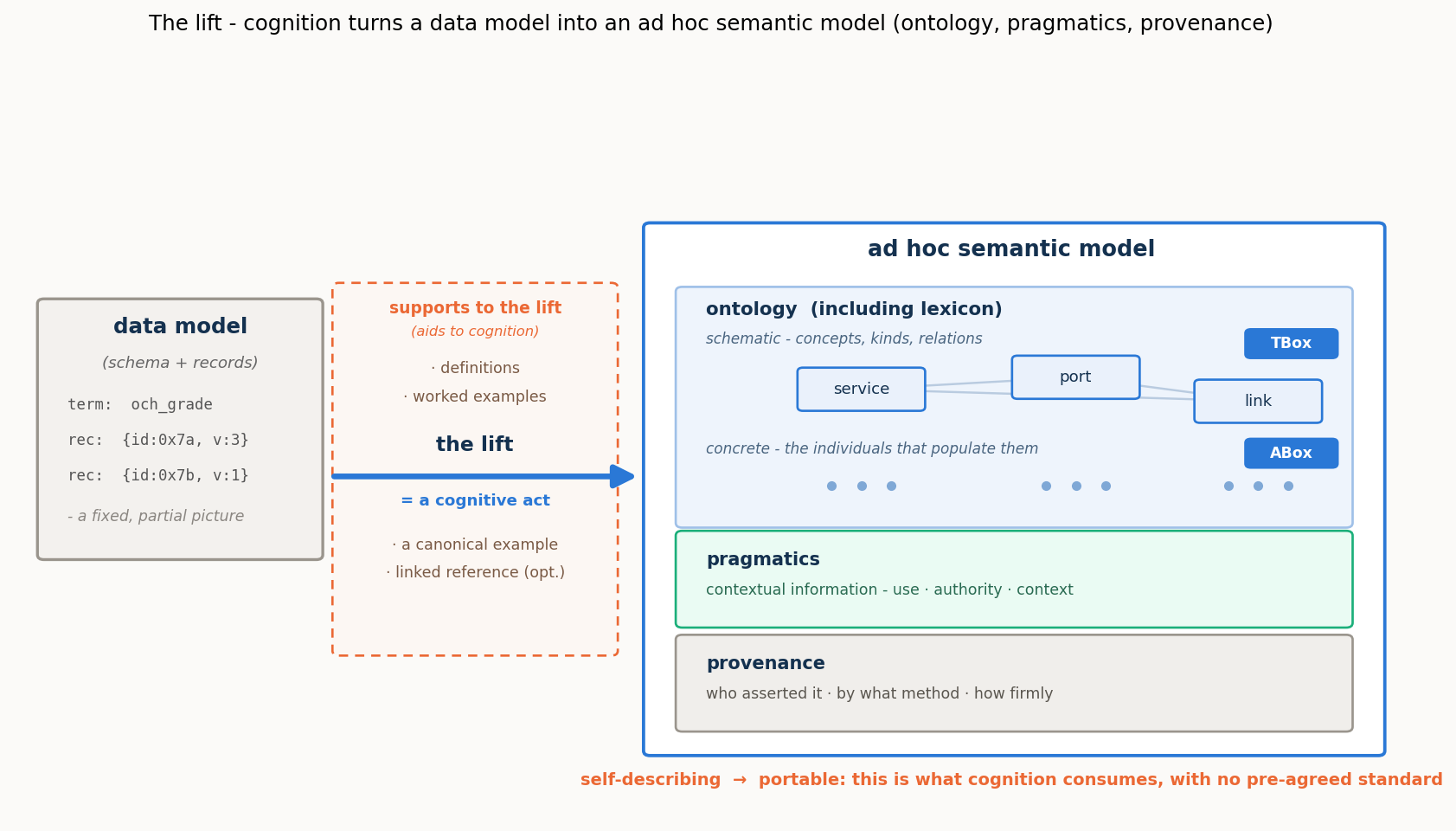
The lift is the move from a data model (a schema and its records: already a partial semantic picture, but a fixed one, with much of its meaning left implicit) to a semantic model that carries its meaning explicitly. A semantic model has three parts: an ontology, including its lexicon, with a schematic layer (concepts, their kinds and relations, and the labels and synonyms that name them: the TBox) and a concrete layer (the instances that populate them: the ABox); pragmatics, the contextual information a consumer needs (what a thing is for, whose authority governs it, in what context it holds), obtained not by lookup but by judgement; and provenance (who asserted each part, by what method, how firmly). The lift itself is a cognitive act, aided by supports that are not parts of the model: definitions, worked examples, a canonical example, and an optional link to a shared reference. Being self-describing, a lifted model is portable: any cognitive consumer can pick it up with no pre-agreed standard. Reconciliation runs over these lifted models, not over labels.
Drawn out, the ontology and its instances are a knowledge graph: the schematic layer is its schema (typed concepts and permitted relations) and the concrete layer is its assertions (typed individuals and the edges among them). Reconciliation divides the same way — aligning concepts is ontology matching, and co-referencing individuals is entity resolution over the graph — which is where the community’s knowledge-graph work for network operations meets this approach. The pragmatics and provenance are what the semantic model adds beyond a bare graph, and they are exactly what a thin reference cannot supply.
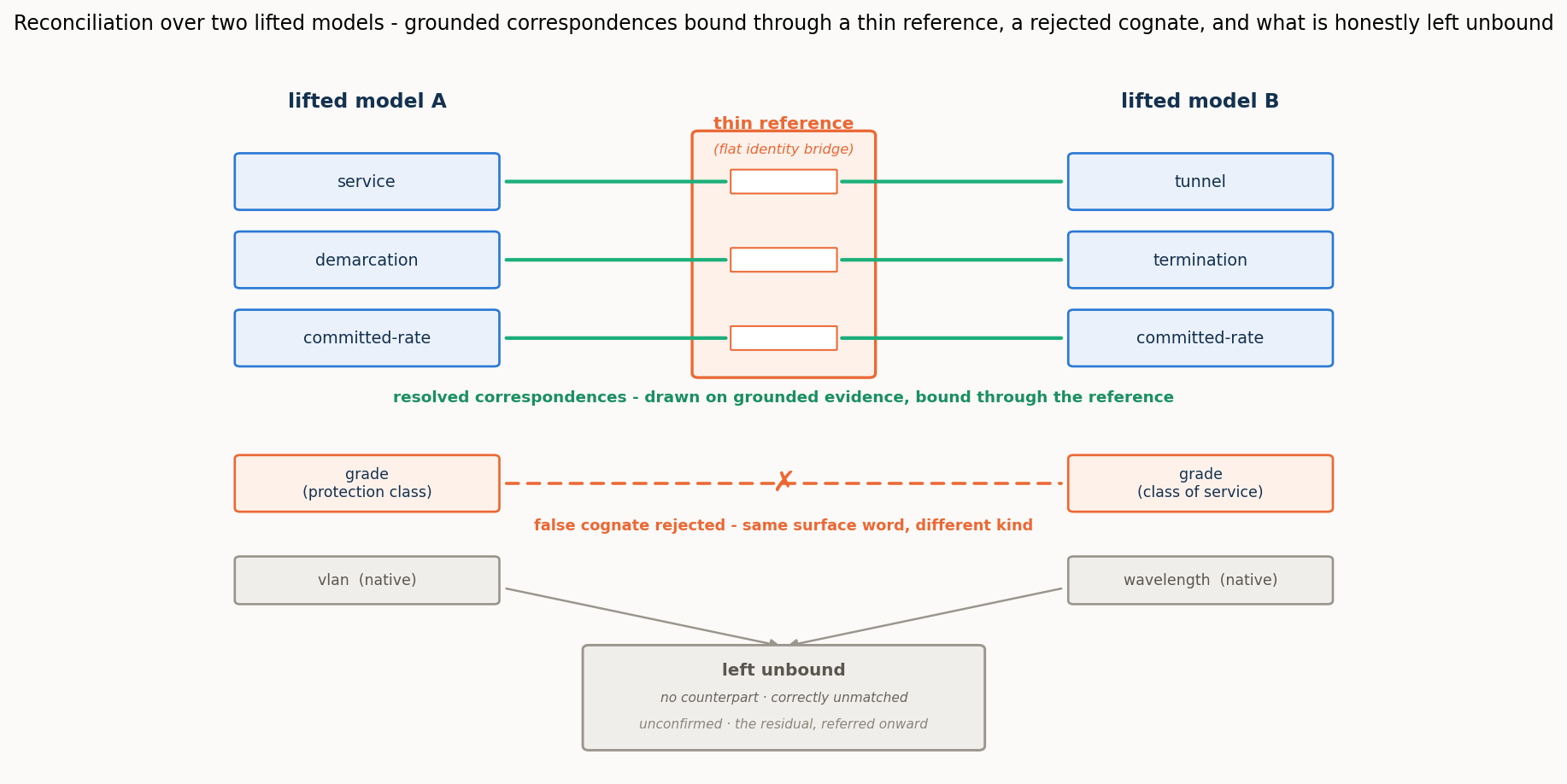
A case is two lifted semantic models plus a gold standard derived from the models and validated, so it cannot drift. A reasoning stack reconciles them — deterministic controls and a language-model agent run at each point on the cognition spectrum (both live, one inert, both inert). At the fully-cognitive end the two live sides reconcile as two separate agents under information asymmetry, each holding only its own lifted model and a surface catalogue of the other’s, proposing correspondences and ratifying the other’s, with the option of a decisive virtual experiment to settle a hard pair; as a side goes inert a single agent reconstructs it. The harness scores the output against the gold and records quality — precision, resolved fraction, surviving false cognates, and the residual — and, for the agent, cognitive effort (reasoning tokens, latency). A resolved fraction below one is deferral, not error: the residual is the shortfall from full cognition’s reach, and it grows as cognition recedes.
What’s new (2026-09-27)
A second review pass over the master report, the addition of the IETF Internet-Draft to this repository, and an editable PPTX of the deck. The findings, theses, and results are unchanged; the report changes add one missing case to the account of divergence and tighten naming, framing, and two captions.
-
The “true gap” (one-to-zero) divergence is now named (§11, §12, §13). Alongside one-to-one and the one-to-many granularity case, the map now treats a concept that is present in one model and simply absent from the other — two models cutting the world at different joints, as when one side reasons in services and the other only in the resources a service is realised over. Its treatment splits on whether the exchange needs the absent concept: left uncovered where it does not, and otherwise bridged either by deriving the concept from what the deficient side holds or by extending the shared reference both sides bind through — not by editing either native schema. The Figure 2 caption and the §13 finding are aligned to this.
-
§9 retitled and its seam example sharpened. “From one portable model to two: the bridge to reconciliation.” Its first example now names the seam plainly as a BSS → OSS one: a service intent a business support system commits, set against the technical realisation an operations support system delivers.
-
The two cognition spectra named consistently. The production-side lift-cognition spectrum (§4) and the reconciliation spectrum (§13) are now qualified on every naming mention, so the shared access axis they grade is not mistaken for a single construct.
-
Two captions corrected. Figure 15 is retagged when constructing a reference is worth it, and its lead clause now describes all three reference conditions (none / constructed / given) rather than only the constructed one; and the verification passage’s stacked “gold-free graph oracle” is unstacked to an independent graph oracle (one that needs no gold key).
-
The IETF Internet-Draft is included (
id/), in XML (xml2rfc source), PDF, TXT, and HTML. It condenses the study for the NMRG and carries the same one-to-zero addition; its access × product quadrangle figure was rebuilt to carry the full axis and shift-arrow labelling. -
The deck is now also provided as an editable PPTX (
reports/MASTER_REPORT_Deck.pptx) alongside the PDF, with the closing slide refined.
What’s new (2026-09-24)
A review pass over the master report and the deck, responding to detailed feedback. The findings, theses, and results are unchanged; the changes tighten a few headline claims, add transparency, and bring the deck up to date with the recent conceptual work (2026-09-22).
-
Portability scoped to the system, not to domain knowledge (Thesis P2, and throughout). The claim no longer says portability is independent of domain knowledge; it now reads family-independent and capability-banded — it does not require prior knowledge of the particular system or schema, and tracks the reader’s capability, not its model lineage. The “reasoning, not knowledge” framing is reworded to separate no prior knowledge of this system from the general conceptual competence a capable reader still brings. Applied consistently across the definition (§2), §6, Thesis P2, the conclusions, and the final summary.
-
The four comprehensibility verdicts are now a table (§6), with the invented verdict tightened (accepting a planted false cognate) and tied explicitly to the confabulation rate.
-
Provenance of the benchmark inputs is tabulated (
reports/NOTE_producing_the_inputs.md): for each artefact, whether it is authored, agent-derived, or deterministically derived; its source; whether it is an experimental input or scoring gold; and its real-world counterpart — making the boundary between controlled evidence and real-data validation explicit. -
Self-description scoped, with a standards implication (§8). Where a system exposes none of its system-specific meaning, pragmatics, authority and provenance, autonomous reconciliation cannot be guaranteed — the gap must be met from another authoritative artefact, a live interface, or a person. The positive step is to standardise how a system describes itself and answers questions — exposing a portable knowledge object (concepts, relationships, context and pragmatics, assembled at runtime, carrying provenance, confidence, and a licence to defer) — rather than a universal domain model.
-
Reference wording aligned with the evidence. A bare identity pointer carries no usable meaning; the reference works through its descriptive content (consistent with Thesis R6). Thesis P3 now states that a reference used in the lift recovers much of the loss (not “repairs it”), and that portability is a capability-banded property of the lift.
-
The JSON-to-RDF/OWL claim narrowed (§3). The structural JSON maps to OWL/RDF given an explicit schema or JSON-LD context that supplies the literal-vs-identifier-vs-class distinctions plain JSON does not carry by itself.
-
Instance information’s three roles made explicit (
benchmark/schema.md): concept-levelinstancesas grounding evidence, translation/verification proposals in the round-trip and invariant checks, and individual co-reference records — related but distinct, and only the first is theinstancesfield. -
The worked concept labelled as a composite of the complete lifted semantic model (carrying per-concept pragmatics and provenance for illustration), not a literal case-file record.
-
Deck brought up to date and rebuilt (now 15 slides). Two slides were added from the 2026-09-22 work: the lift generates, grounded not confabulated (after the lift), and the decisive next step — a situated lift on a live operator system (before the close, featuring the observability case run with NMOP). The access × product quadrangle was kept in the report rather than the deck, where a persuasive one-idea-per-slide flow is the priority.
What’s new (2026-09-22)
A conceptual sharpening of the master report, and a new experimental direction, drawn from a
working exchange on how the lift actually works. The findings, theses, and results are unchanged; what
is added is a clearer account of how the lift produces meaning and what would prove it on real
systems. A companion synopsis of related work is added under reports/.
-
The lift and its placement, made precise (§4). Two axes now organise where cognition sits: access (situated, able to consult the running system, or un-situated, holding only the artefact) and product (an internal understanding, or an externalised, self-standing model). The lift is the situated-and-externalising corner; a new figure, the quadrangle (
figures/fig_master_quadrangle.png), places it against the three others. The section states the placement as a hand-off — cognition situated once, as the lift, so that an un-situated consumer needs only the artefact — and reframes the hard limit of a static artefact as, most often, a missing-lift gap (a fact present in the system that a situated lift reaches) rather than a true frontier. What a concept needs then partitions in three: what is implicit but present (grounded generation), what is present but elsewhere (situated access), and what is neither (the residue). -
The lift generates, within a bound (§3). Producing a semantic model is not transcription: the lift writes glosses where the surface gave none, makes implicit meaning explicit, infers untyped relations, and articulates tacit pragmatics. The bound is grounded generation against confabulation — content synthesised from structure, instances and state and checkable against them, not a sense invented for a bare name.
-
The decisive next experiments (§23). The most consequential open step, and one only an operator can take, is a situated lift on a live system: attach cognition to a controller or datastore, have it perform the lift in place with real access to state, instances and pragmatics, and measure portability against the un-lifted baseline. The section gives a concrete protocol — how to attach cognition, how it pursues the lift, how portability is measured, a situatedness dial from emulator to self-lift — and names the prize: only a situated study can measure the true residue. It also names the observability case, run with NMOP, as the readiest host: significance verdicts that carry only when the pragmatics are present make it where a situated lift matters most, and the NMOP anomaly work and its hackathons already supply the data, the term ladder, and the venue. A prioritized recommendations list heads the future work.
-
A companion synopsis of an independent YANG-description-quality study is added at
reports/companion_yang_description_synopsis.md(with PDF). It is referenced as the un-lifted baseline against which the lift’s value is the distance travelled up the quadrangle’s diagonal. -
The quadrangle related to the cognition spectrum (§4). A short passage now ties the two devices rather than leaving them side by side: the spectrum grades the quadrangle’s access axis (as a per-party dial, from self-lift or both-cognitive through to inert), while the quadrangle’s product axis — externalise a self-standing model, or keep the understanding internal — is the distinction the spectrum lacks and the one that names the lift. They stay distinct: the quadrangle names which cognitive act; the spectrum grades how far it reaches.
What’s new (2026-09-20)
A small wording pass on the master report, sharpening three phrasings. The findings, theses, and structure are unchanged; only the prose is tightened.
-
The central question is phrased more honestly. It now asks whether pre-agreement is “still required or useful” once the systems can reason, not merely whether it is “required” — the softer framing better captures what is actually at stake.
-
A cognition-spectrum sentence reads more naturally — “a gap cognition gets stuck on.”
-
The intent scenario’s reproduction result is stated more clearly — “accuracy over the full multi-step service lifecycle falls with agent capability,” in place of the terser “the multi-hop lifecycle grades with capability.”
The master report PDF is rebuilt to match.
What’s new (2026-09-17)
Mostly a reframing of the whole account, together with the portability experiments the reframing rests on. The findings are unchanged; what changed is the frame around them, the evidence under one half of it, and the deck.
-
The concept is reoriented around the lift. The material now flows from the lift first — the cognitive act that turns a system’s data into a semantic model — developed on its own terms, and only then to reconciliation, presented as a key example of cognition-based use of a lifted model rather than as the point of the exercise. The object comes before its uses; reconciliation is the flagship one.
-
Portability is now the defining attribute of a “complete” model — and it is measured directly. A lifted model is portable when any sufficiently-reasoning agent can pick it up and use it from the package alone, with no pre-agreed standard, and we treat that as what makes an ad hoc semantic model complete. A block of new experimental work assesses it head-on rather than inferring it through a downstream task: comprehensibility across the capability ladder and across model families, what a meaning-poor surface does to it and how a reference used in the lift repairs it, and a judge-independence check. Portability comes out real, capability-banded, a property of the lift, and measured by a judge that does not favour its own family.
-
The deck is a different animal. It is no longer a slide-by-slide mirror of the master report but a concise enticer — its job is to make the reader want to open the report, not to reproduce it.
-
Consistent terminology and a truer title. The four cases are now scenarios throughout (master report, sub-reports, deck), and the master report is retitled Portable semantic models and ad hoc reconciliation by cognitive agents, naming the object first and its flagship use second.
The master report and the four sub-reports are rebuilt to match. The portability drivers, results, and figures live under pipeline/, results/, and figures/.
What’s new (2026-09-15)
A focused programme drilling into the one question the four-scenario study leaves open at its own boundary: whether the semantic and pragmatic inputs a reconciliation runs on can be produced from the thin, real interface models a deployment actually meets — careless YANG, or REST whose data is present but whose meaning is implicit in the application — without becoming a heavy design-time process. Five experiments (E16–E20) settle a position, drawn together in a standalone note:
reports/NOTE_producing_the_inputs.md — Producing the inputs: a three-route decision for thin sources.
The position, in one line: producing the inputs is a route decision — lift, governed overlay, or live elicitation, selected by whether the source is inert or cognitive — and the governed overlay is the robust, capability-independent route, with the design-time burden bounded and, on this evidence, small. What the experiments establish:
- The overlay is the robust route (E16). Over a deliberately thin source, a governed overlay lifts every tier of the capability ladder to a full close (resolved fraction to 1.00, both hard seams recovered, the false cognate blocked); without it the strong model defers rather than guess. Live elicitation is a substitute only within the band that can use it — and on a surface-similar case it is less sufficient, so the overlay is the more clearly decisive lever.
- You cannot lift what isn’t there, and confident invention is a mid-capability hazard (E17). A cold-start lift recovers well while the surface carries meaning — down to keys and data with names and types stripped — but where the meaning is genuinely absent the strong model defers, the weak model abstains, and the mid model confidently invents. The dangerous lifter is the capable-but-uncalibrated middle, so an explicit insufficient-evidence path matters most there.
- The minimum viable overlay is a name per seam (E18). One descriptive field per entry — even just a name — is enough to bind; a one-line gloss earns its place only where a weaker model needs it to block a cognate; and coverage must be complete over the seams but not universal. The authored artefact is a short glossary, not a re-modelling.
- The design-time / run-time split is drawable and bounded, and provenance is a distinct layer (E19). Freeze the schema and the provenance — what a thing is, and who to ask; resolve live the instances and the pragmatics — what they currently say, and what a thing is for. Over half the seam’s facts freeze, capable agents recover the split reliably, and they separate provenance (the source of record) from pragmatics (governance) cleanly — a distinction the earlier framing had blurred.
- It is an architecture, not a YANG quirk (E20). The same results reproduce on a case built from two independently published REST standards — a product-ordering interface reconciled against a service-ordering one — against a false cognate identical in name and enumerated values. The concept surfaces are lifted from the real specifications; only the answer key is authored.
New drivers under pipeline/ (inert_vs_cognitive, cold_start_lift, minimum_overlay,
design_run_split, with figure scripts), a new REST case config_rest built from the two real
specifications, and results and figures under results/ and figures/.
What’s new (2026-09-14)
This revision extends the study at the experimental end with a substantial programme of further experiments, biting into the harder half of the problem — producing and aligning the inputs, not only reconciling models that already share a reference — and replicating the sharp findings across additional model families. The central findings are unchanged and deepened: the new results are woven into the master report’s synthesis (including a reading on producing the inputs, §13.10), and each scenario report gains a Further experiments section (report 1/4 §5, report 2/4 §5, report 3/4 §6, report 4/4 §5).
- The harder half, tested. Independent-lexicon alignment is tractable for a capable agent (precision 1.00) but capability-gated — weaker models take cross-lexicon false cognates confidently; the dependency map and cross-domain authority are each shown derivable (from inventory, and from an external artefact), and reuse onboarding a new system is linear, 2.0–2.7× cheaper and more accurate. The reference’s descriptive fields turn out not to be the precision driver — the real axis is lexicon divergence.
- Cross-family replication that corrected a claim. Replicated across three model families and two tiers (gpt-5.x, DeepSeek, Qwen-2.5-7B) through a JSON-mode compatibility shim: the verifier’s apparent “capability-independent ceiling” was a gpt-5.x-family habit, while the grader’s cross-framing hardness is family-independent. Replication told a disposition from a law.
- Confidence made a first-class metric. A confident-error rate, calibration gap and Brier are now scored and reported apart from honest deferrals; the confident wrong correspondence — the dangerous failure — is real, concentrated at the weak end, and confidence alone cannot filter it. An explicit abstain path is the remedy.
- Robustness and honest nulls. Cognition absorbs real vendor structural messiness (surface matching collapses to recall 0.33; agents recover to 0.89–1.00 at precision 1.00); contradictory authority sources are surfaced, not silently resolved; and, where the provider’s side reduces to selecting from a fixed catalogue, a real second reasoning agent in the intent negotiation changes almost nothing — a null that scopes the “two-sided negotiation” language to scenarios where the provider must weigh its own deliverability, rather than retiring it.
- The lexicon-divergence sweep. Following up the field-ablation result, a sweep that progressively independently lexicalises the two sides — from a fully shared reference to two independent lexicons — finds no break for a capable agent: precision holds at 1.00 across the whole sweep, no model takes a planted cross-lexicon cognate at any level, and what divergence moves is only the weak model’s confident-error rate (it roughly triples). Lexicon divergence, on this case, is not the axis that defeats a capable agent’s alignment; a hard break, if one exists, is a question for more divergent domains (report 1/4 §5.7).
- New code and cases. New harness:
src/reconcile/compat.py(a JSON-mode structured-output shim so any OpenAI-compatible provider can drive the harness) and confidence-sensitive metrics. New drivers underpipeline/(onboarding, verify_divergence, operation_necessity, escalation_analysis, correlation_generalization, deps_derivation, authority_derivation and authority_conflict, targeted_request, two_agent_intent, independent_grader, divergence_sweep, deliverability_negotiation, and a local/DeepSeek setup checker). New casesconfig_evpn_indeplex,correlation_config,derive_deps_config,config_vendor_messy, anauthority_sourceartefact underconfig_cross_domain, andunderspecified_pairs, with their builders and gold derivations. Results land underresults/and the leaderboard.
What’s new (2026-09-10)
This revision brings the pragmatic layer to the front, shows the lift itself as an act of cognition, and makes the agent-performed lift replicable from the command line. The central findings are unchanged; the reports carry the results in place.
- Pragmatics across the lifecycle — new master-report §13.9. The report now separates the three layers of a lifted model by how each is obtained from it. The ontology’s schematic layer (the TBox) and its instances (the ABox) are both observed in the lifted model: a determinate lookup any consumer, even a non-cognitive one, can do. Each is the frozen output of the cognitive lift that made it explicit, not a picture the source data model hands over ready-made; the cognition is front-loaded, not absent. The pragmatics (whether a state matters, whether an offer is acceptable, who decides) are judged, from schema, instances and context, and are defeasible and context-relative. The asymmetry is the point: TBox and ABox need cognition once, at lift time, and then freeze cleanly and read as lookup forever; pragmatics cannot be frozen cleanly and must be re-judged against the live context at each use. A static model, ours or an OWL export, holds the TBox in full and the ABox as a refreshable snapshot, but can only describe pragmatics, never carry them resolved; the section shows the OWL mapping and its limit. A live operation supplies them through four general mechanisms: pulling a pragmatic fact in by interrogating a live peer, refreshing it against the current context, creating certainty by a decisive virtual experiment, and resolving the verdict itself by judgement, the last being the capability-gated frontier. The static artefacts a system carries turn out to be frozen outputs of these mechanisms (a published reference is a frozen pull-in, a snapshot a frozen refresh, a pre-placed policy a frozen resolve), each valid only until the context it assumed drifts; and the mechanisms are gated by two things at once, liveness (which recedes across the cognition spectrum, so the mechanisms fall away in order as sides go inert) and capability (which bites hardest on resolution). This is why the framework does not merely extend beyond reconciliation but predicts the other scenarios’ signatures, the observability verdict being capability-gated while its correlation, a structural test, holds across the ladder. The point is carried through the rest of the report: §14’s second map gains a note tying its Lift and Pragmatic-resolution rows to §13.8 and §13.9, and the one-paragraph close (§17) now states it.
- The lift, shown and performed — extended §13.8. Three things land in the lift section. A concrete lifted model is now printed in full (§2 shows one complete concept as JSON, with a note that the shape is encoding-agnostic), so “what exactly is in a lifted model?” has a definite answer. A lift-in-the-act trace box shows the agent naming its own per-concept evidence on the relabelled control, where the recognisable names are replaced by invented ones so only the structure remains: the agent names the surface signals it used and the look-alikes it ruled out, confirming the reading is structural, not recalled. And the agent-performed lift is run lift-only across eleven schema cases and the whole model ladder: coverage is complete and structure intact at every rung, every false-cognate trap is caught (the relabelled control included), and the differences are of verbosity, not accuracy — so §16 gains a clause that lift correctness is robust across the ladder.
- New code, and the replicable work it supports. The agent-performed lift is now a first-class,
reproducible entry point.
pipeline/lift_study.pygains--lift-only(produce the lift without running reconciliation),--cases all(discover and run every schema case), and--trace(record the agent’s stated per-concept evidence);src/reconcile/lift.pygains the trace mode, andsrc/reconcile/model.pyato_dict()that serialises a lifted model back to the case JSON shape, with offline tests added undertests/. Runningpipeline/lift_study.py --lift-only --cases allover the three-model ladder is what produced the eleven-case result above; the lifted models it emits are committed underresults/agent_lifted_models/so the finding can be inspected and rebuilt. - Figures and deck updated to match. Figure 1 now labels the ontology’s schematic and concrete layers as the TBox and the ABox, tying the opening picture to §13.9. The constructed scaling chart (former Figure 11) is dropped — it was not a peer to the measured figures and its point is made in the text — and the later figures are renumbered. The master slide deck carries the new material: the pragmatics-across-the-lifecycle distinction, the four operation-time mechanisms, and the lift in the act.
What’s new (2026-09-08)
This revision deepens the fully-cognitive end and adds two controls. As before, the central findings are unchanged and the reports carry the results in place; this note is for readers tracking what moved.
- Completion by decisive experiment, shown end to end. At the fully-cognitive end, when the two agents cannot settle a correspondence by discussion, either can provision the candidate in a private virtual copy of the network, operate it, and read back whether it holds; the verdict binds or refutes. With this, two agents reach the reference’s close on three of the four schema scenarios with no reference at all, and the master report now includes verbatim transcripts of the negotiation and of the experiment. (See §13.7.)
- The lift, performed by an agent. The study reconciles lifted models whose explanation layer, each concept’s gloss and worked example, had been supplied ready-made. An agent is now asked to produce that layer itself from a side’s bare schema, and reconciliation over the agent’s own lift matches the ready-made one: identical for the capable agent binding through a reference, across all four scenarios. So the results do not depend on the lift being authored in advance; what stays open is the lift from raw, messy schema and a cold start before any instances exist. (See §13.8.)
- A memorisation control. The flagship TAPI/TEAS case is re-run with the public-standard identities stripped and relabelled, to separate reasoning from recall of a known standard: reasoning alone reaches a resolved fraction of about 0.67 where the recognisable case reaches 1.00, and a shared reference restores 1.00 either way. (See §16.)
- Slide deck refreshed to carry the negotiation, the decisive experiment, and the lift study.
What’s new (2026-09-05)
This revision strengthens the study in-house — the central findings are unchanged and hold — and closes the in-house gaps the first cut left open, leaving only the genuinely external one (real network data). The reports carry the results in place; this summary is here for readers tracking what moved between revisions.
- Construct-then-bind, end to end (scenario 3). The standard-free scenario previously handed the agents the shared reference and scored the binding alone. The agents now build that reference themselves from the two models and then bind through it, with nothing pre-given. The strong agent lifts from a no-reference resolved fraction of 0.20 to 0.80 (0.90 with a decisive experiment), near the reference-given 1.00, at perfect precision and with no false cognate. Constructing the shared ground works, and building it is the work.
- A six-model capability sweep. Swept across six models at both-cognitive, two-agent negotiation compresses the capability gradient: bilateral ratification holds precision high and drives false cognates to zero across almost the whole ladder, while resolution is uniformly lower. The discipline a lone weak agent would lack is supplied by the negotiation structure itself.
- Instance co-reference measured beyond scenario 1. Entity-level co-reference is now measured in scenarios 2 and 4 as well, reproducing the budget-limited-then-structural pattern: capable agents resolve fully where a live side can be interrogated, the weakest only partially. (A fix to the interrogation path — letting an agent ask which attributes exist rather than guess field names — moved scenario 4 from a floor to full resolution.)
- A classical descriptor baseline. A non-cognitive matcher (labels, glosses, structure) is included as an explicit baseline, confirming that descriptor methods carry a reconciliation to a ceiling that cognition then passes.
- A reach study — what an agent can see and what it can ask. Holding the strong agent at its best, we vary two things independently: how much of a record it may see (from a bare key up to full topology) and what it may ask of the live system (nothing; a named attribute; the open question “what facts do you have?”; a full virtual experiment). Seeing more, on its own, caps the hardest cases at one-half. The hinge is the open question: being able to ask what exists — rather than having to name the field in advance — takes the reconciliation to a full, correct close. Run down the model ladder, the same access lands by capability: the strong agent converts it to a full close, the mid plateaus, and the weakest posts high resolved fraction but with slipping precision. (See §13.5 of the master report, Figure 14.)
- Breadth — every signature reproduced on new cases. Each of the four scenarios is now exercised on three independently-built cases, not one — two new ones per scenario, in different domains, with different vocabularies and different traps. Every signature reappears: cognition completes the match while the reference mainly prevents the weaker agents’ errors (configuration); the strong-omit / weak-commit mirror, repaired by a thin reference (standard-free); refinement and negotiation completing while the multi-hop lifecycle grades with capability (intent); and the alarm-is-not-an-anomaly look-alike reliably told apart (observability). This closes the “you only showed it on one case” worry as far as in-house work can. (See §16 of the master report, Figure 16.)
- The economics of the reference — when constructing it is worth the cognition. Building the shared reference is itself an act of cognition, so we measured its cost against what it buys. The rule: it is load-bearing only where no standard exists and the agent is capable (standard-free, strong agent: resolved fraction 0.20 → 0.80, and 0.90 with a decisive experiment, for a little extra spend); where a reference already exists (configuration, observability) the given reference reaches the same close for a fraction of the cognition, so constructing one is redundant; and for a weak agent it is counterproductive — construction cost explodes (to tens of thousands of reasoning tokens) for a worse close, not a better one. So construct-then- bind is not a blanket default: build the reference where there is none to bind through and the agent can build a good one; otherwise use the one that exists. (See §13.6 of the master report, Figure 15.)
- Benchmark packaged. The cases, harness, and leaderboard are packaged under
benchmark/for external use — now eighteen cases across the four scenarios.
What remains is now genuinely external: larger and more varied cases drawn from real networks, and the real-data grounding that only carrier and standards-body collaboration can supply. The breadth cases above are still authored by the same hand, so they test robustness to variation, not to real data — which is exactly the gap that external collaboration exists to close.
Repository layout (study/)
reports/                      the deliverables
    MASTER_REPORT.md              the synthesis — start here
    REPORT_1of4_configuration.md  scenario 1 · configuration (TAPI ↔ TEAS)
    REPORT_2of4_intent.md         scenario 2 · intent (refinement, negotiation, lifecycle)
    REPORT_3of4_standard_free.md  scenario 3 · standard-free (no standard)
    REPORT_4of4_observability.md  scenario 4 · observability (alarm ≠ anomaly)
notes/
    studies/                  scenario-1 method notes (lift baseline, reference anatomy,
                              instance disambiguation, verification modes)
    design/                   design notes of record, per scenario
    archive/                  superseded working notes
    SETUP_OPENAI.md           how to supply the API key (kept out of the repo)
figures/                      all report figures (regenerated by pipeline/figures*.py)
src/reconcile/                the harness: models, reference, metrics, stacks, oracles
benchmark/                    case builders and cases/ (two lifted models, reference, traps, gold)
results/                      the exact per-run data behind every figure and table
pipeline/                     all runner, figure, and build scripts
tests/                        offline tests of the stacks and scoring (no API)
pyproject.toml
Quick start
Run from the study/ directory. The controls, gold derivations, offline tests, figures, and PDF build
need no model access (standard-library Python plus matplotlib/markdown/wkhtmltopdf). The
language-model runs need openai and an API key — see
notes/SETUP_OPENAI.md — and reach api.openai.com, so they run where that is
available.
cd study

# deterministic, no API:
python pipeline/run.py --case config_big_hard --no-write     # controls only
python pipeline/scaling.py --max-n 12                         # the scaling result
python -m pytest tests/                                       # offline tests
python pipeline/figures_master.py                             # regenerate the master figures
python pipeline/build_pdfs.py                                 # rebuild every report PDF

# the language-model studies (need OpenAI; run where api.openai.com is reachable):
python pipeline/run.py --case config_big_hard --agent --trials 4 \
  --placement both_cognitive,one_inert,both_inert \
  --model gpt-5.6-sol,gpt-5-mini,gpt-5-nano
python pipeline/intent_study.py     --model gpt-5.6-sol,gpt-5-mini,gpt-5-nano
python pipeline/pragmatics_study.py --model gpt-5.6-sol,gpt-5-mini,gpt-5-nano
python pipeline/observability_study.py --model gpt-5.6-sol,gpt-5-mini,gpt-5-nano

# the agent-performed lift, on its own, across every schema case (dumps each lifted model to JSON;
# add --trace to record the agent's stated evidence per concept):
python pipeline/lift_study.py --lift-only --cases all --model gpt-5.6-sol,gpt-5-mini,gpt-5-nano
Per-scenario run commands are in each report’s Reproducibility section, and the method notes under
notes/studies/ carry the sub-study commands.
Grounding and scope
The study operationalizes and empirically tests the claims of the proposal: the IRTF NMRG work on agentic network-as-a-service negotiation, the cross-domain provisioning demonstration, and the IETF NMOP anomaly/alarm model (RFC 9940). The claims are existential and mechanistic — this is how ad hoc reconciliation works, and here it is working — established on single, seeded cases built to exercise each mechanism and prove each trap, across the model ladder; they are not population estimates. What remains is now external: larger and more varied cases drawn from real networks, and the real-data grounding that only carrier and standards-body collaboration can supply.
Choose a license before publishing.